



:: Urban
Forest Economic Value::
While social and psychological benefits of the urban forest are quite difficult to capture in economic terms, a great deal of headway has been made in quantifying the value of the urban forest's environmental benefits. By cleansing the air, retaining runoff, and sequestering CO2, urban trees provide valuable services that society would otherwise have to pay for. To provide an example, if the trees on a development sequester X gallons of water a year, then their dollar worth might be expressed as the amount a retention basin (to sequester the same X gallons of water) would cost (if the trees were not present). Of course, this would only be part of their value-- we could also consider the savings in health care costs associated with the pollution they sequester from the air, and so forth.
Capturing the value of the urban forest in dollar terms is a useful way to communicate the importance of the urban forest to other sectors of society. It also allows the urban forest to be integrated in economic calculations (cost-benefit in particular) related to city planning and development, where it might otherwise be overlooked.
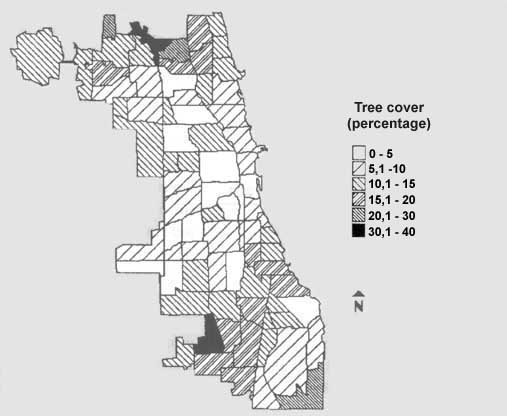
Seminal Study: The Chicago Urban Forest Climate Project The Chicago Urban Climate Project was initiated by the National Forest Service (NFS) and represents one of the first large scale attempts to quantify urban forest structure, function, and service value. The project was headed up by Gregory McPherson and David Nowak (who later developed the UFORE model) at the NFS. [More]
|