(Text, unless otherwise noted, is the author's own)
Urban
Trees, Urban Heat Island, and Energy
The urban heat island is
the phenomenon whereby urbanized areas exhibit significantly higher temperatures
(generally at night-time) than their outlying, rural areas. This phenomenon
has been linked to poor air quality, uncomfortable and sometimes dangerous urban
temperatures, and increased energy use (for cooling). Augmenting greenspace
in urbanized areas is currently recognized as one of the key strategies for
urban heat island mitigation. Ambient temperatures vary throughout the city
as a function of sites’ design and materials. Many studies have noted
that sites with high tree coverage tend to have lower temperatures than sites
with few to no trees.
Trees accomplish this by:
1. directly shading surfaces and reducing the amount of radiation absorbed,
stored, and released by urban surfaces
2. evapotranspiring and converting radiation to latent heat, decreasing that
which is converted to sensible heat
3. altering airflow and the transport of water vapor and energy
(Mcpherson et al 1995)
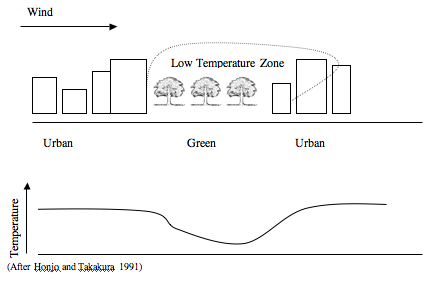
The so-called ‘oasis’ effect produced by vegetated urban sites is
well documented (see Figure 1). A review by Taha (1997) found that vegetated
spaces could be 2-8°C cooler than their surroundings. The same review found
that studies in Montreal, Tokyo, and Davis, CA reported that vegetated regions
and parks were 1.6°C, 2.5°C, and 2°C respectively cooler than neighboring,
non-green regions.
The cooling effect that vegetation has on site microclimate is largely undisputed.
Figure 1. Temperature effects of urban greenspace
The lowered temperatures achieved by greenspace not only positively affect urban
health and comfort, but also lower energy use in commercial buildings and residences.
Many energy companies are even encouraging customers to use trees to cool their
buildings. The most recommended way to cool buildings is through the direct
shading of surfaces.
Before the introduction of mechanical systems, tree shade was often used to
passively lower the temperatures of structures (Burberry 1978). A number of
recent studies have demonstrated that thoughtful landscaping is still an efficient,
though largely overlooked, way to control building temperatures and lower energy
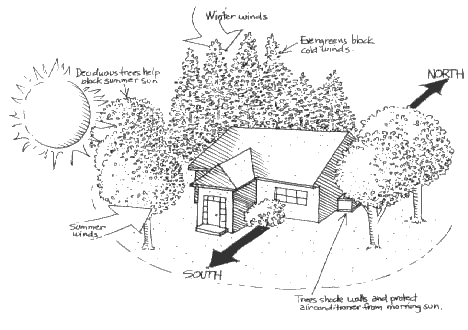
demand (Meier 1990). Carefully planted deciduous trees provide shade where needed
in the summer, but lose their leaves in winter and do not significantly block
solar gain. A modeling effort examining residential energy use found that trees
placed to shade a home’s roof, as well as its east and west side, reduced
heating and cooling energy costs by 20-25% when compared with the same house
in the open (Heisler 1986). Akbari et al (1997) planted 16 trees at two residential
sites in Sacramento, CA and reported that summer cooling savings averaged 30%.
While most studies have looked specifically at residential units, which, given
their size, are easier to influence with plantings, there is evidence that larger
structures can benefit from properly placed vegetation as well. An experimental
study of a university building in Athens, Greece found that un-shaded surfaces
consistently had over twice the net radiation and thermal flux values as the
shaded surface (Papadakis 2001). Such studies can allow the effects of urban
trees to be quantified in terms of energy savings, providing an incentive for
their planting and care.
Figure 2. The impact of trees on household temperature and
energy use
(Image source: American
Forests)
By blocking cold winter winds, evergreen trees and shrubs can reduce heating
costs as well (see Figure 2)
There are some caveats to these benefits. First, they are fully realized only
when the trees are mature. This can take 10-15 years, although fast growing
species are also available. Second, planting methods for energy savings may
vary in different climates. Clearly in regions that have significantly more
heating degree-days than cooling ones, intercepting solar radiation, even minimally,
could raise instead of lower energy costs. Thus, air conditioning savings are
likely to be greater in hot climates. However it is generally agreed that savings
can also be achieved in temperate climates with vegetation that shades surfaces
in the summer, without blocking any southern exposure in the winter (Sand 1991).
Air
Pollutant Removal and Carbon Dioxide
Pollution
(Text Source:
Nowak,
D., USDA)
Trees remove gaseous air
pollution primarily by uptake via leaf stomata, though some gases are removed
by the plant surface. Once inside the leaf, gases diffuse into intercellular
spaces and may be absorbed by water films to form acids or react with inner-leaf
surfaces. Trees also remove pollution by intercepting airborne particles. Some
particles can be absorbed into the tree, though most particles that are intercepted
are retained on the plant surface. The intercepted particle often is resuspended
to the atmosphere, washed off by rain, or dropped to the ground with leaf and
twig fallg. Consequently, vegetation is only a temporary retention site for
many atmospheric particles.
In 1994, trees in New York City removed an estimated 1,821 metric tons of air
pollution at an estimated value to society of $9.5 million. Air pollution removal
by urban forests in New York was greater than in Atlanta (1,196 t; $6.5 million)
and Baltimore (499 t; $2.7 million), but pollution removal per m2 of canopy
cover was fairly similar among these cities (New York: 13.7 g/m2/yr; Baltimore:
12.2 g/m2/yr; Atlanta: 10.6 g/m2/yr)h. These standardized pollution removal
rates differ among cities according to the amount of air pollution, length of
in-leaf season, precipitation, and other meteorological variables. Large healthy
trees greater than 77 cm in diameter remove approximately 70 times more air
pollution annually (1.4 kg/yr) than small healthy trees less than 8 cm in diameter
(0.02 kg/yr)k. Air quality improvement in New York City due to pollution removal
by trees during daytime of the in-leaf season averaged 0.47% for particulate
matter, 0.45% for ozone, 0.43% for sulfur dioxide, 0.30% for nitrogen dioxide,
and 0.002% for carbon monoxide. Air quality improves with increased percent
tree cover and decreased mixing-layer heights. In urban areas with 100% tree
cover (i.e., contiguous forest stands), short-term improvements in air quality
(one hour) from pollution removal by trees were as high as 15% for ozone, 14%
for sulfur dioxide, 13% for particulate matter, 8% for nitrogen dioxide, and
0.05% for carbon monoxide
Carbon
Dioxide
(Text Source:CITYgreen
Manual)
Trees remove carbon dioxide from
the air through their leaves. Carbon storage is the total amount of carbon held
in a
tree’s wood (biomass). Carbon sequestration is the rate at which trees
store carbon. Older trees have more carbon storage; younger trees have a higher
sequestration rate. Approximately half of a tree’s dry weight is carbon.
For this reason, large-scale tree planting projects are recognized as a legitimate
tool in many national carbon- reduction programs.
Urban
Forest and Water
Urbanization transforms
the landscape from one dominated by forests, wetlands, and vegetation to one
covered by buildings, asphalt, pavement, and compacted soils, all impervious
to water. Impervious surface coverage (ISC) has been recognized as an accurate
indicator of urbanization intensity (i.e. increases in density, energy/unit
area etc.) (Paul and Meyer 2001, Brabec et al 2002). Heavily urbanized regions,
such as cities and downtown areas, can have over 90% impervious surface cover.
In a natural environment, precipitation is returned to the atmosphere via evaporation
and transpiration, infiltrates into soil, recharges groundwater, and enters
into receiving surface waters. Surface runoff, one of the main sources of water
for streams and lakes, is generally the end stage of this cycle, and occurs
only when the amount of precipitation exceeds the rate at which it can be evaporated
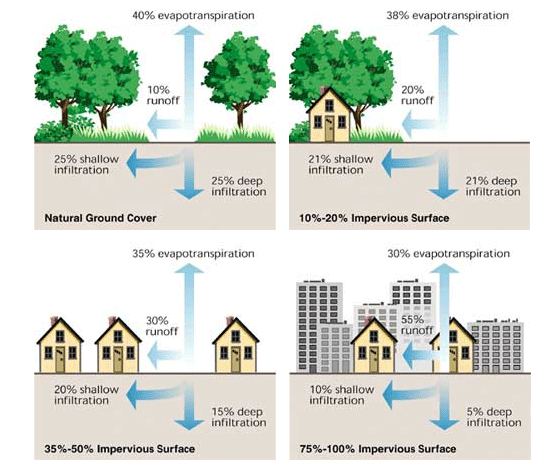
or infiltrated. In urban environments ISC reduces opportunities for water to
flow into the earth, and the displacement of vegetation decreases the amount
of evapotranspiration that can occur. Storm water pathways are thus limited
and the majority of rainwater becomes runoff. The runoff tends to move more
quickly through an urban environment than a natural one, as surfaces are smoother
(lowered coefficient of roughness) and flatter (lowered storage capacity). This
is also a result, an intended outcome in fact, of conventional storm water systems,
which have been engineered to provide efficient and rapid removal of rainwater
from urban surfaces. Landscapes have been graded, piped, and paved in an effort
to quickly move water off urban surfaces to storm water sewers and into treatment
plants, or, more commonly, into receiving waters (Coffman et al 1998). The overall
result is a larger quantity of runoff moving across surfaces and entering receiving
waters more rapidly than it would have pre-development (see Figure 3). In addition
to causing erosion and incision in urban waterways, the runoff mobilizes the
myriad contaminants that lie across the urban surface, such as salts, metals,
particulates, and sediments.
Figure 3. Impact of development
on runoff
(Image
Source)
Trees and open spaces in cities play
an important role in runoff sequestration and flood protection by:
1. increasing the permeability of surfaces
2. increasing depression storage
3. allowing infiltration and ground water recharge
4. allowing infiltration and pollutant remediation
Trees intercept large quantities of water with their leaves and bark, slowing
the flow of runoff and increasing opportunities for evaporation. Their roots
increase the permeability of soils, aiding infiltration and groundwater recharge.
A study on one large deciduous tree in Southern California found that it reduced
runoff by over 4,000 gallons per year (Xiao 1998). This type of mitigation is
especially beneficial because it is an accessible technology and can be applied
on many scales. Furthermore, unlike methods such as detention basins, trees
and vegetation control runoff at the site.
Trees and vegetation can
also remediate water, taking up nutrients and degrading pollutants.
Wildlife
Habitat
(Text Source: San
Francisco Dept
of Environment.)
Trees provide food and shelter for urban wildlife. Many types of insects feed
on trees, and in turn provide food for other insects and birds. Some birds and
small mammals feed directly on tree pollen, flowers and fruits. Birds also use
tree branches for courting displays and nesting.
Microbial populations that form the bottom of the food chain are significantly
higher in the soil surrounding tree roots. Many species of fungus (mycorrhizae)
are intimately associated with tree roots. Mushrooms and other fruiting bodies
of these fungi provide an additional food source for urban wildlife.
Groups of urban trees near water sources can support an even wider variety of
insects, birds, small mammals and reptiles. You can maximize the benefits of
trees to native wildlife species by eliminating the use of toxic insecticides
and fungicides, planting trees in uncovered tree pits, and planting native tree
species.