|
|
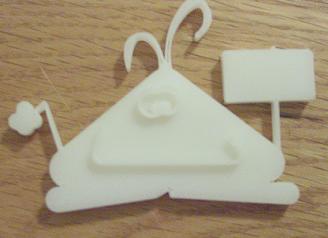
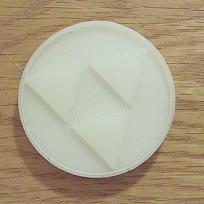
casting The idea tossed out about casting the items printed on the 3D printer really stuck with me, and I'm hoping to give it a shot. I think I've got some help lined up for a crash course on the foundry run by course 3, and in preparation made a couple items that would be rather easy to cast (shown at left here). |
|
|
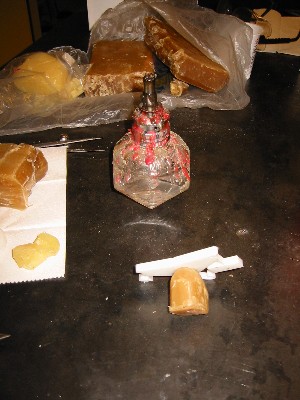
preparation Before casting, a ceramic mold must be made around the original model. This mold must have a geometry that allows the model to be burnt out and later metal to be added in. Using beeswax, a cone is made flush with the back of the model. In order to attach any two dissimilar materials, here beeswax and ABS, "sticky wax" is melted over an alcohol lamp and applied like epoxy to both materials, then held together until the wax solidifies. |
|
|
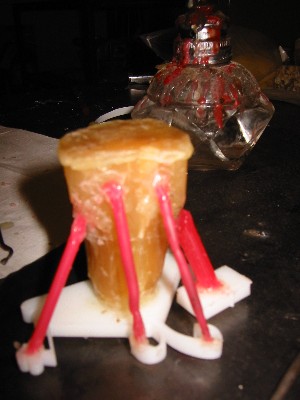
sprues Due to the shape of the piece or other factors, extra "plumbing" must be added. The sprues shown here (red) are made of "sprue wax," and allow air trapped in extremities to leave the mold, changing the pressure and therefore pulling metal into those areas. At this point, the ceramic can be mixed for the mold. Four were used on the squanch: two on the antennae, one on the flower, and one on the sign. Lastly, the bottom of the cone is attached with more sticky wax to the bottom of a plastic cup. |
|
|
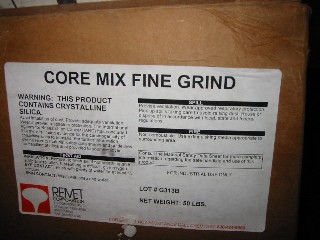
ceramics Ceramics are materials made by firing minerals at high temperatures. They have a huge number of uses, as gas sensors, catalytic converters, fiberglass hulls, dies, and many more, including investment casting. To mix the ceramic, a volume of crystalline silica equal to that of the cup the mold is in is measured out. 20% by mass must be binder, of which 60% is Prehydrolized Ethyl Silicate and the remaining 40% is Ethyl alcohol. 6% of powder mass is made from a 3% ammonium carbonate solution, which is used as a catalyst. They are stirred together and poured, then left to sit. The mold is burnt out at a couple thousand degrees Celsius, melting all wax and plastic within the ceramic and burning off the remaining ethyl alcohol. |
|
|
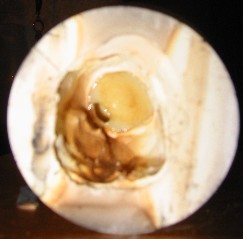
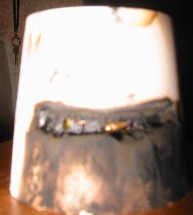
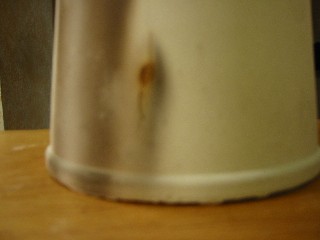
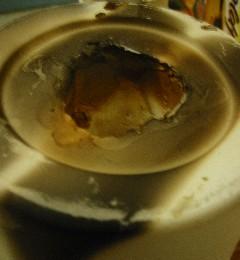
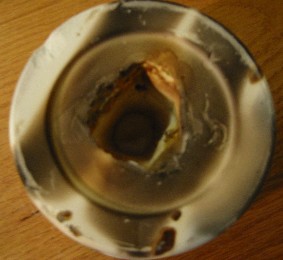
fired mold Unfortunately, ABS isn't the best material for this, it seems. When heated, the wax melted out as normal, but the plastic simply melted together into a big yellowish ashy puddle. To get it to melt out, the ceramic could have been fired at a higher temperature, but both molds began to develop cracks which would introduce fatal flaws during casting (below left and far left). Due to the unhappiness of the molds, casting in metal was not done. This might have stood a better chance of working had it been printed in wax, which the 3D printer is also capable of working in. Working in the ABS was worth a shot though... |