|
|
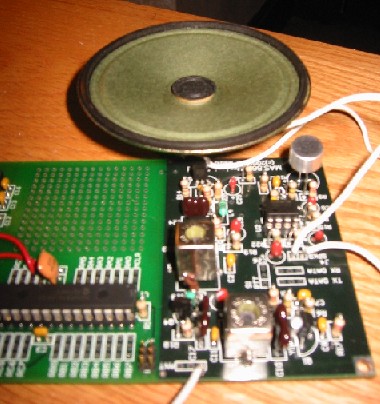
radio assembly The radio side of the project board begun last week was built using the assembly instructions by Matt Reynolds. Testing revealed a number of points that had not been properly soldered and eventually demonstrated that the speaker could scratch, static, and hum quite well. After adjustments were made to the tuning slugs with the aid of an oscilloscope and a signal generator, the board could be used to transmit/receive the signal generator tone or a voice. |
|
|
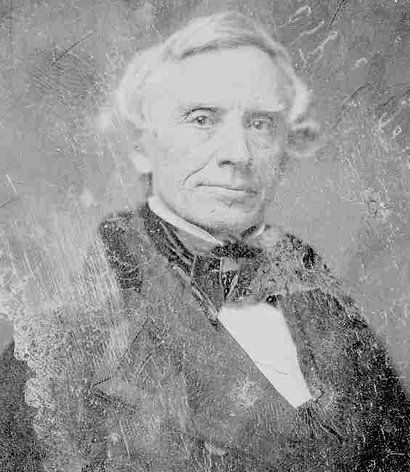
more morse Slight changes in the C program made last week to print morse code with the red and green LEDs so a "dit" or "dah" would come through the speaker as well as on the LED. The resulting clicks are audible over the speaker noise but are not well-suited for more complicated projects. The classic sample is, of course, "hello world." A little history in context, since there isn't another nice picture of the circuit itself: "Telegrah inventor Samuel F. B. Morse (1791-1872) was born in Charlestown, Massachusetts. He developed the idea of an electromagnetic telegraph in the 1830s and tapped out his first message 'What hath God wrought?' in 1844 on the first telegraph line, running from Washington D.C. to Baltimore. The construction of the first telegraph line was funded by Congress ($30,000) after Morse failed to get any other financial backing. After Western Union was founded in 1856, telegraph lines were quickly strung from coast to coast in America." Source: The History Place: This Month in History |