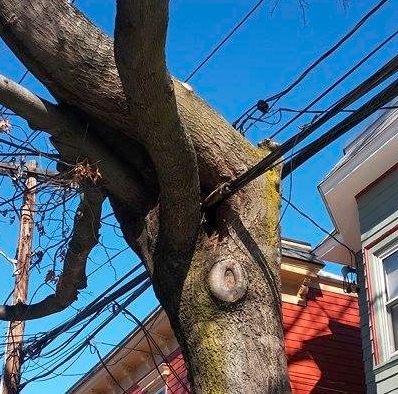
 This image shows a tree growing around a power line. Neither the power line nor the tree could be easily removed without destroying the other.
Through a close reading of this site in the northeast corner of Cambridge, I have found a powerful expression of the ideas and patterns laid out in The Granite Garden and in my brief study of the urban landscape. Because of my site’s unique configuration with industrial and residential areas merging together, a perspective of the impact of nature on the ever changing city is quite clear. There are an abundance of forces from nature hidden within the small plot, and bringing them to the forefront reveals the differences between the industrial and residential areas of the site in this perspective. The air, earth, flora, fauna, and water that are constantly forming and editing the city represent a much broader force than simply a street tree growing through the sidewalk or a vine wrapping around a power line. Images of this site will be paired with the ideas from The Granite Garden in order to reveal that cities are inherently and perpetually shaped by natural forces, and that understanding these can help us to replicate the interactions elsewhere to alleviate and maintain the observed problems that cities have developed. Ultimately these forces create an environment that is neither truly urban nor natural, and the more we permit nature’s impact, the more at home we feel.
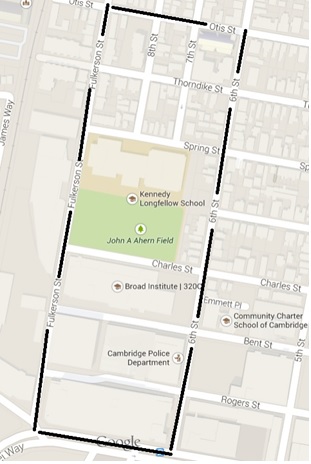 Figure 1- This shows a Google Maps view of the site with the boundaries indicated by the black lines
In order to track how my plot represents a natural environment transformed it is important to look at what the natural environment of my site was before its settlement. In 1781 the area where my site now stands was depicted by artist J.F.W. Des Barres as an area that was far less settled than Boston itself, as shown in figure 2 where the settlements of Boston and parts of the Harvard area contain buildings, but the area of my site does not (Figure 2).
Instead of showing the settlements, the artist depicts the land as generally flat and bordered closely by a small hill and a river that travels west and cuts south, named the Willis Creek. The current landscape shows no obvious signs of this creek or of the topographical hills and bumps that are shown on the historical map, indicating that the movement of the city has affected nature in this regard. It is also notable that this site did exist before the filling of Boston, meaning that it existed as a natural land area before expansion of the city as opposed to a natural waterway area. A second map of Boston and the surrounding area from a century later indicates that the extension of settlement north of Boston into Cambridge was well underway (Figure 3).
Looking closely at the map, the easiest landmark to identify in East Cambridge is the triangularly shaped intersection of modern day Broadway and Hampshire Street, which is boxed above in figure 3 and below in figure 4.
To the northeast of this intersection on figure 4 there is a rectangular green space named John A Ahern Field, marked with an arrow and situated directly between the residential and industrial sections of the plot. In figure 3, there is also substantial evidence that this same plot of land that is now John Ahern field existed in 1857 as a sector of green space, marked with a similar arrow on figure 3. On figure 3 it is drawn with small rows of trees that are barely visible, but which stand directly in that location even in 1857. This finding will be of great significance when the relationship between nature in the residential and industrial areas, and the transition between them is discussed later. This is the first map (chronologically) that was found to depict this green space. It is interesting to note that very little area directly to the east or north of this plot was developed at the time of the drawings in figure 3, but it seems to have been set as a green area before anyone lived or worked there. To place the time period in perspective, it is clear from the image that the filling of the Boston Back Bay was just being started in 1857, with the Mill Dam drawn and some of the Back Bay land being developed. The early maps of this site show that it in large part remained preserved for long periods of initial settlement in Boston and Cambridge, at least until 1857, which may be the reason for the green space surviving for almost two hundred years. This green space consequently marks the fascinating and vital transition between the industrial and residential sectors of my plot.
The industrial blocks of my site offer a useful starting point for a discussion of the natural environment transformed. Figure 5 above shows the typical view of one of the streets in the industrial part of the plot. There are few to no street trees and the only green areas are located on small patches of unused land that contain dirt and some small grasses (Figure 5). Another view is given in figure 6, taken near the southernmost end of the industrial section.
Figure 6 shows two short trees that stand in small patches of dirt outside of a FedEx processing facility. The area is guarded by granite bars preventing auto accidents, and the trees are obviously not particularly tall or healthy. The trees face north, and the southern direction blocks most of the day’s sun. While this is a convenient location for the business owners to plant trees outside of the entrance to their facilities, it does not relay any sense of the natural environment, especially with closely packed ground surfaces that block a large part of the rainwater that would otherwise soak into the ground and support the trees. The next photo is of one of the central streets located in the industrial plot (Figure 7).
Here there is another north facing plot of dirt up next to the side of a building where some small shrubs and trees have been planted (Figure 7). These trees and shrubs represent an inherent human value as this small section of land has been force fed with plants to liven the appearance in contrast to figure 5. These human values are outlined in The Granite Garden, which posits that “the story of the urban street tree provides and insight into the evolution of the city and highlights cultural differences among countries” (Spirn, 188). Even in the heart of an industrial zone, the planting of trees and bushes, no matter how inconveniently planned for the plant, represents a taste of nature that humans desperately want to foster and live within. In some cases the developed, industrial landscape can even assist natural processes, as shown in figure 8 with radiant heat coming off of the brick wall of this building and melting snow, allowing for small green grasses to grow in winter conditions.
These small, relatively unobtrusive traces of the natural world present in the industrial part of the city result in three outcomes. The first is that the city and industrial environment inherently makes it difficult for plants (and animals, traces or signs of which were not observed in the industrial blocks) to survive. This is a simple conclusion, but it confirms that life in cities is a constant struggle, resulting in the traces of nature that we see impacted in obvious ways by the hands of a human (examples in my site being the plot of plants facing away from the sun in figure 7 or the two trees unable to get appropriate soil, water, or sun needs in figure 6). The second outcome is that the natural ecosystem is irremovable from the city environment. This is exemplified in my site by the grass growing alongside a warm wall in the middle of winter (figure 8), or the small cracks of pavement where green stems are constantly poking through to survive (not pictured). Finally, the combination of these outcomes suggests that regardless of these forces we as humans are most at home and comfortable in more natural places, an ironic statement realizing that cities were in fact designed specifically for humans. Although the industrial sector suggests this, the residential area will begin to provide evidence to prove it. Walking through the industrial part of my plot the cold wind tears down long wide streets at high velocities, and the sun glares off windows and blinds you when trying to look upward on a sunny day. These discomforts are not independent of the struggle for nature to survive in an industrial type setting, but they are directly caused by it. Continuing a walk north in my site to the residential area reveals a noticeable and impactful difference.
The north sections of my site are mainly residential, and are significantly different in terms of the interaction between nature and the people that live there. The streets are subdivided into cross sections by smaller streets that cut through, creating neighborhoods that are secluded from the main road. Leaving the loud and windy industrial part of the plot and waking just three minutes into the neighborhoods causes a dramatic increase in comfort as the wind speeds drop and the air is completely silent, and not even cars can be heard at certain times. Simply walking around the neighborhood on a sunny day there is noticeably less glare and squinting while looking up at houses. The area supports some plant and animal life, and there is a considerable canopy of trees in the majority of the neighborhood. Figure 9 above depicts the front yard of a house on 7th Street, showing clearly the impact of open soil on the size and health of the trees in the photo. In addition, a small slice of land located in the alley between Spring Street and Thorndike Street has been turned into a walking area and park for the apartments and houses nearby, and its plant life is shown in image 10 above. The open grass and space between buildings, as well as the orientation of the park pointed north to south is the major factor in its health and aesthetic quality (Figure 10). Standing near this park there is no wind and no noise from the close by main roads. There is a great deal of noise however, the source of which is one of the strips of high bushes at the edge of the park, pictured in figure 11 below.
This bush was packed with birds at the times of all three of my visits to the site, and upon inspection the reason is clearer. Just to the west end of the bush one of the homeowners placed a birdfeeder being swarmed by sparrows, which then took refuge in the branches of the bush (Figure 12). The noise of these birds seemed deafening because of the lack of any animals elsewhere in the site, and it truly redefined the feeling of the location even though it is so close to the wide and windy streets of the industrial sections just a few blocks south. The benches of the small park offer protection, peace, and comfort in the urban environment, which cultivates the sense of nature and home in this area. The value that we hold for nature led to its successful integration in this residential part of the plot, yet there is still a clash when the natural environment is transformed, as the following observations will confess.
Steps away from the peace inside this enclosed area are the parallel Fulkerson and 6th Streets. Here, where the noise is purely impacted by automobiles, some influential observations were made shedding light on the broader situation of the natural environment transformed. Figure 13 shows a vine crawling up the side of a home using a power line that is connected to a house, and figure 14 shows an example of a tree that has completely grown around a power line on 6th street. These two images display a powerful metaphor of the natural environment transformed by the city, but they also modify this idea to show that nature is also using the city as a resource. Although it is unlikely that either of these can survive forever given the potential complications, each is a case where the city and nature have come together to add beauty and interest to the landscape in a way that neither the city nor nature could accomplish alone. Figure 15 also captures an ivy creeping over the brick wall of a homeowner, and figure 16 shows the potted evergreen plant of one homeowner that was placed along with two others on the street sidewalk on 6th street.
Clearly the natural world has an importance to these residents who choose to preserve it on brick and concrete, and unlike the industrial areas these residential streets are beautified and made more comfortable as a result. These four images epitomize a junction of nature and the urban environment that creates something entirely unique. The birds rely on a feeder in the winter, the ivy needs a warm wall where it can absorb sunlight and not be covered in snow, and the potted plants need soil and watering to exist on a pavement sidewalk. This interaction is by no means perfect. In the transition area between the residential and industrial, mentioned in the discussion of figures 3 and 4, all of the trees on Charles Street have been gashed and cut by snowplows (figure 17). In response, the trees have begun to be moved inside of the park where they will have more soil and be safe from this (figure 18).
In overarching metaphorical form, we can see the industrial site moving to the residential site, but it passes through this transition where the city’s interaction with nature must be monitored and adapted for success. This truly encapsulates what will required of urban design in the future to capture the benefits seen in the residential section of the plot elsewhere.
Over the course of a walk through this site, with the changing industrial and residential land uses, a visible pattern has been noted as to the presence and effect that nature has had on the city environment. The industrial areas are relatively barren, with the building and landowners forcing nature into places where it cannot thrive. In the transition area marked by John Ahern Field there is evidence of the incorporation of nature into the city landscape through trial and error. In the residential areas exists a more influential resurrection of natural forces in the city, although they meet with the urban setting to create something entirely unique. Learning from this interaction is what will enable cities to capture the comfort and peace that it brings, without sacrificing the efficiency that an urban place offers. The fact that higher levels of comfort are achieved through the presence of nature in the northern sections of the plot explain directly why people choose to live there. As noted in The Granite Garden, “each city must appreciate the social values inherent in natural processes and understand that urban form and human purpose can evolve in concert with nature” (Spirn, 262). What is formed by this joint evolution is neither truly urban nor natural. As humans we intrinsically feel comfort and love for natural places, and integrating them into the city where so many people live is crucial for the future of the environment and for urban life. This integration however will require knowledge of the natural processes that shape cities, and it will create something unique in its infusion of elements of purely urban and purely natural form.
Works Cited:
Note: All figures in this text that do not fall into one of the citations below belong to the author. Figure 4 and Figure 19 (below):
"Google Maps." Google Maps. Google, 2015. Web. 07 Mar. 2015. Figures 1-3:
Krieger, Alex, David A. Cobb, Amy Turner, and David C. Bosse. Mapping Boston. Cambridge, MA: MIT, 1999. Print. Other:
Spirn, Anne Whiston. The Granite Garden: Urban Nature and Human Design. New York: Basic, 1984. Print.
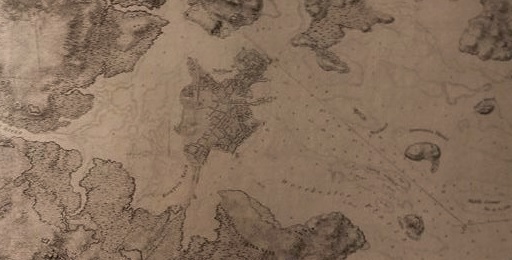 Figure 2 is a map showing the natural features present near my site (boxed in) in 1781, including a nearby stream which no longer exists and a hill that likewise is now flat
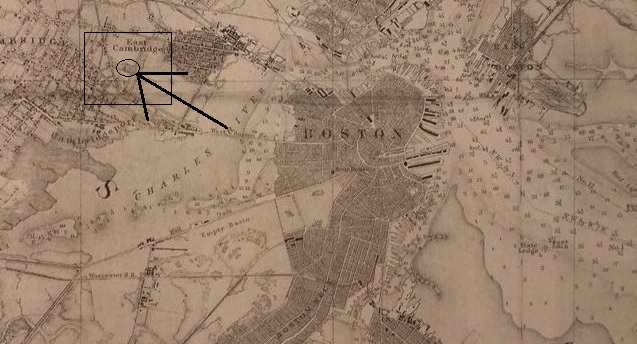 Figure 3 shows an 1857 map of Boston, with my site boxed in, and with a small green space indicated by an arrow. This green space still exists today, evidenced by figure 4 below. This map also shows the logistics of the filling project with the Mill Dam pictured towards the bottom
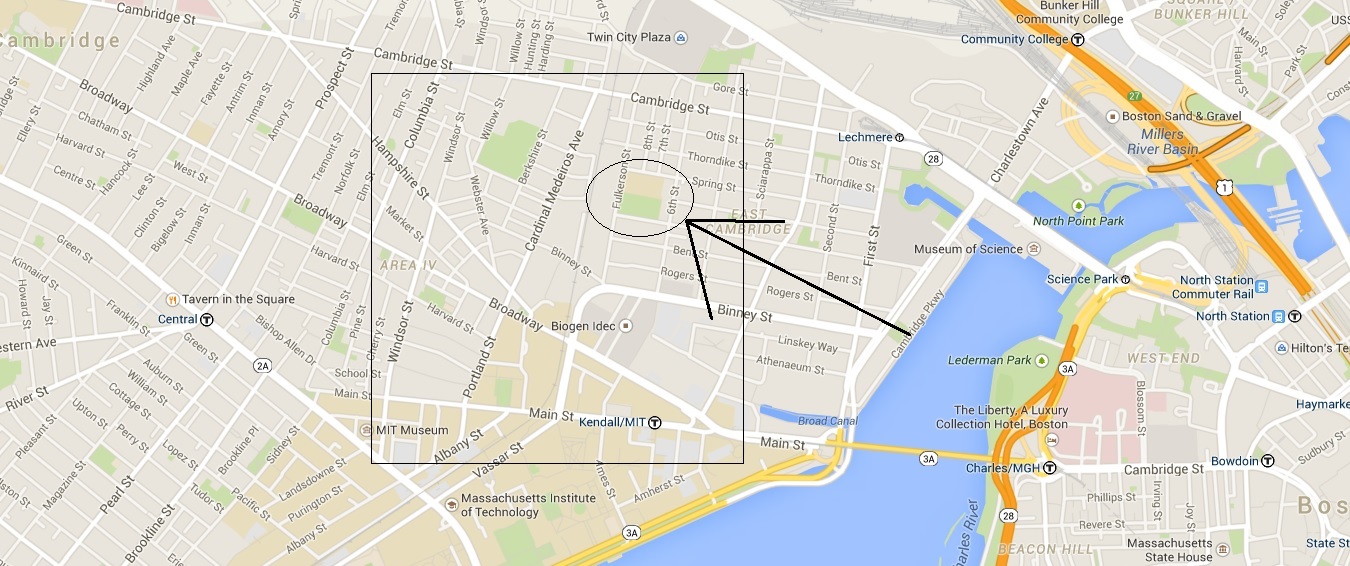 Figure 4 shows a modern day map with the Broadway Hampshire intersection as well as the Ahern field green space indicated.
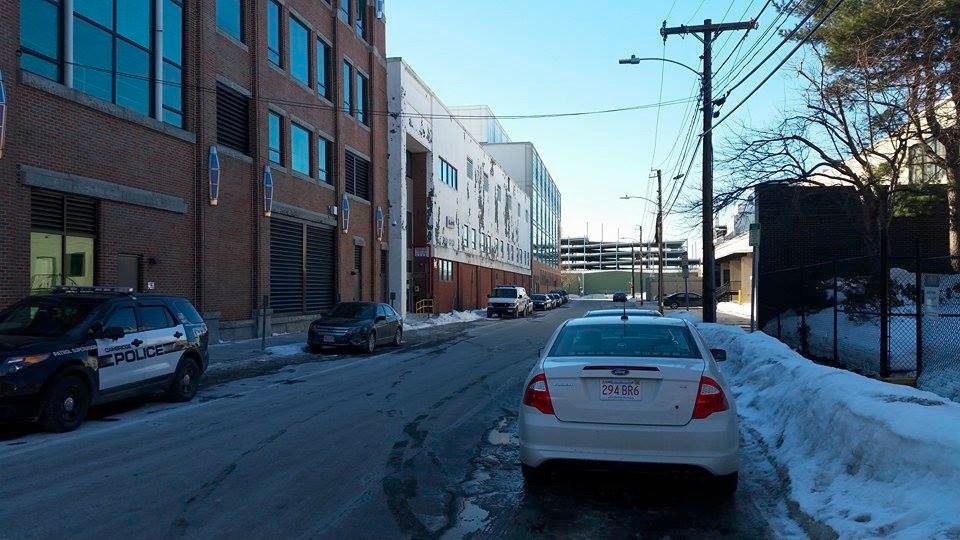 Figure 5 is a photo taken at the east end of Bent Street behind the Cambridge Police Department, showing the characteristic industrial section of the plot with no street trees and no protection from wind or sun aside from the tall buildings
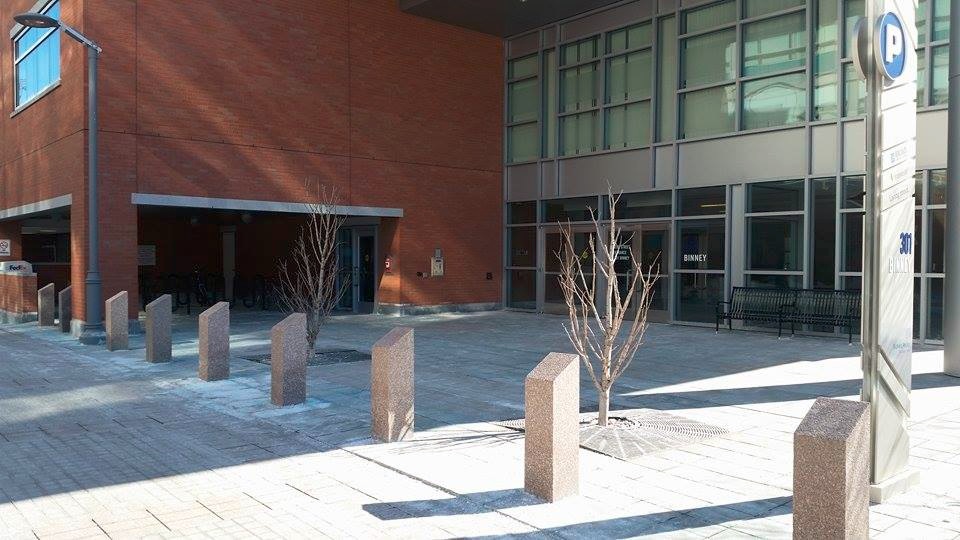 Figure 6 is a photo taken outside of a FedEx facility on Fulkerson Street. The image shows the dismal situation for these street trees with little access to sun and water, and emphasizes the lack of connection between human motives and nature’s needs in the industrial part of the plot
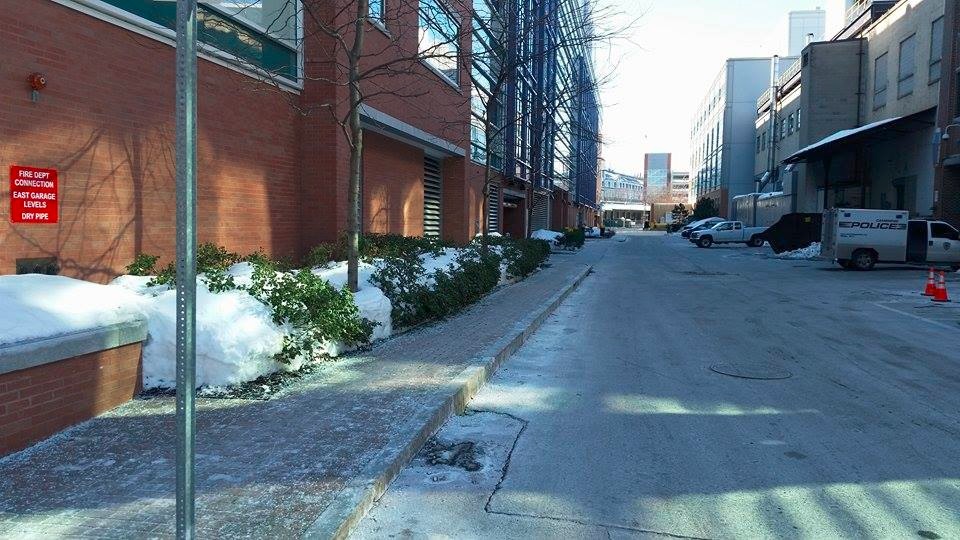 Figure 7 is a photo taken at the end of Rogers Street looking west showing the poor placement of the planted area on the left, but also showing the lack of other places on this street for this planting to take place, with a loading facility along the right hand side of the road. The wall on the left shows a perfect example of sunlight shining from the south onto the wall on the right, and then reflecting back to the wall on the left
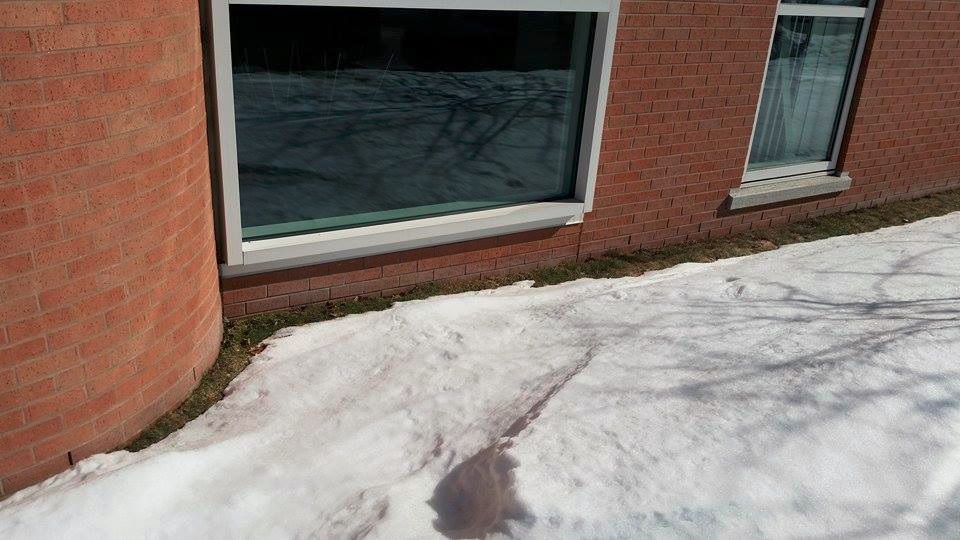 Figure 8 shows a patch of grass that is surviving on Binney Street because of the warm wall (warm to the touch) melting the snow behind it. This suggests that nature will never be removed from cities, but keeps in mind that with attention to detail plant life can even thrive in city/industrial environments
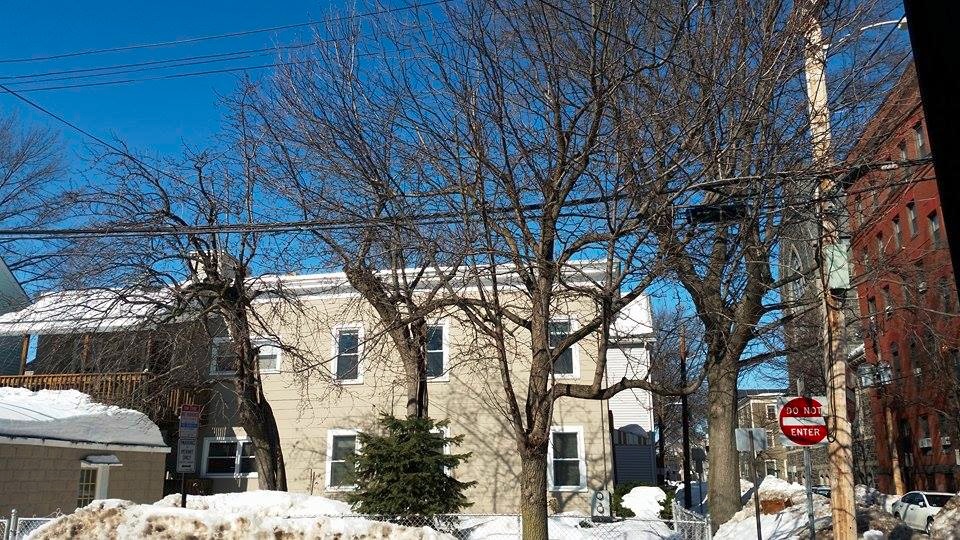 Figure 9 is taken at the intersection of 7th street and Thorndike Street, with the visible wall of the house facing south. These trees are thriving in open soil, and pushing through the power lines with few noticeable effects on either
 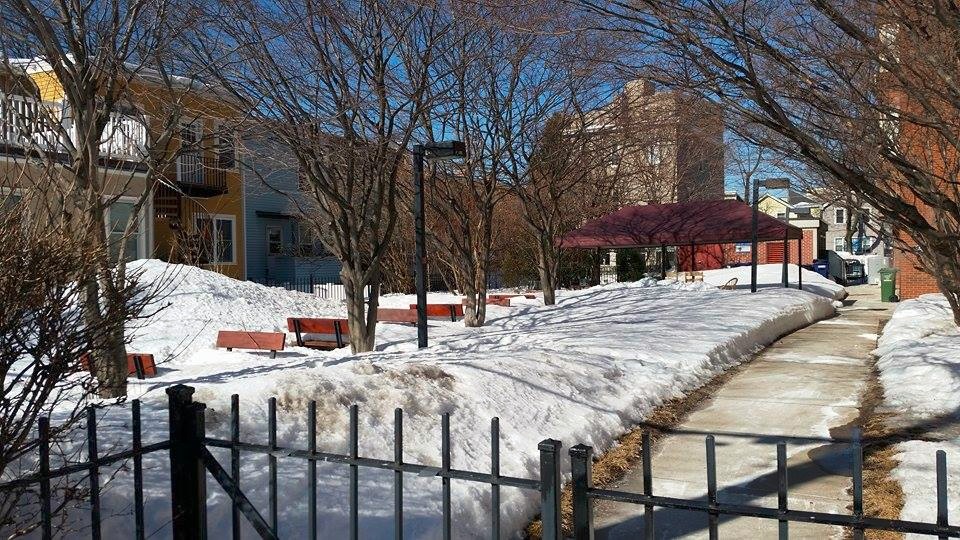 Figure 10 shows the space between a small apartment complex and a row of houses. The orientation of the park is north-south, and the area is very comfortable, without wind or too much bright light. This area could have been developed or built upon, but instead it has been preserved as an open space within a relatively dense neighborhood
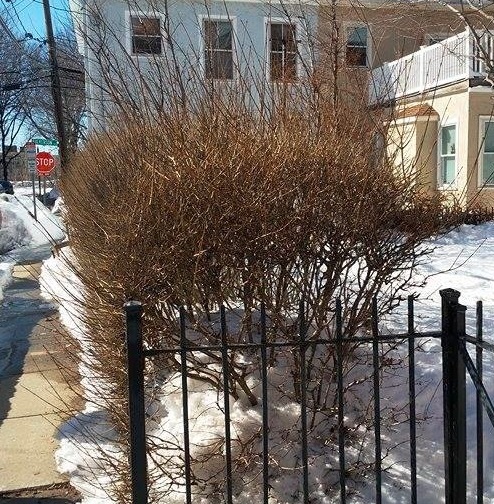 Figure 11 shows the bush that was filled with birds on all of my visits.
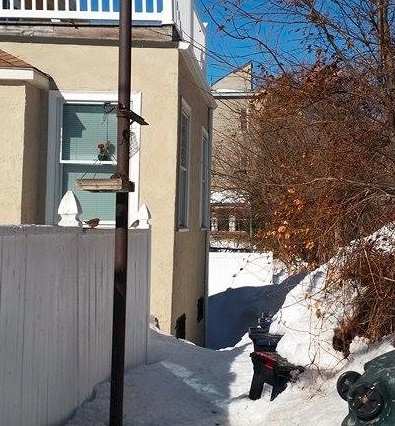 Figure 12 shows the birdfeeder that drew them here, filling the scene with peace and removal from the busy urban environment
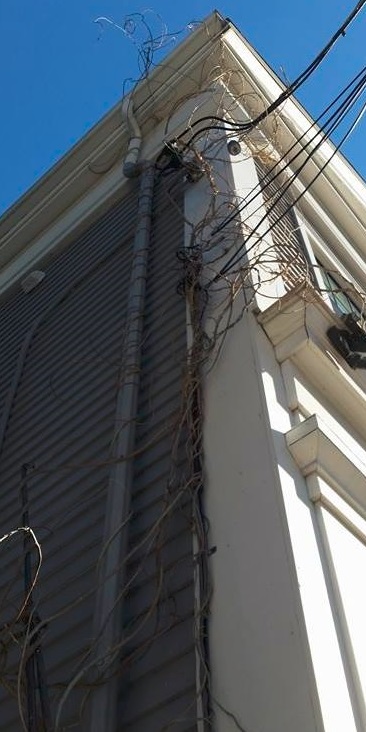 Figure 13 shows a vine crawling up wires on the side of a house, growing into the side of the house
Figure 14 shows a tree that grew around power lines which then practically became a part of the tree, connecting physically the natural and urban environments in an irremovable way. For either to be removed or replaced, the other will have to be destroyed, yet it contributes a sense of beauty
Figure 13 shows a vine crawling up wires on the side of a house, growing into the side of the house
Figure 14 shows a tree that grew around power lines which then practically became a part of the tree, connecting physically the natural and urban environments in an irremovable way. For either to be removed or replaced, the other will have to be destroyed, yet it contributes a sense of beauty
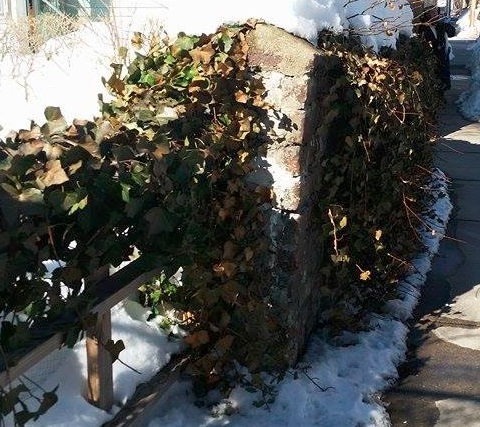 Figure 15 shows the ivy and vines flowing over a homeowner’s fence and rock wall. I in fact saw them exiting their house and asked them if they thought about why they keep the vine around. They replied that “it’s beautiful”
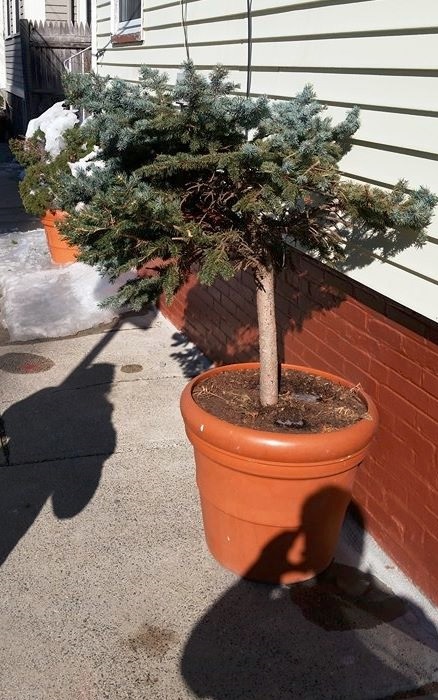 Figure 16 shows a potted spruce tree (one of three) placed on this sidewalk by a homeowner
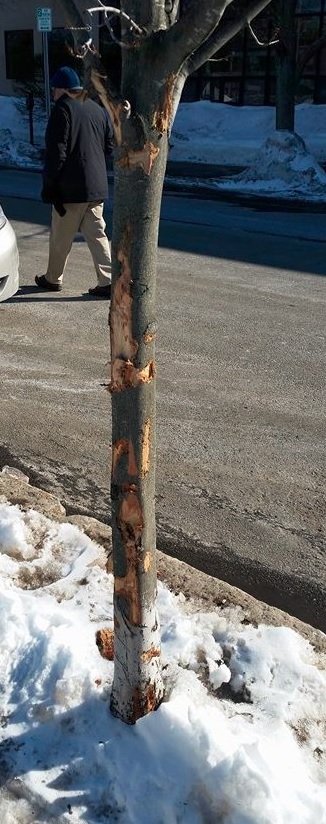 Figure 17 shows a street tree on Charles Street in front of Ahern Field that has had its bark destroyed by the actions of a street snow plow”
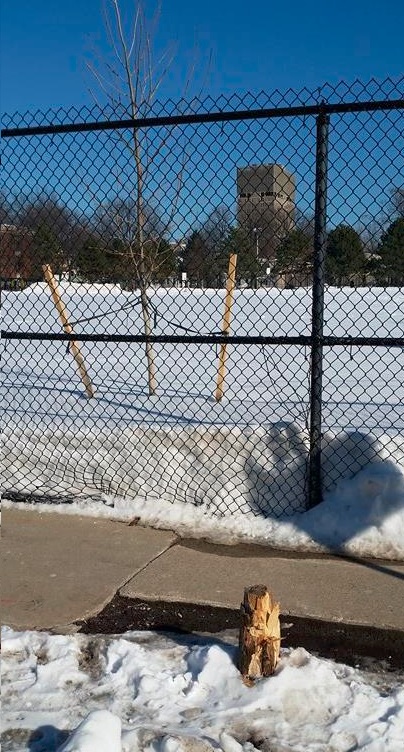 Figure 18 shows a tree on Fulkerson Street in front of the same field where the street tree has been relocated from the sidewalk to the inside of the park. This new location will protect the tree and provide it more soil and water to grow. This has been done with every street tree on Fulkerson Street bordering the field. This action reveals some of the learning being done in the transition area between residential and industrial, providing residents of the area with a more beautiful and healthy environment than the one shown in Figure 17