
As sample volumes decrease, integrated control systems become critical for manipulation of liquid volumes on the pico- to nanoliter scale. Several technologies have been developed for microfluidic metering, mixing, and compartmentalization. On-chip valve structures for aqueous solutions include passive valves consisting of chemically-derivatized hydrophobic patches, small physical channel restrictions that prohibit capillary flow, and silicon-based mechanical valves and pumps, whose intricate assembly process combined with the stiffness of silicon makes the technology impractical for rapidly prototyped microfluidic devices. Elastomer-based microfluidic devices, created by soft lithography methods, are emerging as valuable tools in this constantly expanding research field. These devices have the advantage of low cost, rapid prototyping, and highly flexible design constraints. An excellent method of moving fluid through these devices is induced charge electroosmosis (ICEO), whose theory was developed by Bazant and Squires and experimentally realized in the Thorsen group. The basic concept of ICEO is to drive fluid flow near metal surfaces using weak AC electric fields. Flow generated under ICEO is extremely localized, occurring just nanometers from the metal surface. Using micro-electro-mechanical-system (MEMS)-based fabrication techniques, we have fabricated ICEO structures that function as mixers in nanoliter-sized microfluidic chambers.
We are developing new kinds of pumps and mixers exploiting “induced-charge electro-osmosis” (ICEO), as a potential platform for portable microfluidics. ICEO refers to the slip of a liquid electrolyte at a polarizable (metal or dielectric) solid surface, driven by an electric field acting on its own induced surface (double-layer) charge. Unlike classical (fixed-charge) electro-osmosis, which requires large DC voltages (>100V) applied down a channel, ICEO can be driven locally by small AC voltages (<10V). It is sensitive to the geometry, ionic strength, and driving frequency and scales with the square of the applied voltage. The effect generalizes “AC electro-osmosis” at planar electrode arrays and offers some more flexibility. We originally demonstrated ICEO flow in dilute KCl around a platinum wire by comparing flow profiles from micro-particle-image velocimetry (μPIV) to our theory. We have also fabricated many devices involving electroplated gold structures on glass in PDMS microchannels, which exhibit mm/sec flow rates in 100 V/cm fields at kHz AC, and further optimization is underway. As a first application, we are developing a portable ICEO-powered biochip to detect blood exposure to toxic warfare agents by lysing cells and amplifying and detecting target genes.
Recently, Bazant and Squires described more general flows due to induced charge electro-osmosis (ICEO) around three-dimensional metal structures, which has since been experimentally realized in microfluidic systems. Motivated by ICEO around raised electrodes, we are developing a variety of new three-dimensional AC electrokinetic pumps capable of much faster directional flows than planar ACEO pumps (for the same applied voltage and minimum feature size) by an order of magnitude according to the usual low-voltage model. Numerical simulations have predicted, and experiments have confirmed, that three-dimensional (3D) stepped electrodes can dramatically enhance the performance of AC electro-osmotic (ACEO) pumps. 3D ACEO pumps with electroplated steps are fabricated on glass substrates, and pumping velocities in weak electrolyte solutions are measured systematically using a custom microfluidic loop. Simulations predict an improvement in pump velocity with increasing step height, at a given frequency and voltage, which qualitatively matches the trend observed in experiment. The results suggest a simple geometrical parameter that may be tuned to optimize the performance of 3D ACEO pumps. Electrokinetic pumps are attractive for portable and flexible microfluidic analysis systems, since they operate without moving parts using low (battery-powered) alternating potentials. Since the discovery of AC electro-osmosis (ACEO) in the late 1990s, there has been much work in designing planar, periodic pumps, which exploit broken symmetry in electrode spacing and width to produce a streaming flow over a surface. Although surface-height modulation has been suggested as another means of breaking symmetry, it has never been numerically or experimentally pursued.
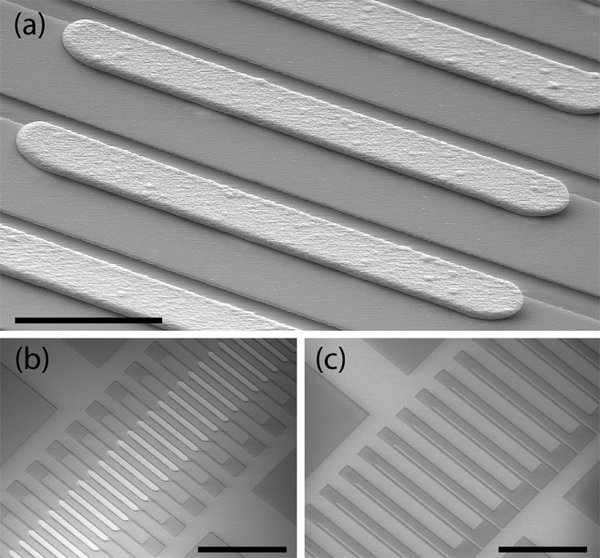
This phenomena and an example microfabricated device are illustrated below. We test and improve our theoretical designs experimentally in a microfluidic loop. Our pumps involve interdigitated planar electrodes with raised metal structures from a simple electroplating step, which leads to greatly enhanced pumping.
  |
Present Post-Doctoral Fellows
Chien-Chih Huang |
Present Graduate Students
 |
J.P. Urbanski (Doctoral Student) |
Present Undergraduate Students
Visitors
Alumni
Collaborators
Martin Bazant, Dept. of Applied Mathematics, M.I.T.
Martin Schmidt, Dept. of Electrical Engineering, M.I.T.
J.A. Levitan (Post-Doc Alumni, Bazant Group)
Todd Squires, Dept. of Chemical Engineering, U.C. Santa Barbara
Links
Non-Linear Electrokinetics at M.I.T.
Support
U.S. Army, Institute for Soldier Nanotechnologies (ISN): DAAD-19-02-2002
Refereed Publications and Conference Proceedings
1. J.A. Levitan, S. Devasenathipathy, V. Studer, Y. Ben, T. Thorsen, T. M. Squires, and M. Z. Bazant, Experimental observation of induced-charge electro-osmosis around a metal wire in a microchannel; Proceedings of ELKIN04 International Conference on Electrokinetics, Carnegie Mellon, June 2004. Colloids and Surfaces A 267(1-3): 122-132 (2005).
2. Y. Ben, J. Levitan, H. Stone, T. Thorsen and M. Bazant. Induced charge electroosmosis in microfluidic devices. American Physical Society 58 th Annual Meeting of the Division of Fluid Dynamics, Chicago, IL, November 22, 2005.
3. J. P. Urbanski, J.A. Levitan, T. Thorsen, M.Z. Bazant. Fast three-dimensional ICEO pumps, American Physical Society Annual Meeting, Baltimore, MD, March 15, 2006.
4. J.P. Urbanski, J.A. Levitan, Y. Ben, T. Thorsen, M.Z. Bazant. The effect of step height on the performance of three-dimensional AC electro-osmotic pumps. International Electrokinetics Meeting (ELKIN), Nancy, France, June 27, 2006.
5. J.P. Urbanski, J.A. Levitan, M.Z. Bazant and T. Thorsen. Fast AC Electro-osmotic Micropumps with Non-Planar Electrodes. Appl. Phys. Lett. 89: 143408 (2006) (PDF)
6. J.P. Urbanski, J.A. Levitan, D.N. Burch, T. Thorsen, M.Z. Bazant. The effect of step height on the performance of three-dimensional AC electro-osmotic pumps. J. Colloid Inter. Sci. 309: 332-341 (2007) (PDF)