 |
 |
 |
 |
| |
|
|
|
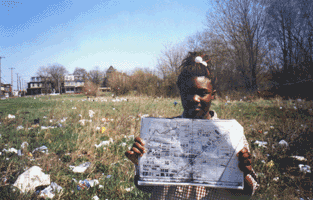
| Our goal is to explore how a new curriculum organized around "The Urban Watershed" can combine learning, community development, and water resource management. The whole neighborhood is the classroom with the school at the center. At the heart of the story is the Mill Creek, a stream that once flowed across the field where the school playground is now, and still does flow, buried in a sewer that runs right past the school. Together, Penn and Sulzberger students learn to read the neighborhood's landscape, to trace its past, understand its present, and envision its future. The tools they use are their own eyes and imagination, the place itself, and primary documents -- old maps, photographs, tax records, census tables, railroad timetables, city plans -- windows into otherwise hidden dimensions. Field trips and classroom guests from the Philadelphia Water Department, the West Philadelphia Empowerment Zone, and Aspen Farm Community Garden enrich the learning experience. Ideas are expressed through discussions, writing and drawings. The students share their own neighborhood stories by making posters, newsletters, booklets, and web sites. |
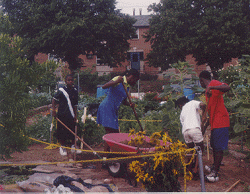
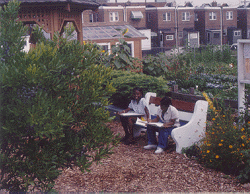
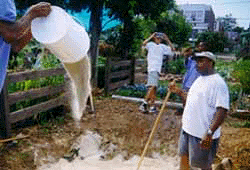
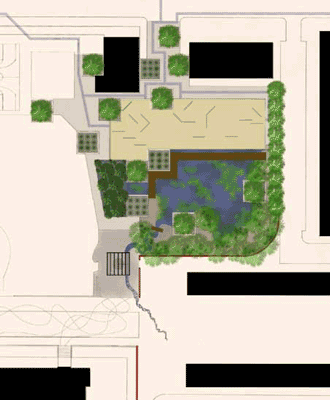
| The fish pond, wetland, and outdoor classroom for environmental study at Aspen Farms community garden was expanded and reconstructed. The revised design reflected the urban wetland curriculum for seventh- and eighth-grade science devised in summer 1998 for use in a constructed wetland near the school. The facility was completed with support from the Philadelphia Urban Resources Partnership and Philadelphia Green. | 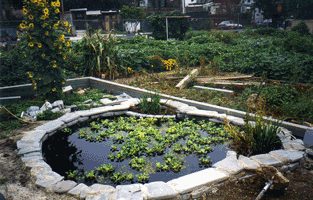 |
 |
Primary documents and other curriculum materials developed and used in SMS classrooms over the last three years were reorganized. The product is a set of curriculum materials about the social, environmental, and architectural history of Mill Creek and West Philadelphia, which combine primary documents (maps, prints, photographs, tax and census records, planning reports, newspaper articles) matched to sets of questions designed to provoke critical thinking, elicit a line of reasoning, yield insight into the processes shaping the neighborhood, and inspire ideas for community design, planning, and development. These materials will enable SMS teachers to use this information more effectively; they are appropriate for use with youth or adults. |
Spring 99
|
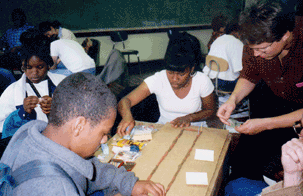
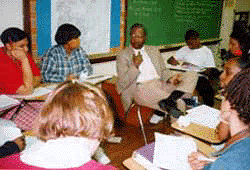
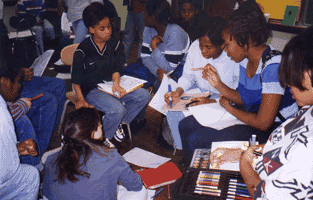
In spring 1999, sixty-four students in Ms. Hoxter's and Mr. Mells seventh and eighth grade classes worked with eleven Penn students in Urban Studies 205: "Power of Place: Introduction to Urban Environmental Design." Together they read the history of the neighborhood in the urban landscape and its streets, buildings, vacant lots, topography, plants, soil, and rocks. Penn and SMS students made proposals for new landmarks that tell stories of Mill Creek's past, present, and future. Mill Creek is one of several neighborhoods city-wide selected to work with an artist to develop proposals as part of the Fairmount Park Art Association's New Landmarks Program. The students work contributed to that project. |
 |
In November
1998, the Philadelphia School District named Sulzberger
Middle School "School
of the Month" for its pioneering curriculum and
service learning initiative. Professor Spirn was also
honored as the School District's "Person of the
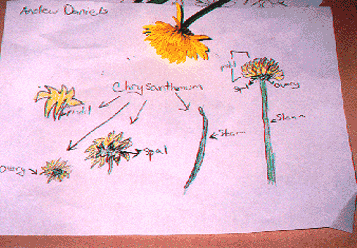
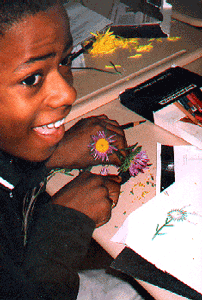
Month" for her four years work at Sulzberger. In Fall 1998, nine students from Professor Spirn's Transforming the Urban Landscape studio started the semester by designing an expansion of the water garden/outdoor classroom at Aspen Farm and went on to design a wetland/water garden/outdoor classroom for a vacant lot next to Sulzberger. The Penn students spent eight afternoons with 64 students in Ms. Hoxter's and Mr. Mells seventh and eighth grade classes to develop ideas for the environmental study area and an associated curriculum. Together, they dissected and analyzed flowers and looked at them under a microscope, studied water flow and water quality, designed water catching apparatus and many other activities. The Sulzberger students also reviewed and critiqued the Penn students' designs for Aspen Farm.
|
 |
 |
 |
|
Power
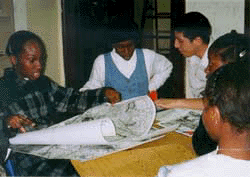
of Place: Introduction to Urban Environmental Design In spring 1998, thirty-two students in Glenn Campbell's eighth grade class are working with eleven Penn students of Urban Studies 205: "Power of Place: Introduction to Urban Environmental Design." Together they will prepare a map/ guide to stories of Mill creek's past in traces still visible in the landscape and a design and business plan for a miniature golf course that tells stories of Mill Creek's past, present, and future. A miniature golf course on vacant land in the Zone within the Mill Creek "floodplain" to create and sustain new jobs within the community is an idea being considered by Empowerment Zone staff. Penn and Sulzberger students will present their plans to the Empowerment Zone. |
 |
Tranforming
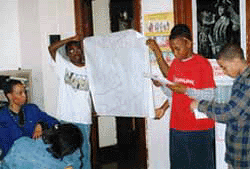
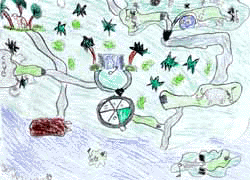
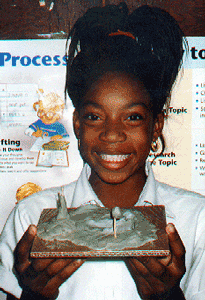
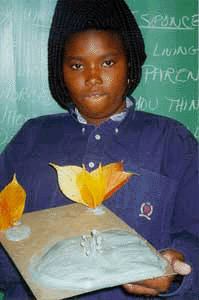
the Urban Landscape In Fall 1997, 32 students from the University of Pennsylvania in Professor Spirn's Transforming the Urban Landscape studio designed a miniature golf course for the Mill Creek community. As part of their introduction to the neighborhood, they went into Ericka Stewart's seventh grade classroom and Glenn Campbell's eighth grade. Penn students introduced a variety of activities in a collaboration that spanned eight weeks: Sulzberger students made maps and drawings of their homes, took photographs of their block, and made models of their visions for the future golf course. |
|
|
Ask
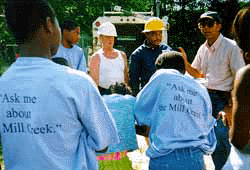
me about the Mill Creek.
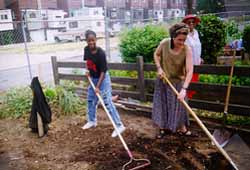
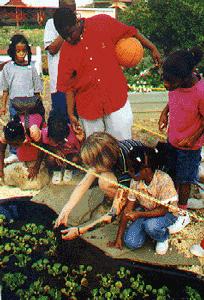
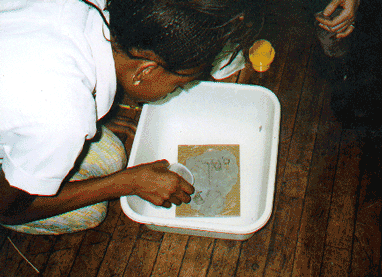
Outdoor activities included regular visits to the nearby Aspen Farms Community Garden. There were several construction projects built to serve as an outdoor classroom for a year-round environmental studies program. The projects included installing a small hardshell pond with aquatic plants, a butterfly house at the butterfly garden, and a vegetable plot with a compost bin. (See Sulzberger students' webpage reports.) Hayward Ford, President of Aspen Farms and Jeff Myers of the Pennsylvania Horticulture Society also assisted the students. Many students brought their families to the garden for the first time. Indoor activities included making a topographical model of the watershed, mapping watersheds, (worksheet) and webpage reports (see SMSnews). The group discussed the value of trees in the city and designed a street tree nursery for their school grounds after a visit from Mindy Maslin of Philadelphia Green.(worksheet) As an exercise in reclaiming vacant land, the group designed proposals for a miniature golf course near their school. Each hole is an illustration of an era in the Mill Creek's history. (worksheet) They went on a field trip to a miniature golf course with an international theme in Rosyln, PA. (worksheet) |
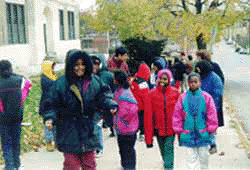
| On the last day of the program, the group made a bus trip that traced the Mill Creek from the school to the Schuylkill River and met Joe Serrone from the Philadelphia Water Department. They also visited Bartram's Garden near the Schuylkill River to view a wetland reclamation project that probably resembles the historic mouth of the Mill Creek. |
| Power
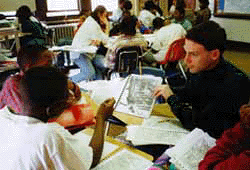
of Place: Water, Schools, and History In spring 1997,
thirty Sulzberger students in Glenn Campbell's eighth
grade class worked with Professor Spirn and five Penn
students of Urban Studies 320: "Power of Place:
Water, Schools, and History." The Penn students
shared their reports and primary reference sources
addressing the following topics:
Special classroom guests included: |
|
| The Sulzberger students gave a public presentation with slides and posters at a symposium held at the University of Pennsylvania in May. The posters were also showcased in June at the Philadelphia Urban Resources Partnerships Conference at the Philadelphia Convention Center. Before the students graduated, Penn students made a booklet of the Sulzberger students drawings and essays regarding the Mill Creek history and plans for a water garden. |
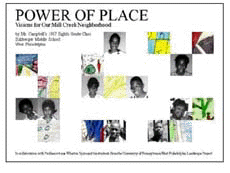 |
Excerpt from Sulzberger
teacher Glenn Campbell's booklet foreword: " As they shared knowledge and research methods, both groups of students used cultural exploration to shatter cultural and academic myths and create a powerful partnership across secondary school and university levels." |
| Sim-City
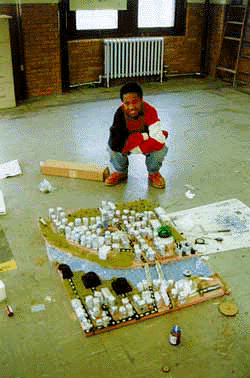
Competition 'Silver City' During the winter of 1996 the students of Daisy Century's science class participated in the 5th annual National Engineers Week Future City Competition. Since the program began in 1992, the purpose of the competition has been to introduce students to engineering through practical applications of math and science and work with engineers. The team consisted of three Sulzberger students, a licensed civil engineer and Martin Knox, a Penn landscape architecture student. They designed future cities on a computer using Maxis' SimCity Classic© software and used a blueprint to build a model of a section of the created city. "Silver City" won Best Design at the Philadelphia region competition held at the Franklin Science Institute. |
 |

|
Transforming
the Urban Landscape In fall 1996, Professor Spirn and twenty-four graduate students from the Landscape Architecture and Regional Planning 601 studio "Transforming the Urban Landscape" worked with four Sulzberger teachers and 130 Sulzberger students: Glenn Campbell's eighth grade; Crystal Roye's eighth grade; Mattie Lloyd's sixth grade; and Joann Shafer's seventh grade. The whole neighborhood was the classroom with the school at the center. At the heart of the story was the Mill Creek, a stream which once flowed across the field where the school playground is now, and still does flow, buried in a sewer which runs right past the school. Working with teachers and students at Sulzberger, the graduate students documented environmental and community history as well as devising designs for the vacant land near the school. |
| Spring 1996
|
||
 |
 |
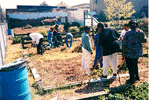 |
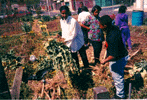
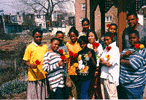
Daisy Century's class started a vegetable garden at Aspen Farm Community Garden in 1996 with the help of Rachel Sterling-Boyers and Hayward Ford. Their vegetables won several ribbons at the Fall 1996 Harvest Show, sponsored by the Pennsylvania Horticultural Society. |
||
1995 ASCE Future City Competition
 |
 |
 |
||
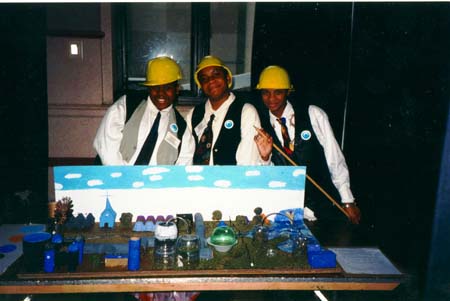
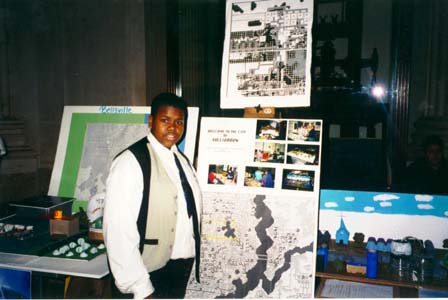
| Students at the January 27, 1996 competition. |
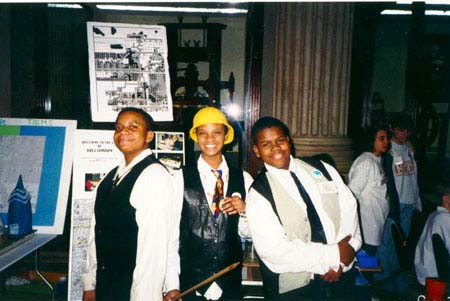
Students at the January 27, 1996 competition. |
Students at the January 27, 1996 competition. |
| From October 1995 to January 1996 several students participated in the 4th annual National Engineers Week Future City Competition. Since the program began in 1992, the purpose of the competition has been to introduce students to engineering through practical applications of math and science and work with engineers. The team consisted of three students, Adam Ankrah, Nagia Owen and Dennis Williams, assisted by Daisy Century, Rachel Sterling-Boyers, a Penn landscape architecture student, Laura Aibel, a licensed civil engineer and other members of the class. They designed future cities on a computer using Maxis' SimCity Classic© software, used a blueprint to build a model of a section of the created city, and finally wrote an essay on considerations in designing a manufacturing zone. The Sulzberger students competed in Philadelphia on Saturday, January 27, 1996 at the Franklin Institute. |
| Credits Work with teachers at Sulzberger is supported by work-study grants from Penn's Center for Community Partnerships. The Urban Watershed Program is supported, in part, by a grant from the Philadelphia Urban Resources Partnership and the U.S. Department of Housing and Urban Development. |
This site is maintained by the Webmaster at wplp@pobox.upenn.edu
Last Update: 4 January 2000