Satellite Orbit and Positioning:
-
There will be three satellites, all in geosynchronous orbit above Mars'
equator. One will be positioned above the longitude of the landing site,
whereas the other two will be 65 degrees on either side.
-
Each satellite, stationed 1.69*107 m above the Martian equator
will be able to cover latitudes from 80.4 degrees South to 80.4 degrees
North. If it becomes necessary to land outside of this range, a satellite
in polar orbit will be launched.
Satellite Specifications:
-
Each satellite will have one X-band and one Ka-band directional antenna.
-
Each satellite will be stabilized about three axes, and will weight approximately
2250 kg.
-
Each satellite will have 2 solar panels (approximately 15 m long each)
symmetrically located on either side. These panels will be capable of generating
about 1700 watts for at least 10 years. When on the dark side of Mars,
NiCd batteries will supply power. Internal heaters combined with thermal
coating will provide temperature control.
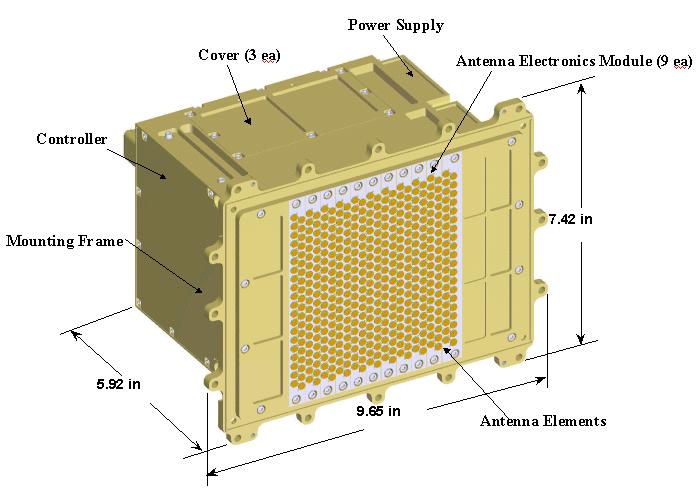
Antenna Specifications (Ka)
-
Each Ka-Band antenna will weight approximately 5.2 kg.
-
It's dimensions will be as follows: 25.4 cm x 25.4 cm x 15.2
cm.
-
It will radiate a DC power of about 72 watts.
-
Maximum data transfer rate of 310 Mbps for a satellite-to-ground link.
-
Maximum data transfer rate of 4 Mbps for a satellite-to-satellite link.
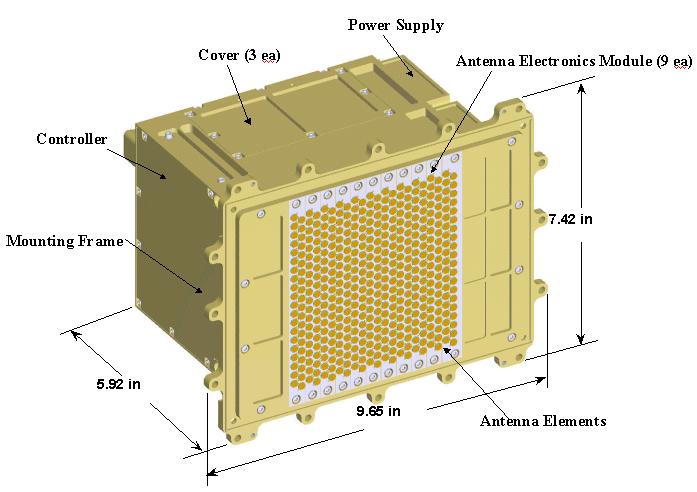
Antenna Specifications (X)
-
Each X-Band antenna will weight approximately 5.5 kg.
-
It will radiate a maximum DC power of about 160 watts.
-
Maximum data transfer rate of 105 Mbps.
-
Asynchronous data transfer
-
Uses 64 directional elements to form a phased array.
-
Can be omnidirectional or unidirectional.
-
Dimensions: 28 cm x 33 cm x 7.62 cm.
-
Cost effective
Author: David Broniatowski
References:
http://eo1.gsfc.nasa.gov/Technology/Documents/XPAADescription.PDF
http://jazzman.gsfc.nasa.gov/technology/kaband.htm
http://eo1.gsfc.nasa.gov/Technology/XPAAGallery.html |
http://jazzman.gsfc.nasa.gov/technology/kaband.htm
http://eo1.gsfc.nasa.gov/Technology/XPAAGallery.html
|