UNIFIED ENGINEERING Spring 2006
Ian A. Waitz
Problem P3. (Unified Propulsion) L.O.’s A, B & G
Below is a schematic of the first two blade rows in a turbine: the nozzle and the first stage rotor. The nozzle accelerates the combustor exit flow (low kinetic energy, high internal energy), giving it high axial and tangential velocity (converting the internal energy to kinetic energy).
It is convenient to represent the circular blade rows in two dimensions as shown in the schematic on the right. Here the axial direction is horizontal on the page and the tangential direction is vertical on the page. Assume the annulus height is constant (the radial dimension on the engine, or out of the page in the two dimensional schematic). Also assume that the fluid is incompressible and flows steadily through the device.
The spacing between the airfoils is s. Assume the speed and pressure at inlet to the nozzle (uin, pin) are uniform in the tangential direction and that the inlet flow is purely axial. Assume that the speed and pressure at the outlet of the nozzle (uout, pout) are uniform in the tangential direction and that the outlet flow has swirl defined by an angle bout relative to the axial direction. Choose upper and lower boundaries for the control volume such that they are the same as the streamline that runs through the center of the nozzle passage (then you will see that the pressure forces along these two boundaries cancel.
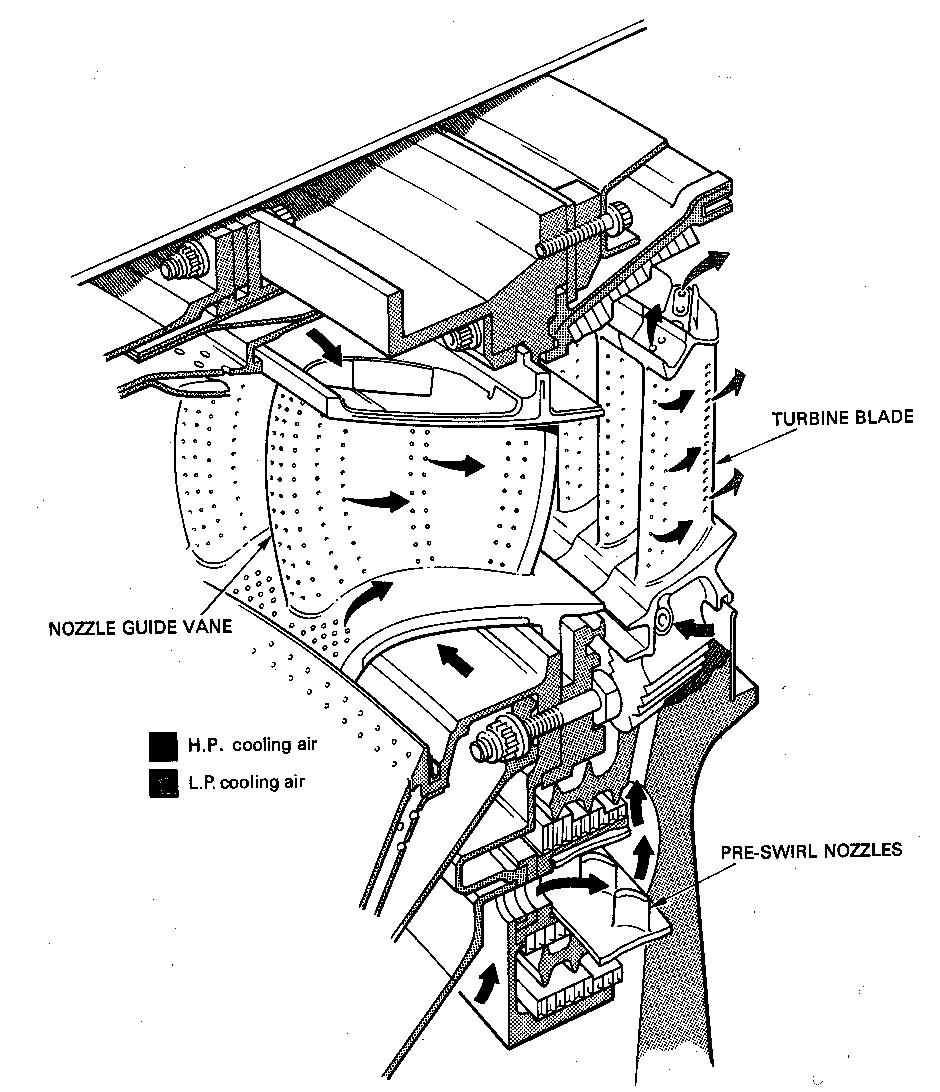
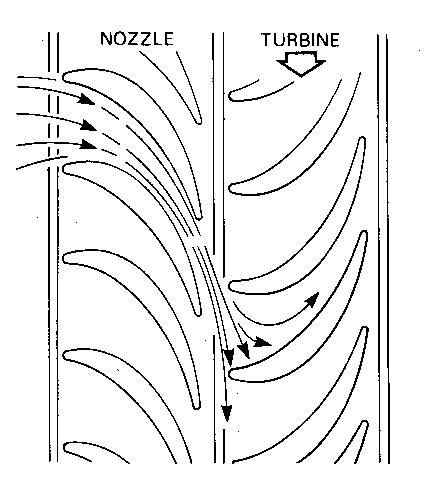
(Graphics from Rolls-Royce, “The Jet Engine”)
a) Write an expression for the axial flux of tangential momentum in terms of s, r, uin, pin, uout, pout, and bout. Does the magnitude of the axial flux of tangential momentum increase, stay the same or decrease across the blade row?
b) Does the pressure increase, stay the same, or decrease across the blade row? Why?
