triding down a hallway at M.I.T., Amy Smith has
a bucket in one hand and a length of string in the other. The brain
behind such creations as the phase-change incubator, she is on her
way to the Charles River to retrieve some dirty water for her next
class. As she lopes along, Smith describes the ordeals of testing
water in remote villages. Her words spurt out. She's a woman on
fast-forward, and she does not so much talk as download information.
triding down a hallway at M.I.T., Amy Smith has
a bucket in one hand and a length of string in the other. The brain
behind such creations as the phase-change incubator, she is on her
way to the Charles River to retrieve some dirty water for her next
class. As she lopes along, Smith describes the ordeals of testing
water in remote villages. Her words spurt out. She's a woman on
fast-forward, and she does not so much talk as download information.
We reach the massive front doors of M.I.T.'s main building, and
she pushes out into the crisp air and roar of traffic. Without interrupting
her disquisition on water-testing, she perches sidesaddle on a banister.
Elegantly poised, she slides down the handrail, still talking.
She lands on the sidewalk with a practiced leap. ''You slide faster
in the winter,'' she says, ''when you've got a wool coat on.''
If you're an inventor and you ride the banister below the pillared
entrance of a university, there's a good chance of coming off as
way too cute, like Robin Williams playing an inventor in a Disney
movie. But Smith can get away with this kind of flourish. She is,
after all, one of the brightest minds in a movement that sets out
to prove that the best technology can be cheap and simple. The banister
is a perfect example: it requires less energy than the stairs, and
it's free.
In a culture that hails mobile phones and plasma-screen televisions
as the great innovations of our time, Smith is gloriously out of
step. She designs medical devices and labor-saving machines for
people who live at the far end of dirt roads in Africa. Her inventions
cost anywhere from a few hundred dollars to a few pennies. ''You
can't understand how important a grain mill is,'' she says, ''until
you've spent three hours pounding grain and gotten a cup and a half
of flour.'' It is this kind of understanding -- of tedium, of tired
muscles, of hunger pangs -- that Smith brings to her work.
 n
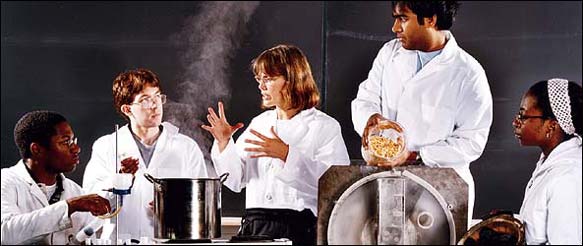
hour later, in Smith's ''D-lab'' class, students gather around a
huge, black-topped slab of a table. It's the first semester of design
lab, and these undergrads are learning about the politics of delivering
technology to poor nations, how to speak a little Creole and the
nitty-gritty of mechanical engineering; during the midsemester break,
they will travel to Haiti, Brazil or India. There, they will act
as consultants in remote villages, helping locals solve technical
problems. Oh, yes, and the students will also test village drinking
water for dangerous bacteria.
n
hour later, in Smith's ''D-lab'' class, students gather around a
huge, black-topped slab of a table. It's the first semester of design
lab, and these undergrads are learning about the politics of delivering
technology to poor nations, how to speak a little Creole and the
nitty-gritty of mechanical engineering; during the midsemester break,
they will travel to Haiti, Brazil or India. There, they will act
as consultants in remote villages, helping locals solve technical
problems. Oh, yes, and the students will also test village drinking
water for dangerous bacteria.
Today, Smith is training them to do that. Using a small pump, the
students draw the Charles River water through a filter. Smith points
to a piece of the testing rig -- what looks like a silver barbell.
''This test stand costs $600,'' she says. ''Personally, I find that
offensive.'' When the students work in the field, she says, they
will be using a far cheaper setup -- one that she patched together
herself for about $20, using a Playtex baby bottle. ''You can do
a lot more testing for the same amount of money.''
Now the students have made cultures of Charles River water in petri
dishes. The next step is to incubate the petri dishes for an entire
day at a steady temperature. But how do you pull that off in a lean-to
in Haiti, with no electricity for miles around? Again, Smith has
a solution. She passes around a mesh bag of what appears to be white
marbles. The ''marbles'' contain a chemical that, when heated and
kept in an insulated environment, will stay at a steady 37 degrees
Celsius for 24 hours. The balls are the crucial ingredient in one
of Smith's inventions -- a phase-change incubator that requires
no electricity. The design won her a 1999 Collegiate Inventors award.
She says she hopes that the Centers for Disease Control and Prevention
will soon endorse her incubator. ''From there it's not a big step
to go to the Red Cross,'' she says. One day it could be a key piece
of equipment at rural health clinics, where doctors depend on intermittent
electricity or none at all. Smith has founded a company to handle
the exigencies of getting her incubators up and running and out
into the field. ''I have 6,000 of these balls on their way here
from China as we speak,'' she says.