Extravehicular Activity (EVA)
Dynamic Modeling and Simulation
Professor Dava Newman
Grant Schaffner
David Rahn
Simulation of astronaut motions during extravehicular activity (EVA) tasks is performed
using computational multibody dynamics methods. The application of computational
dynamic simulation to EVA was prompted by the realization that physical microgravity
simulators have inherent limitations: viscosity in neutral buoyancy tanks; friction in air
bearing floors; short duration for parabolic aircraft; and inertia and friction in suspension
mechanisms. These limitations can mask critical dynamic effects that later cause problems
during actual EVAs performed in space.
The dynamic equations of motion for multibody systems are formulated
with emphasis on Kane's method, which forms the basis of the simulations. The four basic
steps in creating the computational
simulations are: system description, in which the geometry, mass properties, and
interconnection of system bodies are input to the computer; equation formulation based on
the system description; inverse kinematics, in which the angles, velocities, and
accelerations of joints are calculated for prescribed motion of the endpoint (hand) of the
arm; and inverse dynamics, in which joint torques are calculated for a prescribed motion. A
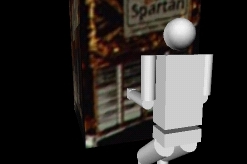
graphical animation and data plotting program, EVADS (EVA Dynamics Simulation), has been
developed and used to analyze the results of the simulations that were performed on a
Silicon Graphics Indigo2 Extreme computer.
 Results from some simulations of astronaut EVA tasks.
Back to the Man Vehicle Lab home page
Back to the Aero/Astro home page