MIT Center for Real Estate

Leveraging Science, Developing Innovation

building: mcgovern institute for brain research

MIT Professors and Students Help to Rebuild New Orleans

September 29, 2006

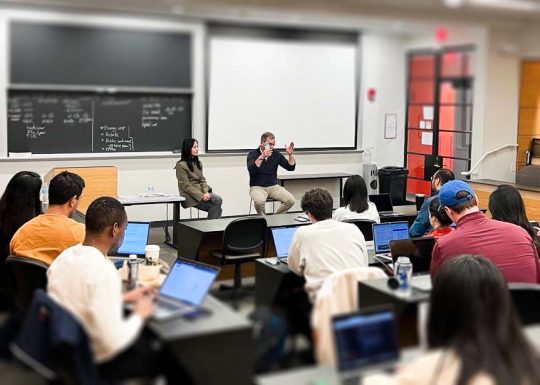
"One year after the storm, there is still devastation," said Phillip Thompson, MIT Associate Professor of Urban Politics. Speaking as a part of the MIT Center for Real Estate's graduation weekend, Thompson gave a compelling account of the destruction left by Hurricane Katrina in terms of lives, infrastructure, and real estate. But he also described positive progress working in New Orleans' Treme district with MIT students, community foundations, corporate philanthropists, and labor unions to help rebuild the city. Despite challenges ranging from battles over what should be rebuilt to a government lacking resources, data, and money, the groups achieved tangible results. Highlighting real estate issues, Thompson addressed his talk to graduates of MIT/CRE's Master of Science in Real Estate Development program.

The Most Costly Natural Disaster in U.S. History

The flooding caused by Hurricane Katrina killed 1800 people and caused $81 billion in damage. "It was the most costly natural disaster ever to strike the United States," said David Geltner, Director of the MIT Center for Real Estate (MIT/CRE) who introduced the talk. Two to ten feet of water covered most of the city for over two weeks, flooding houses and industrial sites, and spilling hazardous chemicals and sewage into the streets. "There is still devastation one year after the storm," Thompson said. "In the lower 9th ward last winter, there were still bodies under the rubble."

Thompson's statistics told the tragic story:

Should New Orleans Be Rebuilt?

Many critics contend that a cost-benefit analysis would show that rebuilding New Orleans is a losing proposition. Thompson takes issue. "It is unfair to focus solely on New Orleans," Thompson said, instead of looking at how the whole nation uses resources — for example, by piping water into deserts near San Diego and Phoenix to grow crops. "It's a question of unequal protection.... Can the government continue to enjoy the allegiance of minorities if it is not fully committed to protecting the vulnerable from disaster? We need a fair process for deciding where to invest in infrastructure," Thompson said.

New Orleans is home to many rich American traditions. It is the birthplace of jazz, and is the location of the oldest free African-American community in the United States. Chippewa and Choctaw Native Americans intermarried with that community, helping to create the uniquely American Creole language and culture. "Like the World Trade Center, it's hard to measure its worth," Thompson said.

It's easier to measure New Orleans' economic worth. The port connects to the busiest inland waterway in the United States, serving more than 6,000 ocean-going ships a year. The port generates 107,000 jobs, with over $2 billion in earnings. Off-shore oil and natural gas wells produce 18 percent of domestic oil and 24 percent of domestic natural gas. Thirty percent of U.S. seafood comes from the Louisiana coast. But that industry continues to be threatened by disappearing coastal land mass. Louisiana is losing 25 acres of coastal land to the sea every day, and has lost 34 acres of land per year for the past 50 years.

Builders Face Uncertainty

Real estate development in post-Katrina New Orleans is difficult due to continuing uncertainty over ownership, building standards, and costs. In term of ownership, when Thompson arrived in New Orleans last winter, the city had only a handful of attorneys working to resolve 30,000 cases of properties that had been seized by the city for unpaid taxes. Because of the loss of building stock, home prices have surged over 40 percent.

Building standards were also uncertain. For example, the standards for how high above ground houses needed to be raised to qualify for insurance were in flux for almost a year following the disaster. "Why did it take nine months to come out with a three-foot standard across the city?" Thompson asked. "We had no idea what they were doing for nine months."

Estimating building costs in post-Katrina New Orleans is an ongoing challenge. "It's hard to know whether you can even find workers," Thompson said. "Where will they come from? Where will they live?" Bringing in workers can add extraordinary costs to a project, Thompson said – and then there are the building materials. "If you think about building 100,000 units of housing, where will the material come from? How much will it cost?" Thompson asked.

The most unwieldy problem for rebuilding New Orleans is what Thompson called the "assembly problem" — getting enough people together in one place to have a viable community. "If you have children, you're not going to move back to a neighborhood where no one lives; schools may not re-open because no one else lives there. Most people want to move back with neighbors," Thompson said. Coordinating a move is difficult when the community doesn't know who will come back or when they will come back.

According to Thompson, there has been strong local resistance to the government taking properties by eminent domain to rebuild communities, and private groups are finding it difficult to assemble large parcels of land to recreate neighborhoods. "At first we [Thompson's group] had a plan for buying scattered plots in Treme. We were literally running into bars and restaurants trying to find out who was on property lists." Some of the key pieces of property in Treme were once flophouses — multifamily buildings that served low-income transient populations. "They're going to be back in business soon, and it's highly profitable," Thompson said. "With all those construction workers coming back to rebuild the city, they think they'll be fine." Thompson advocated a "middle way," partnerships at the neighborhood level that would commit to rebuild.

Obstacles to Recovery

New Orleans is prey to what Thompson called "accumulated inequalities." A third of African-Americans in the city live in poverty, defined as an income of less than $16,000 a year for a family of three. In the Treme district where Thompson has been working, the average family income is $17,000 a year. Bitter desegregation struggles in the early 1960's left the schools weakened; 50 percent of African-American 9th graders do not graduate, and nearly 50 percent of African-American adults in the city are illiterate. Local programs designed to train laborers for construction jobs — at entry-level positions — were frustrated because applicants' math and reading skills barely reached the fourth-grade level — well below the eighth-grade level required. Some New Orleans residents are suggesting that the city's public schools be entirely replaced by private charter schools. "The school system didn't work pre-storm, so why rebuild it as it was?" Thompson asked. "Some of the most educated among the unemployed workers are re-entering prisoners," said Thompson, explaining that prisoners have often had their sentences reduced by earning a GED. Thompson cited reports that 62 percent of young black men in Treme have a prison record.

New Orleans also suffers from structural and political fragmentation. The city has a weak mayoral system and a government that is decentralized; the mayor has no control over facilities such as ports, schools, or parks. Seven different tax offices assess the city's property, making it difficult to find out who owns a parcel, much less how to locate its owner after a hurricane.

Thompson reported that there is no city-wide consensus about how to rebuild the city. In general, African-American residents feel that the federal government should take responsibility for rebuilding, Thompson said, while wealthier white residents feel that rebuilding should be an individual responsibility. At one public meeting, the mayor's panel on recovery proposed rebuilding just a small portion of the city at first, and waiting to see if more building was needed. Whites cheered the plan, but the African-Americans whose communities would not be rebuilt objected.

The meeting grew so contentious that Thompson and many other attendees were locked out of the auditorium during a bathroom break, and the meeting was closed down by the police. "Folks down there aren't talking about bringing the poor people back into their neighborhoods. Many people are glad they're gone and don't want them back." Thompson said. "This is not Black-White. This cuts across the spectrum. Then there are the people who lived in public housing who don't agree...who say, 'Look, I have no place to go. I want to go home.'"

The debate over whether to shrink the footprint of the city is "a political issue," said Thompson. "Is it technically possible to rebuild New Orleans and protect it from storm surges and flooding? Yeah! It's just that cost is involved." Whether New Orleans should a big city or a small city, Thompson said, "depends on who pays for it."

MIT's Part in Rebuilding New Orleans

MIT has been helping to rebuild New Orleans in numerous ways. MIT faculty who already had existing ties with community groups often continued to work with them. Thompson himself had already been working with labor unions — helping them find ways to invest their pension funds in communities where union members live. Hurricane Katrina destroyed thousands of union members' homes, making it difficult for employers to find workers. After the storm, the SEIU, AFL CIO, and other unions worked with Thompson to figure out how to use some of their pension funds to help union members who had lost homes. (A corporate CEO who chooses to remain anonymous also pledged $20 million to help very-low-income displaced residents.)

Prior to Katrina, Thompson had spent years helping labor union pension funds find opportunities for investing in low-income areas where many union members live – investments Thompson calls "the double bottom line."

Since the hurricane, Thompson has been working with New Orleans community groups, labor unions, and graduate students from the MIT Department of Urban Studies and Planning to rebuild New Orleans. The MIT School of Architecture and Planning also is pursuing short-term and long-term rebuilding projects in New Orleans.

According to Thompson, MIT's rebuilding efforts have been multifold:

But much more remains to be done. "How do you rebuild housing and an economy at the same time?" Thompson asked. "You can't look only at housing. People need jobs."

top of page top