MIT Center for Real Estate

Leveraging Science, Developing Innovation

building: mcgovern institute for brain research

MIT 1K House Logo

The "1K House" Project. MIT's visionary housing effort seeks to build houses for the phenomenally low cost of $1000, providing affordable housing to people worldwide who face extreme poverty.

1K House Project design

The "Roof House," one of more than a dozen designs of super-affordable houses in MIT's 1K House Project. Prototypes of this and other models are destined for China, the Philippines, and elsewhere.


MIT's "1K House" Project

Affordable Housing for the World

Posted November 20, 2009

What do you get when you cross MIT's $100 Laptop concept with the MIT Center for Real Estate? The answer, not surprisingly, is another project from the Massachusetts Institute of Technology that seeks to improve the global standard of living through technological innovation – in this case, one affordable house at a time.

The venture is the 1K House Project, which aims to build houses for the phenomenally low cost of $1000 apiece. At a time when 1.5 billion of the world's inhabitants are living on less than a dollar a day, and 60% of these are in rural areas, can technology help to make housing affordable even to the very poor?

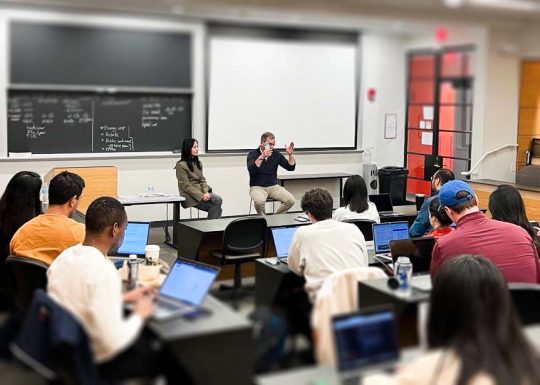
During MIT/CRE's recent 25th Graduation Weekend, the Center presented an overview of the 1K House Project, along with background, designs, plans for prototyping, and results so far.

top

Origins of the 1K House

MIT/CRE Chairman Tony Ciochetti opened the presentation by sharing how he'd first conceived of the concept. "I was thinking about the $100 Laptop idea as I drove through rural areas outside Delhi in India," he said. "When I saw some shelters by the side of the road, the idea for the $1000 house jumped into my head."

Ciochetti explained that soon after, he had met with his friend Yung Ho Chang, Professor of Architecture and Head of MIT's Department of Architecture. Ciochetti had asked if the idea were viable, and Chang enthusiastically embraced it. Chang proposed that his students explore the project as a studio intensive, and that he and Ciochetti teach the studio together. Thus was the 1K House Project born.

Professor Chang opened his presentation by admitting that he is a longtime fan of movies. "I used to watch them a lot," he said, "back when I had time to watch them." One of his favorites was the epic film Lawrence of Arabia. "I remember a scene in which somebody said, 'The only thing that interests Lawrence is what's impossible.' That came to mind when Tony brought me my very own mission impossible."

The project has been underway for about a year, guided by three fundamental principles: affordability, livability, and sustainability. "Our work has been to think through these three real-world limitations," Chang said. The project currently seeks to implement prototypes in three different locations – China, the Philippines, and here in Cambridge – with future prototyping slated for India, Africa, and Central America.

Chang said that the project's biggest success so far is in China. "We can build a house for $1800. In the Philippines the cost is closer to $2000, but that's still pretty good. Our progress is similar to what's happened in the $100 Laptop project. The cost of the actual laptop is closer to $200, but even so, the cost is impressively low. If we build a house for $1800, it'll still be the most inexpensively designed house in China."

top

Designing the 1K House

Chang invited two graduate students from the 1K House design studio – Laura Rushfeldt and Tim Olson – to present a slide show about six of the thirteen studio projects developed so far. These designs are especially intended for the Chengdu area of Sichuan Province, China, where housing needs are particularly pressing due to the recent earthquake.

The Recycled Materials House

As the name implies, this two-story structure uses locally- and regionally-available recycled materials, both to reduce costs and to promote sustainable housing practices. For example, fly ash residue from local coal-burning factories supplements the concrete medium and replaces the more expensive cement component.

In addition, an innovative wall system uses a matrix of recycled glass bottles (at 7 cents apiece) to create a formwork for pouring the concrete walls, with straw bale providing reinforcement.

The roof structure is vaulted. Recycled or resurfaced oil drums serve as a formwork for pouring a concrete roof, which is strong enough to support the planting of a "green" roof on top of that.

The Soft Courtyard House

This design draws heavily on bamboo, which is readily available in China. The frame system of bent bamboo tubes arrives at the site prefabricated, and unfolds like an accordion, making for low onsite costs. The bamboo frame supports a vinyl envelope.

Erected, the house is courtyard-style – traditional in Chinese residential housing. The house can expand to include the courtyard area in nicer weather, which in Southern China is a possibility for much of the year.

The interior includes partitions that can be extended or retracted, allowing flexibility as living or work situations demand.

The Drunken House

The smallest of the IK series, this model resembles a shoe box tipped slightly back along one of its long sides. It is called "drunken" because of its tilting geometry.

This innovative tilting feature serves several functions. First, the face of the house can be angled to maximize exposure to the sun – especially important in northern climates – and is determined according to latitude. In addition, the house can rest on uneven ground, with each corner of the house adjusting to a different height. Finally, the building's tilt allows water to drain easily off the roof.

Reminiscent of the Ikea product model, this house can be packed flat at the factory, shipped with minimal space requirements, and be assembled quickly onsite with relatively little site-work. This house is designed to get occupants under a roof as quickly as possible – especially important when disaster leaves a population homeless.

The Anchor-Pier House

The premise behind this house is that if it is anchored around one set of elements – the piers, which are essentially three concrete towers about eight feet high – the rest of the structure could be relatively light.

Each of the three anchor-piers serves an important household purpose – cooking, bathing, or dining – and each also has multiple functions. For example, the cooking pier also helps to regulate temperature because the cooking flue runs through the cement. The bathing pier includes a rainwater catch. The dining pier includes built-in storage.

Attached to the piers with Velcro is an insulated fabric comprising the interior and exterior walls (which can roll up in good weather). The roof is an insulating rubber compound supported by a system of metal cables connected to the three piers.

The Roof House

This design (pictured above) is composed of two very different systems. The first is the floor and wall system, which can be made locally and inexpensively with rammed earth – a matrix of earth, sand, clay, and 7% concrete for strength and to resist earthquakes.

By contrast, the roof system is shipped to the site, and is lightweight, high-technology, and high-performance. The roof itself is vaulted, and composed of translucent fiberglass to let the sun's light and heat pass through. The roof system is a combination of mechanical blinds and bubble insulation that serves as a radiant barrier, and can be operated like window blinds when the weather is warm. The roof can also be raised or lowered for cross-ventilation.

The Pinwheel House

Of the thirteen models developed thus far, the Pinwheel House is the least expensive, costing about $1800. Essential to the concept for this house is the idea that each dwelling can attach to another, becoming part of a larger communal cluster of several units.

The fundamental element of the pinwheel design is an L-shaped corner – four of which complete a single housing unit. The composition of these L-shaped corner walls would be rammed earth and bamboo. In an innovative twist, the formwork that produces the rammed earth walls can be disassembled and then reassembled to create the roof.

The units would link to each other in a variety of configurations, creating a small village of shared courtyards and private and semiprivate dwellings and cultural spaces.

top

Collaboration Is Key

For their talk at MIT/CRE's graduation weekend, Chang and his students presented just six of the thirteen projects developed so far. Chang echoed what Ciochetti had emphasized at the beginning of the talk – that collaboration has been essential to this project. Not only have MIT/CRE and the School of Architecture been involved, but also MIT researchers in mechanical engineering, information systems, and civil engineering – collaborations that Chang hopes to extend to the Sloan School and elsewhere as the project grows.

For more information, visit the 1K House Project webpage at http://web.mit.edu/1khouse/

top