
The climatological impact of increases in greenhouse gas concentrations in the atmosphere, despite being a subject of intensive study in recent years, is still very uncertain (IPCC, 1990, 1996). One major uncertainty affecting possible climate change that has not received enough attention is the uncertainty in heat uptake by the deep ocean. We analyze the influence of this process and its uncertainty on climate predictions by means of numerical simulations with a 2-dimensional (2D) climate model. In the case of high climate sensitivity, as a result of uncertainty in deep ocean heat uptake, there is more than a factor of two uncertainty in the predicted increase of surface temperature. The corresponding uncertainty in the sea level rise due to thermal expansion is much larger than the uncertainty in the predicted temperature change and is significant even in the case of low climate sensitivity.
The uncertainty in the rate of heat uptake by the deep ocean has not been included in the projections of climate change made by the Intergovernmental Panel on Climate Change (IPCC, 1990, 1996). However, our results show that this uncertainty plays a very important role in defining the ranges of possible warming and, especially, of sea level rise. To assess the uncertainty we have used a 2-dimensional (zonally averaged) climate model, the MIT 2D model (Sokolov and Stone, 1995; Prinn, et al., 1996; Xiao, et al., 1996). This model allows us to perform a much larger number of numerical simulations, than would be possible with a coupled atmosphere ocean general circulation model (AOGCM).
The atmospheric part of the MIT 2D model is a modified version of the zonal mean statistical-dynamical model developed at the Goddard Institute for Space Studies (GISS) (Yao and Stone, 1987; Stone and Yao, 1987, 1990), which is based on the GISS GCM (Hansen, et al, 1983). As a result, most of the model's parameterizations of physical processes are identical to those used in the GISS GCM (Hansen, et al, 1983). A number of modifications have been made to the model at MIT to make it more suitable for climate change studies (Sokolov and Stone, 1995; Prinn, et al., 1996; Xiao, et al., 1996). Model versions with different sensitivities are obtained by imposing a cloud feedback which depends on the increase in surface air temperature (Hansen, et al., 1993). The range of sensitivity (that is, equilibrium response to the doubling of CO2 concentration, DeltaT Additional sets of diffusion coefficients, differing from the standard values by a constant, have been calculated by matching the MIT 2D model's transient warming to those produced by different AOGCMs (see Table 1). In the absence of direct measurements of mixing of heat into the deep ocean, this range gives us one estimate of the uncertainty in the effective value of the diffusion coefficients. The transient response of the 2D model with "standard" ocean heat uptake is similar to that obtained in the simulation with the Geophysical Fluid Dynamics Laboratory (GFDL) AOGCM (Manabe, et al., 1991) (see Figure 1). Five times larger values of the diffusion coefficients are required to match the delay in warming produced by the Max Planck Institute (MPI) and United Kingdom Meteorological Office (UKMO) AOGCMs (Cubash, et al., 1992; Murphy and Mitchell, 1995). (Data for the MPI model have been corrected by taking into account temperature drift in the control simulation.) At the same time, no heat diffusion into the deep ocean is required to reproduce the fast warming produced by the National Center for Atmospheric Research (NCAR) AOGCM (IPCC, 1996). We do not know reasons for these differences, but we note that the amount of deep convective mixing in ocean GCMs is sensitive to the parameterization of subgrid scale mixing (Danabasoglu and McWilliams, 1995).
All simulations discussed below have been performed with a 1% per year increase in the CO2 concentration, while all other forcings were held constant. According to our results, when climate sensitivity is high, even a small change in the rate of heat uptake causes a significant difference in the predicted surface temperature increase. In the simulation with DeltaT Our simulations also show a particularly large impact of the rate of heat penetration into the deep ocean on sea level rise due to thermal expansion (Figure 3). The thermal expansion has been calculated from the deep ocean temperature increase using the method of Gregory (1993). Levitus' data (1982) have been used for the unperturbed state of the deep ocean. In spite of our model's simplified representation of the deep ocean, it reproduces the thermal expansion of the ocean as simulated by the GFDL AOGCM quite well (see Figure 1b). The uncertainty in sea level rise is quite significant even for climate sensitivity as low as 1.5 degrees C.
One might argue that the low effective values of K implied by the NCAR AOGCM, when combined with a high climate sensitivity, is inconsistent with the modest 0.3 to 0.6 degrees C warming of the past century (IPCC, 1996). Then one could agree with the IPCC's upper bound for projections of global mean temperature over the next century (ibid). However, excluding this combination of possibilities would not reduce the uncertainty in projections of sea level rise due to thermal expansion (Figure 3). Also it is not at all obvious that the modest warming to date does exclude this combination, because of the large uncertainties in the cooling caused by increases in tropospheric aerosols (ibid).
Acknowledgment
We thank Ron Stouffer for providing the results of the simulation with the GFDL AOGCM used in Figure 1.
References
Cubash, U., et al., Time-dependent greenhouse warming computations with a coupled ocean-atmosphere model, Climate Dynamics, 8:55-69, 1992.
Danabasoglu, G. and J.C. McWilliams, Sensitivity of the global ocean circulation to paramterizations of mesoscale tracer transports, J. Climate, 8:2967-2987, 1995.
Gregory, J.M., Sea level changes under increasing atmospheric CO2 in a transient coupled ocean-atmosphere GCM experiment, J. Climate, 6:2247-2262, 1993.
Hansen, J., et al., Climate sensitivity: Analysis of feedback mechanisms, In: Climate Process and Climate Sensitivity, J.E. Hansen and T. Takahashi (eds.), Geophysical Monograph, 29, American Geophysical Union, Washington, DC, p. 130-163, 1984.
Hansen, J., et al., Efficient three-dimensional global models for climate studies: Model I and II, Monthly Weather Review, 111:609-662, 1983.
Hansen, J., et al., How sensitive is the world's climate?, National Geographic Research and Exploration, 9:142-158, 1993.
IPCC (Houghton, J.T., ed.), Climate Change, 1995: The Science of Climate Change, Cambridge University Press, 572 pp., 1996.
IPCC (Houghton, J.T., G.J. Jenkens and J.J. Ephraums), Climate Change: The IPCC Scientific Assessment, Cambridge University Press, 365 pp., 1990.
Levitus, S., Climatological atlas of the world ocean, NOAA Professional Paper, 13, Washington, DC, 1982.
Manabe, S., et al., Transient responses of a coupled ocean-atmosphere model to gradual change of atmospheric CO2, Part I: Annual mean response, J. Climate, 4:785-818, 1991.
Murphy, J.M. and J.F.B. Mitchell, Transient response of the Hadely Centre coupled ocean-atmosphere model to increasing carbon dioxide, Part II: Spatial and temporal structure of response, J. Climate, 8:57-80, 1995.
Prinn, R., et al., Integrated global system model for climate policy analysis: I. Model framework and sensitivity studies, MIT Joint Program on the Science and Policy of Global Change, Report 7, Cambridge, MA, 1996.
Sokolov, A.P. and P.H. Stone, Description and validation of the MIT version of the GISS 2D model, MIT Joint Program on the Science and Policy of Global Change, Report 2, Cambridge, MA, 1995.
Stone, P.H. and M.-S. Yao, Development of a two-dimensional zonally averaged statistical-dynamical model, Part III: The parameterization of the eddy fluxes of heat and moisture, J. Climate, 3(7):726-740, 1990.
Stone, P.H. and M.-S. Yao, Development of a two-dimensional zonally averaged statistical-dynamical model, Part II: The role of eddy momentum fluxes in the genneral circulation and their parameterization, J. Atmos. Sci., 44(24):3769-3536, 1987.
Xiao, X., et al., Relative roles of changes in CO2 and climate to equilibrium responses of net primary production and carbon storage of the terrestrial biosphere, Tellus, in press, 1996.
Yao, M.-S. and P.H. Stone, Development of a two-dimensional zonally averaged statistical-dynamical model, Part I: The parameterization of moist convection and its role in the general circulation, J. Atm. Sci., 44(1):65-82, 1987.
Table 1. Response of different AOGCMs and matching versions of the MIT 2D model to a gradual increase of CO2 concentration.
Model DeltaT
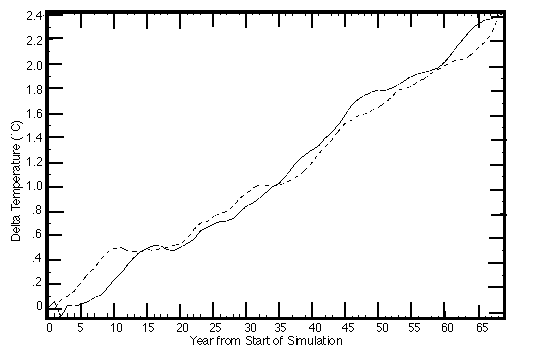
Figure 1a. Global mean surface temperature change caused by a 1% per year increase in CO2 in the simulations with the MIT 2D model with K = 2.5 cm^2s^-1 (solid curves) and the GFDL AOGCM (dashed curves).
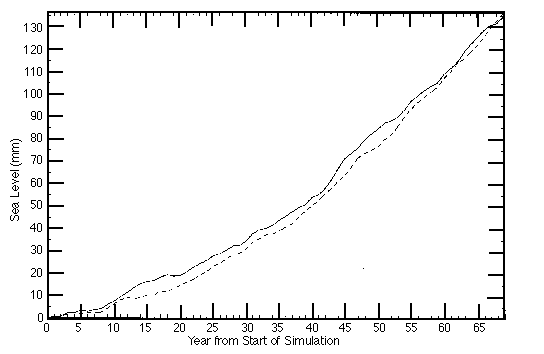
Figure 1b. Global mean sea level rise due to thermal expansion caused by a 1% per year increase in CO2 in the simulations with the MIT 2D model with K = 2.5 cm^2s^-1 (solid curves) and the GFDL AOGCM (dashed curves).
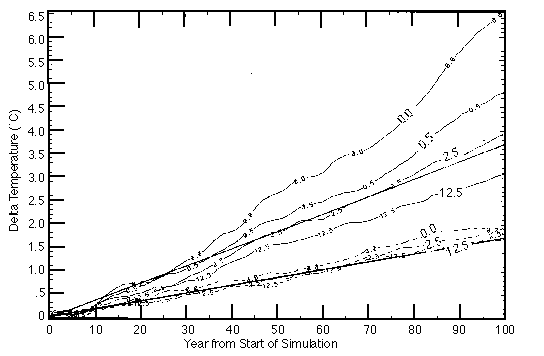
Figure 2. Global mean surface temperature change caused by a 1% per year increase in CO2 in the simulations with DeltaT
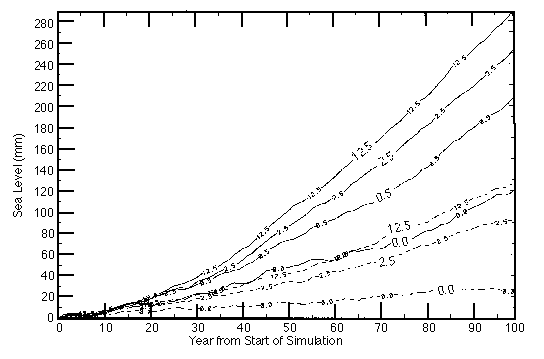
Figure 3. Sea level rise due to thermal expansion caused by a 1% per year increase in CO2 in the simulations with DeltaT
This paper (Report No. 11) is available by request.
(Send an e-mail request now.)
--> Home Page | Report Series | top of page |