There are installations around the world looking for evidence of gravitational waves. They use interferometry to detect the contractions and expansions of space-time.
A proposed installation is LISA--Laser Interferometer Space Antenna.
A team of scientists from the Massachusetts Institute of Technology (MIT) and the California Institute of Technology (CalTech) (plus industrial contractors) have built two facilities to detect gravitational waves.
One facility is near Livingston, Louisiana and the other at Hanford, Washington. They are separated by 2,000 miles which is necessary for the elimination of errors. The facility at Hanford has two interferometers--one with arms 4 km long and the other with 2 km arms. The interferometer at Livingston is 4 km long.
The construction of LIGO was proposed as far back as 1989 and the first stage was completed in June 2000. Data collection started in August 2002. The first LIGO detector is not expected to detect gravitational waves, but it has served to place an upper-bound on gravitational wave sources.
For more data on the LIGO detector, see our in-depth article on LIGO.
VIRGO is a collaboration between two teams--Istituto Nazionale di Fisica Nucleare (Italy) and Centre National de la Recherche Scientifique (France). It is an interferometer with 3km arms on the Arno plain near Pisa, Italy.
Two groups, the Max-Planck Institut für Quantenoptik in Germany and the University of Glasgow in the UK, teamed up in 1989 to build their interferometer with 3km arms--GEO. Unfortunately, this project was unable to get funding and the teams proposed a smaller interferometer in 1994 with arms 600m long--GEO 600. GEO 600 is in the lowlands near Hanover, Germany. Data collection began in 2001 and the first results were published in 2002.
TAMA is organized by:
This interferometer is near Tokyo, built at NAO. Each arm is 300m
Their eighth data taking session finished in April 2003 and totaled 1158 hours.
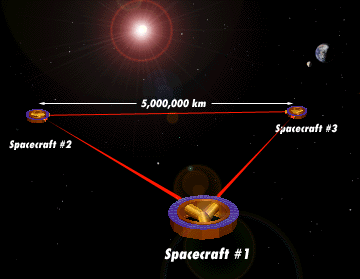
LISA is a proposal by The North American Space Agency (NASA) and the European Space Agency (ESA) to send an interferometer into space.
The proposal is that three spacecraft fly 5 million kilometers
apart in a triangle formation as shown:
Approval is expected in 2004 with a launch in 2011.
For more data on the LISA detector, see our in-depth article on LISA.
The interferometry installations aim to detect gravitational waves and so provide the most stringent test of Einstein's General Relativity (GR). GR has been tested and found to be correct in our own solar system (for example, the advance of the perihelion of Mercury) but gravitational waves are produced in rapidly changing, dynamical systems such as black holes colliding. If GR holds in such a different system, then we can have more faith in its correctness.
Predictions of GR such as the existence of gravitational waves, the mass and rate of spin of the graviton and the behavior of space-time around colliding black holes will be tested.
The interferometers will be able to map the gravitational wave sources and produce a picture of the universe that we are unable to reproduce with study of electromagnetic radiation. Bodies that emit gravitational may not emit electromagnetic waves and so are currently invisible to us. Also, electromagnetic waves are often absorbed by dust and so never reach us but gravitational waves are not easily absorbed and so will reach us from larger distances. This lack of interaction between gravitational waves and matter will allow us to probe the depths of the universe--but it also makes detection of the gravitational waves very difficult.
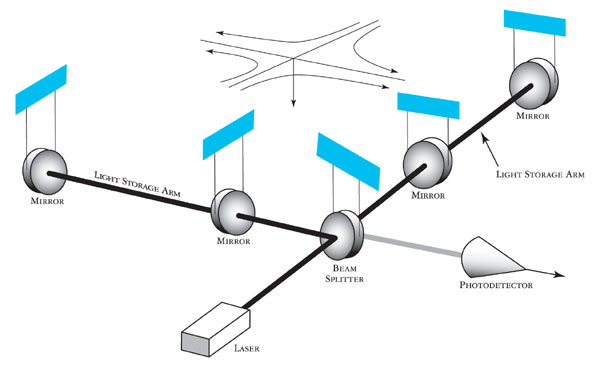
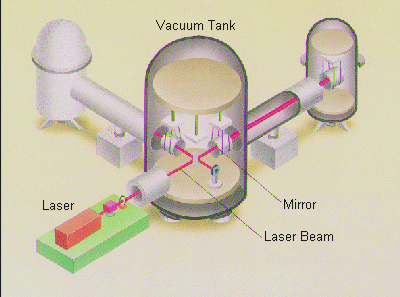
A gravitational wave is predicted to stretch space-time in one direction and contract it in the perpendicular direction. Changes in the distance along the arms are detected by looking at the interference pattern of light sent along the arms. A change would send the two beams out of phase and so would cause interference.
The changes in space-time are very slight. The arms of the interferometer are 4 km long and the change in length due to stretching/contracting is expected to be 10^-18m--that's much smaller than an atom.
The interferometer is affected by things other than gravitational waves, for example, seismic movement, acoustic noise, laser fluctuations and gas molecules in the air. This is why there are many installations working together. If there is a real gravitational wave, all interferometers should detect it. If it is an error caused by a micro-earthquake, say, then only one interferometer will be affected and so the genuine gravitational waves will be identified.
Ground-based interferometers look between 10 and 1000Hz where they expect to see such events as low-mass black hole or neutron star binaries spiral in towards each other, low-mass black hole mergers and ring-downs and fast spinning neutron stars (pulsars). VIRGO in particular expects to see coalescence of binary systems in the Virgo cluster.
LISA can detect much lower frequencies--10^-4 to 10^-1 Hz.