Skip to content


Massachusetts Institute of Technology

Master of Engineering in Manufacturing

Why Manufacturing?

Careers

Why MEng?

Academics

Industrial Projects

Faculty

Apply

Application

Financial

Academics

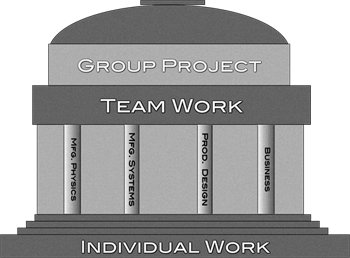
The Master of Engineering in Manufacturing is designed to give students a broad and solid understanding of the core principles of manufacturing. Students take a comprehensive curriculum of Process and Assembly Physics, Factory and Supply Chain Systems, Product Design, and Business Fundamentals and Operational Excellence subjects. The capstone activity is a Group Project done in a Manufacturing Company and leading to a Project Thesis

The curriculum comprises 4 course-based components: manufacturing physics, manufacturing systems, product design and business fundamentals.  Each involves both individual and team work on class projects.  The classes are followed by a 3 month group project in a manufacturing industry. 

A typical schedule of an MEng in Manufacturing student:

Fall

IAP

Spring

Summer

2.810
Manufacturing Processes and Systems

Begin Group Project

2.830J
Control of Manufacturing Processes

Group Project at a Local Company

2.854
Introduction to Manufacturing Systems


ESD 267/268
Supply Chain Planning & Design


2.691
Management for Engineers


2.739J
Product Design and Development


2.875
Assembly


2.888
Professional Seminar


Fall Term

During the fall term, students take four courses—a total of 48 units. The following are required unless similar prior classes can be demonstrated:

2.810 Manufacturing Processes and Systems

http://web.mit.edu/2.810/www/
(Gutowski)
Introduction to manufacturing systems and manufacturing processes including assembly, machining, injection molding, casting, thermoforming, and more. Emphasis on the relationship between physics and randomness to quality, rate, cost, and flexibility. Attention to the relationship between the process and the system, and the process and part design. Project (in small groups) requires fabrication (and some design) of a product using several different processes (as listed above).

2.854 Introduction to Manufacturing Systems

http://stellar.mit.edu/S/course/2/fa06/2.853/index.html
(Gershwin)
Provides ways to analyze manufacturing systems in terms of material flow and storage, information flow, capacities, and times and durations of events. Fundamental topics include probability, inventory and queuing models, forecasting, optimization, process analysis, and linear and dynamic systems. Factory planning and scheduling topics include flow planning, bottleneck characterization, buffer and batch-size tactics, seasonal planning, and dynamic behavior of production systems.

2.961 Management for Engineers

http://stellar.mit.edu/S/course/2/fa07/2.96/index.html
(Chun)
Provides an overview of management issues for graduate engineers. Topics approached in terms of career options as engineering practitioner, manager, and entrepreneur. Specific topics include semantics, finance, starting a company, and people management. Through selected readings from texts and cases, focus is on the development of individual skills and management tools. Requires student participation and discussion, term paper.

2.875 Mechanical Assemblies: Their Design, Manufacture, and Role in Product Development

http://stellar.mit.edu/S/course/2/fa07/2.875/index.html
(Whitney)
Introduces mechanical and economic models of assemblies and assembly automation on two levels. Assembly in the small comprises basic engineering models of rigid and compliant part mating and explains the operation of the Remote Center Compliance. Assembly in the large takes a system view of assembly, including the notion of product architecture, feature-based design and computer models of assemblies, analysis of mechanical constraint, assembly sequence analysis, tolerances, system-level design for assembly and JIT methods, and economics of assembly automation. Case studies and current research included. Class exercises and homework include analyses of real assemblies, the mechanics of part mating, and a semester long project.

JANUARY TERM (IAP)

In January, MST students begin their Group Projects in Industry. They also participate in other activities during this Independent Study Time. 

SPRING TERM

During the spring term students take three courses and a seminar (a total of 39 units), and work on their Group Projects.

2.830J* Control of Manufacturing Processes

http://stellar.mit.edu/S/course/2/sp07/2.830/index.html
(Hardt & Boning)
Statistical modeling and control in manufacturing processes. Use of experimental design and response surface modeling to understand manufacturing process physics. Defect and parametric yield modeling and optimization. Forms of process control, including statistical process control, run by run and adaptive control, and real-time feedback control. Application contexts include semiconductor manufacturing, conventional metal and polymer processing, and emerging micro-nano manufacturing processes.

ESD 267/268J Manufacturing System and Supply Chain Design

http://stellar.mit.edu/S/course/15/sp07/15.763/index.html
(Graves & Simchi-Levi)
Focuses on decision making for system design, as it arises in manufacturing systems and supply chains. Students exposed to frameworks and models for structuring the key issues and trade-offs. Presents and discusses new opportunities, issues and concepts introduced by the internet and e-commerce. Introduces various models, methods and software tools for logistics network design, capacity planning and flexibility, make-buy, and integration with product development. Industry applications and cases illustrate concepts and challenges.

2.739J Product Design and Development

http://web.mit.edu/15.783j/www/
(Tor)
Covers modern tools and methods for product design and development. The cornerstone is a project in which teams of management, engineering, and industrial design students conceive, design, and prototype a physical product. Class sessions employ cases and hands-on exercises to reinforce the key ideas. Topics include: product planning, identifying customer needs, concept generation, product architecture, industrial design, concept design, and design-for-manufacturing.

2.888 Pro-Seminar in Global Manufacturing and Entrepreneurship

http://stellar.mit.edu/S/course/2/sp07/2.888/index.html
(Hardt and Gershwin)
Students also begin their thesis project in the spring. This thesis project continues through the summer term, when students participate in industry-based group projects. This full-time project gives students a chance to apply their understanding of manufacturing fundamentals to real problems and make real-world improvements in process, material flow and logistics.

SUMMER

The key activity of the summer is the Group Project.  The full time work at the companies ends in the middle of August.  The MIT Project Thesis is completed in late August.