
Digital Programs

CYBERSECURITY
Technology • Applications • Policy
Dates: SEPT. 15 - OCT. 27, 2015 | More dates to be announced
Fee: $545 (introductory price)
CEUs: 2.0
Course Overview | Earn a Certificate of Completion | Earn CEUs | Course Outline | Instructors | Location
Individual Registrations

Click here to be notified when registration opens
Course Overview
This online program will explore fundamental technologies and applications in Cybersecurity. By examining security challenges in hardware, software and cryptography, this program will introduce the latest research that can help organizations move from ‘patch and pray’ defenses to security ‘by default’. In addition, this course will also use case studies to illustrate the impact of the emerging technologies and look at the policy implications impacting the field. The program will be taught by a team of world-renowned experts from the MIT Computer Science and Artificial Intelligence Laboratory (CSAIL).
The course is held over six weeks and will provide the following:
- Five modules covering 14 topic areas with 20 hours of video
- Assessments to reinforce key learning concepts of each module
- Case studies
- Discussion Forums for participants to discuss thought provoking questions posed by the MIT faculty teaching the course; share, engage, and ideate with other participants
- Community Wiki for sharing additional resources, suggested readings, and related links
Participants will also take away:
- Course materials from all presentations
- 90 day access to the archived course (includes videos, discussion boards, content, and Wiki)
Individual sessions include:
- Hardware Architectures for Security
- Operating System Security
- Network Security and Protocol Design
- Secure Programming Languages
- Verifying Systems
- Public Key Cryptography
- Multi-party Computation, Secrecy Sharing, Distributed Trust
- Homomorphic and Functional Encryption
- The Landscape of Cyber Policy
In addition, case studies examining the following will be introduced:
- Bitlocker
- Resilient Software
- Web Security
- Mobile Phone Security
MIT Professional Education Alumni Benefits
After successfully completing Cybersecurity, participants will become alumni of MIT Professional Education and will receive all the associated benefits and courtesies listed below:
- Receive exclusive discounts on all future Short Programs and Digital Programs courses
- Access will be provided to our restricted MIT Professional Education alumni group on LinkedIn; this includes invites to join all MIT Professional Education social media platforms
- Networking opportunities with other individuals from around the globe working in a variety of industries, including technology, computer science, entrepreneurship, science, research, Big Data, and many others
- Email distribution of our MIT Professional Education newsletter
- Finally, participants will join the MIT Professional Education alumni mailing list where they will receive advanced notice regarding special announcements on upcoming courses, programs, and events
Earn a Certificate of Completion
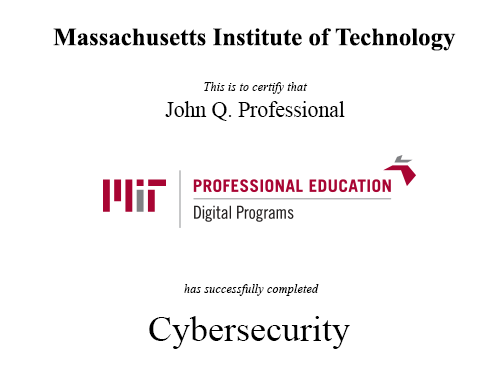
Upon successful completion of the course a Certificate of Completion will be awarded by MIT Professional Education.
To earn a Certificate of Completion in this course, participants should watch all the videos, actively participate in the discussion boards, and complete all assessments by the course end date, with an average of 80 percent success rate.
The Certificate of Completion will be awarded by MIT Professional Education.
Grading: Grades are not awarded for this course.
Sample Certificate of Completion:
 |
Earn MIT Professional Education Continuing Education Units (CEUs)
Participants of Cybersecurity who successfully complete all course requirements are eligible to receive 2.0 Continuing Education Units (2.0 CEUs).
CEUs are a nationally recognized means of recording non-credit/non-degree study. They are accepted by many employers, licensing agencies, and professional associations as evidence of a participant’s serious commitment to the development of a professional competence.
CEUs are based on hours of instruction. For example: One CEU = 10 hours of instruction.
CEUs may not be applied toward any MIT undergraduate or graduate level course.
Course Outline
Module One: Introduction
- Course Introduction – Howard Shrobe
- Security Overview – Srini Devadas
Module Two: Systems Security
- Hardware Architectures for security – Howard Shrobe
- Operating System Security – Frans Kaashoek
- Network Security and Protocol Design – Dave Clark
- Verifying Systems – Adam Chlipala
- Secure Programming Languages – Armando Solar-Lezama
Module Three: Cryptography and Network Security
- Public Key Cryptography – Ron Rivest
- Multi-party Computation, Secret Sharing, Distributed Trust – Shafi Goldwasser
- Homomorphic and Functional Encryption – Vinod Vaikuntanathan
Module Four: Case Studies
- Bitlocker – Nicolai Zeldovich
- Resilient Software – Martin Rinard
- Web Security – Daniel Jackson
- Mobile Phone Security – Nickolai Zeldovich
Module Five: Policy
- The Landscape of Cyber Policy – Danny Weitzner
Instructors
Faculty Co-Directors:
 |
Daniela Rus |
 |
Howard Shrobe |
Additional Faculty Instructors:
 |
Adam Chlipala |
 |
David Clark |
 |
Srini Devadas |
 |
Shafi Goldwasser |
 |
Daniel Jackson |
 |
Frans Kaashoek |
 |
Martin Rinard |
 |
Ronald Rivest |
 |
Armando Solar-Lezama |
 |
Vinod Vaikuntanathan |
 |
Danny Weitzner |
 |
Nicolai Zeldovich |
 |
MIT Professional Education |
 |
Computer Science and Artificial Intelligence Laboratory (CSAIL) |
Location
This course takes place online.
