This section shows results for the inspiral of bodies that are ``circular'': limiting to constant Boyer-Lindquist radius in the absence of radiation reaction, but spiralling through a sequence of orbits of gradually changing radius and inclination when radiative effects are included. The formalism used to compute gravitational waves and backreaction on these circular orbits is presented here:
S. A. Hughes, Phys. Rev. D 61, 084004 (2000).
(Some of the results that were incorporated into that paper can be found here.) I next developed techniques for taking that formalism and actually computing gravitational waveforms and quasi-circular inspiral trajectories. These techniques are described (along with major results) in the following paper:
S. A. Hughes, Phys. Rev. D 64, 064004 (2001).
I found that it is necessary to interpolate the radiation reaction data using two dimensional cubic spline interpolation; linear interpolation noticeable affects the gravitational-wave phasing. To illustrate this, compare the following two sounds. The both correspond to inspiral in the equatorial plane (iota = 0 degrees) of a black hole with a = 0.95 M. Only the l = 2 data is included; this is enough to make the illustrate the point.
In the second case, you should be able to hear quite easily the points at which the inspiraling body crosses a grid domain; it sounds like a car shifting gears.
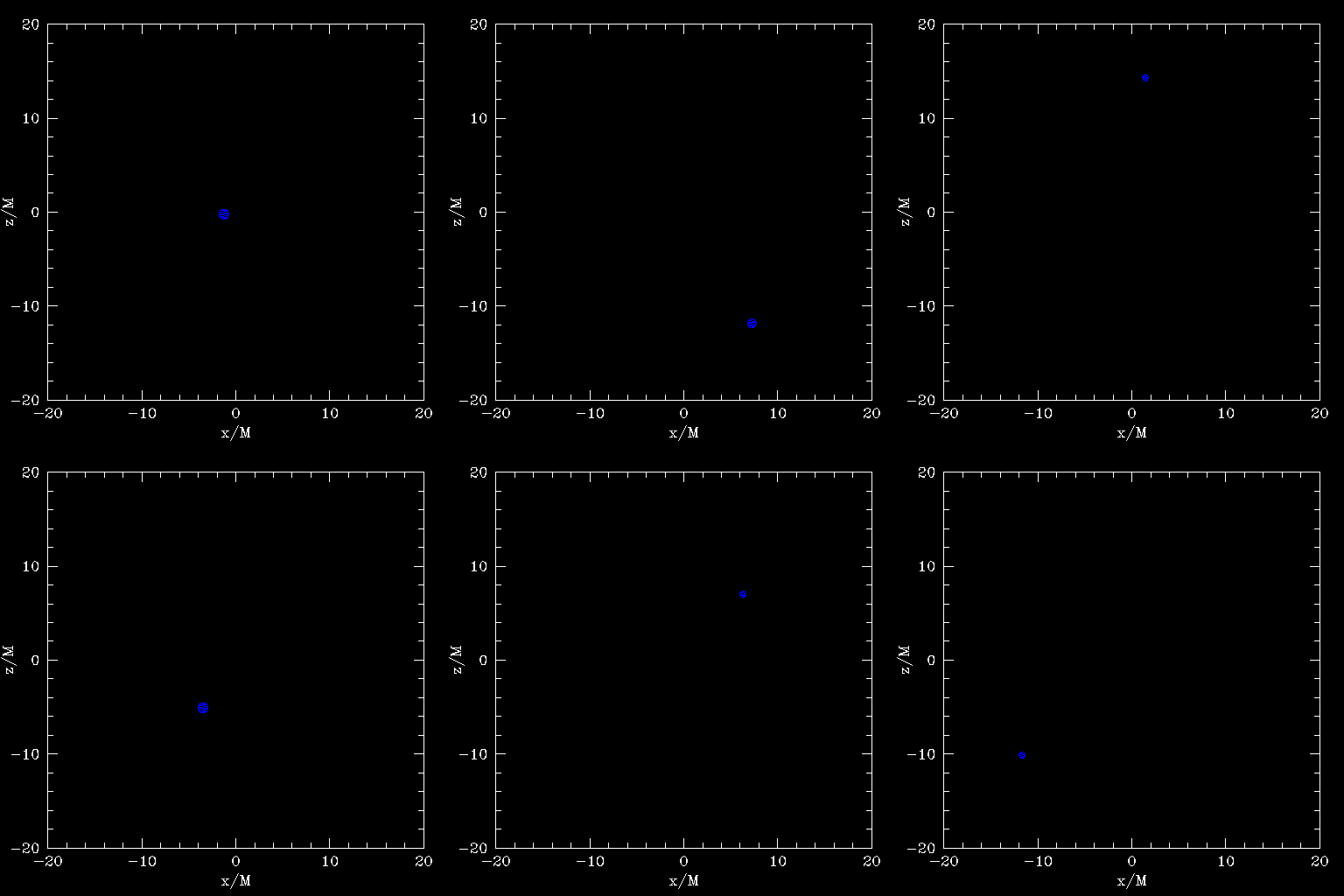
Here is the ``appearance'' down the hole's spin axis.
Here is the ``appearance'' in the hole's equatorial plane.
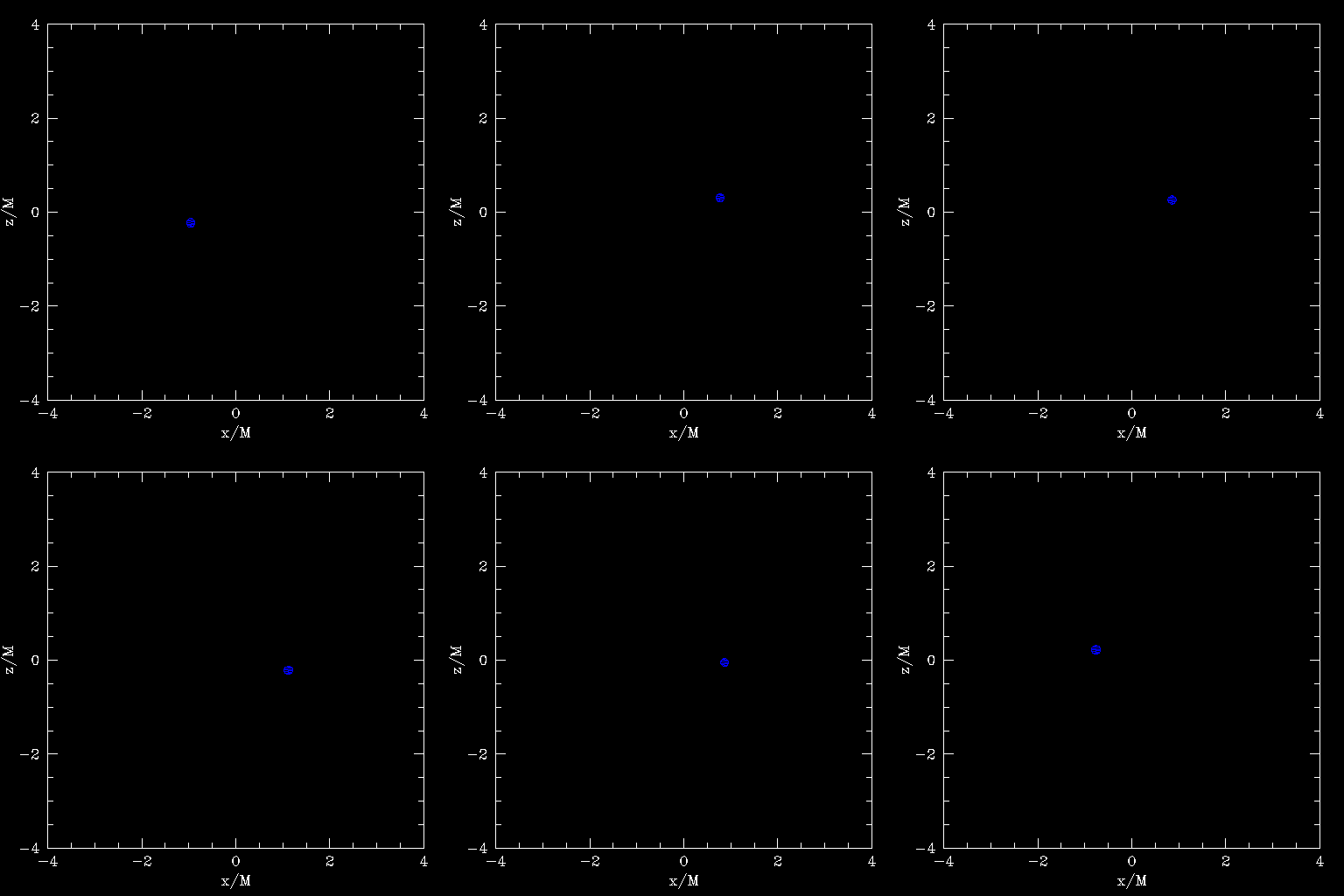
Next, a film for a closer orbit: tilt angle iota = 13.83 degrees, eccentricity e = 0.52, and semi-latus rectum p = 1.73 M. This body comes in to Boyer-Lindquist radius r = 1.14 M, and goes as out to r = 3.58 M. The black hole has spin a = 0.998 M. NOTE: in this animation the frames are evenly spaced in Boyer-Lindquist time (yes, the code is evolving...), so that this more nearly corresponds to what an observer at infinity would ``see''. This orbit was selected by my collaborator Teviet Creighton, who is busily finding lots of goofy orbital features for us to ponder.
Here is the ``appearance'' in the hole's equatorial plane.
A code for implementing this is now working well enough that Teviet and I are able to get first results out. Here are some sounds for inspiral into a hole with a = 0.95M.
Initial p = 5M, initial e = 0.2, inclination
angle = 25 degrees.
The plus polarization
(.au format).
The plus polarization
(.wav format).
Initial p = 5M, initial e = 0.7, inclination
angle = 25 degrees.
The plus polarization
(.au format).
The plus polarization
(.wav format).
Initial p = 5M, initial e = 0.95, inclination
angle = 25 degrees.
The plus polarization
(.au format).
The plus polarization
(.wav format).
Initial p = 5M, initial e = 0.95, inclination
angle = 60 degrees.
The plus polarization
(.au format).
The plus polarization
(.wav format).
All of these sounds are for observation down the hole's spin axis. The mass ratio is M/mu = 3500; the total mass is set in such a way that the whole wave lies nicely in the human audio band.
Here are some sounds for inspiral into a hole with a = 0.998M.
Initial p = 2.2M, initial e = 0.95, inclination
angle = 20 degrees.
The plus
polarization (.au format).
The plus
polarization (.wav format).
Initial p = 2.5M, initial e = 0.97, inclination
angle = 20 degrees.
The plus
polarization (.au format).
The plus
polarization (.wav format).
All sounds are for observation down the hole's spin axis. The mass ratio is M/mu = 15000; the total mass is set in such a way that the whole wave lies nicely in the human audio band.
The kludge used to make these sounds is particularly crude. A paper by myself, Kostas Glampedakis, and Daniel Kennefick will appear soon that improves on this calculation and carefully codifies an easy-to-use kludge that can be used to develop approximate inspiral waveforms. These approximate waveforms will be used to explore LISA data analysis issues while more rigorous codes and computations are developed.