|
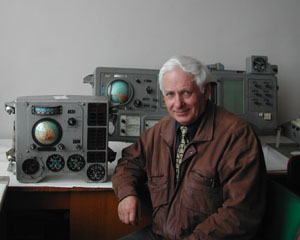 |
Interview with Yurii Tiapchenko
Conducted on-line in October 2002 - March 2003
Yurii Tiapchenko graduated from the Moscow
Power Engineering Institute
in 1961 and joined the Flight Research Institute in Zhukovskii near
Moscow. He worked on information display systems (IDS) for all Soviet
piloted spacecraft, except the Vostok. In 1967 the Specialized
Experimental Design Bureau led by Sergei Darevskii was formed within
the Institute, and this Bureau was appointed the lead organization in
the country for the development of IDS. In 1971 the Bureau separated
from the Institute and became an independent organization. In 1983 the
Bureau was transferred to the Scientific Research Institute of Aviation
Equipment, which was formed on the basis of one of the branches of the
Flight Research Institute. In 1997 the Bureau was restructured and
renamed
the
Specialized Experimental Design Bureau of Space
Technology.
Tiapchenko supervised the design and development of IDS for the service
module of the Mir space station, for the International Space Station,
and for the modernized piloted spacecraft Soyuz-TMA. In 1993-2002, he
was deputy Chief Designer and the head of the Division of Onboard
Information Display Systems at the Bureau. Yurii Tiapchenko's articles,
"IDS for Russian Spacecraft: An Overview",
"IDS for Russian Spacecraft: Generations I and II",
"IDS Generations III, IV, and V",
"IDS for Soyuz-T/TM and the MIR Space Station,",
and
"IDS for Soyuz-TMA and the International Space Station," are posted in the
Essays section of this website.
This interview was conducted and translated from the Russian by Slava
Gerovitch. This interview was published in the collection: Slava Gerovitch, Voices of the Soviet Space Program: Cosmonauts, Soldiers, and Engineers Who Took the USSR into Space (Palgrave Macmillan, 2014).
|
Gerovitch: What are the major problems in the design of information display systems (IDS) for spacecraft?
Tiapchenko:
From the first years of space exploration to the present
the main
problem is to design display systems capable of
working in a vacuum
in case of
spacecraft depressurization, and also in case of higher
pressure during
pressurization tests on the ground. Other requirements
include
fire-proof and hygienic
features and weight and reliability specifications. At the
present the
most important problem is the design of a human-machine
interface.
Gerovitch:
What are the criteria of success? Tiapchenko:
Tests must confirm that a product meets its specifications.
Gerovitch: In case of contradictory demands, how
do you set priorities?
Tiapchenko:
Priority is always given to functionality and reliability.
Weight, size, and other such requirements serve simply as
limitations.
Gerovitch: Who formulates technical
specifications for IDS?
Tiapchenko:
The common practice in Russian cosmonautics is as follows: the
customer provides some initial data in a general form, and
the contractor formulates the technical specifications for IDS: the structure, functional requirements, and technical
requirements. Operational requirements are set by the
customer. The technical specifications are then
signed by the customer and agreed upon by the contractor. In our experience, technical specifications are often developed by the contractor and
agreed upon by the customer. Nevertheless, formally speaking, the
customer is listed as the author of the technical specifications.
Gerovitch:
Do any arguments occur in this process? How are these arguments resolved?
Tiapchenko:
Surely there are arguments, and they are sometimes quite harsh. In
practice, the technical specifications are often finally signed
only after the IDS design is completed. When an IDS was
developed for the Almaz space station, its technical
specifications were signed only during factory tests.
Disagreements are usually settled with the help of the
chief designer of the spacecraft in question.
Gerovitch:
Who carries out quality control?
Tiapchenko:
In the Soviet Union and in Russia quality control at all
stages of the lifecycle of spacecraft equipment is carried
out by the technical control department and by a
representative from the Ministry of Defense, even if the
customer for a given spacecraft is the Academy of Sciences
or another ministry. This approach has made it
possible to produce high quality equipment.
Gerovitch: Has the experience gained in the design of IDS in other fields been used in the design of IDS for spacecraft?
Tiapchenko:
The experience gained in aviation was widely used in the design
of IDS for the first generation of manned spacecraft. For example, the
IDS for Vostok
employed the same principles of design and construction of
three-arrow gauges that were used in aviation. The
designers also borrowed from aviation some controls
(tumbler switches, push-button switches, and current
protection devices), the principles and means of
construction of a visual emergency warning system, the
specifications for a sound warning system, the ergonomic
requirements for various elements of IDS, the arrangement
of instrument boards and control panels and their location
in the cabin, and so on.
In the Soviet Union the approach to the role of a human on
board drastically differed from the the United States. Soviet
spacecraft were designed to be capable of
carrying out all flight tasks automatically according to
instructions from the ground. This created a major
difference between cosmonautics and aviation. In aviation
a human on board had the priority in control tasks,
while in cosmonautics the priority was given to automata
and to a human in a ground control center.
For this reason, the designers of IDS faced a difficult
problem of including the human in the control loop.
We asked specialists in engineering psychology from various universities to help
solve this problem. Sergey Korolev, Konstantin Feoktistov, Yu.P. Karpov, V.A.
Timchenko (of the Energia Corporation), V.A. Ponomarenko, V.P. Zinchenko, and
others made significant contributions to the solution of this problem.
My personal contribution, I think, consisted in the early
decision to divide IDS for manned spacecraft into two
categories: transport ships and long-term space stations.
Gerovitch:
What is the difference in the IDS for space ships and for
space stations?
Tiapchenko:
For the former, major tasks are orbit correction, approach and
docking, re-entry and landing, and so on. Transport ships must be
capable of changing the position of its center of gravity and its
velocity within a wide range. In this case, the main problems, such as
guidance, are similar to aviation.
Space stations, which are living quarters with conditions suitable for specific
activities, belong to a different category. In the design of IDS for space
stations one could borrow ideas from power industry, for example. Our own
experience with adapting space station IDS design principles to the design of
IDS for nuclear power stations and vice versa confirms this assumption. In some projects,
one could easily substitute the words "space station"
with "nuclear power station" and nobody would notice the
difference. Thus one can definitely argue that experience
gained in the design of IDS for large ground systems has
been used in the design of IDS for spacecraft.
Gerovitch:
Did any cosmonauts participate in the design and testing of IDS for spacecraft? Did their suggestions influence the
design of IDS?
Tiapchenko:
Cosmonauts have played practically no part in the design of IDS
for all spacecraft, except for Buran and Almaz. The cosmonauts have always
played an active role in the testing of an ergonomic IDS interface. Without
them, a permission to use an IDS on board cannot be issued. The cosmonauts play
a particularly important role in the testing of indicators on electronic IDS, in
evaluating the difficulty of reaching for controls while in a space suit, and so
on.
In the early years of cosmonautics, on Sergei Darevsky’s initiative, regular
meetings were organized at the Flight Research Institute with cosmonauts after
their return to Earth. The cosmonauts' comments were always taken into
account.
In the past few years cosmonauts made a significant input
in the design of a human-computer interface for the IDS of
the Soyuz-TMA, the first spacecraft controlled by a
personal computer. They succeeded in defending a
conservative approach to the design of this interface.
Gerovitch:
Did any institutes of the Academy of Sciences participate in the design of IDS? Did their suggestions influence
design decisions?
Tiapchenko:
Several institutes carried out engineering psychology
research on the efficiency of operator work with
proposed IDS and controls, evaluated various methods of
human-machine interaction, developed ergonomic requirements
for IDS as a whole and for individual components. The
Pavlov Institute carried out research on optimization of
the design and technical characteristics of compact hand
controllers for spacecraft guidance. Russia was the first
in the world to introduce a hand controller instead of a
control column. This was possible only after extensive
research done on simulators and centrifuges.
The Psychology Faculty of Moscow State University studied characteristic of
human reception of information and developed methods and criteria for evaluating
information display devices, control devices, and information representation
methods.
The Medical Faculty of Moscow State University carried out
experiments on human locomotion. They obtained more precise
data about finger, wrist, and elbow joints. G.B. Korenev of
the Moscow Physical Technical Institute, in turn, used
these data to develop a more accurate model of human
locomotion.
The department of higher nervous activity of the Biology
Faculty of Moscow State University for many years studied
the principles of designing manual control systems with the
hierarchical selection method. This research resulted in
the concept of step-by-step development of such systems.
This concept was implemented in the IDS for the Mir space
station, the International Space Station, the Zond
spacecraft, the N1-L3, and the Soyuz-TMA.
A number of institutes worked on methods of evaluating the
ppsychological and physiological condition of the cosmonaut and methods of controlling
this condition. Particular attention was given to detecting
and eliminating drowsiness.
Gerovitch:
What was the role of the head of the Specialized Experimental
Design Bureau Sergey Darevskii as an engineer and as an administrator?
Tiapchenko:
He was a very talented organizer; he had an amazing
intuition for innovation. For him, there was no unsolvable problem. He had wonderful memory
and a well-developed analytical mind, and he caught new
ideas literally in mid-air and tried to implement them
right away. This happened constantly.
He created a new type of organization. In those days,
working under the Ministry of Aviation Industry, one could
defend a new approach only by perseverance, fanatic
persistence, skillful maneuvering among the top leadership,
and by bringing the Party apparatus over to one's side.
Darevskii was one of the few who managed to gain support in
the apparatus of the Party Central Committee, despite the
fact that local Party activists at the Flight Research
Institute raised the question of expelling him from the
Party.
In the early years, he skillfully arranged cooperation with
other firms and also sought support from academic researchers. He was the first to put forward the idea of a
unified instrument board, and he did everything to
implement this idea not only in cosmonautics, but also in
aviation.
He paid close attention to the propaganda of scientific achievements. He
organized workshops and conferences on IDS. He took an active part in the
organization of national scientific research projects in ergonomics. In the
first government resolution on this issue, his Specialized Experimental Design
Bureau of the Flight Research Institute was assigned the lead role in these
projects. After he was relieved of his duties as the head of the Bureau,
however, the lead role was reassigned to the Flight Research Institute.
Darevskii played a prominent role in the Interagency Coordination Council for
IDS. Due to
his efforts, this Council was created
and worked continuously through all the changes in the
political regime.
He also had some character traits that were unpleasant for
people working with him. However, after all these years,
one can safely conclude that these traits could not have
done greater harm than his actual removal from the
leadership in the field that he created.
Gerovitch: What were the relations between Darevskii and Korolev? Did
Korolev participate in technical discussions
related to IDS design?
Tiapchenko:
Korolev treated Darevskii with great respect. Once, Darevsky
requested a personal meeting to explain a
new approach to the design of IDS. This happened during the
work on the IDS for a spacecraft with artificial gravity.
For that system, contrary to the request of Korolev's firm, we
proposed a matrix method of selecting the object of control. This solution
allowed us to solve the problem of
information display and satisfy the given requirements for
reliability, weight, and power efficiency. A transition to
this new system required, however, significant changes in
the onboard complex control system. Certain departments of
the Experimental Design
Bureau No. 1 openly opposed this change, and we had to
appeal to Korolev himself. He approved our proposal, and shortly we made a
transition to a new generation
of IDS. Generally, Korolev took the problem of human on
board very seriously. He provided huge support to the
establishment of a new research field at the Flight
Research Institute, the field proposed and led by Darevskii.
 Gerovitch: According to the candidate
cosmonaut Valentina Ponomareva's
recollections, the design of the hand controller on
the Vostok spacecraft differed significantly from the
design of a regular aircraft control column. The back-and-forth movement had the same function on both: it
regulated
the pitch. The functions of the right-to-left movement,
however,
turned out to be different: on aircraft it was the roll (if
the column is pushed to the left, the aircraft rolls to the
left), while on Vostok it was the yaw (if the controller is
pushed to the left, the nose of the aircraft turns to the
left). The roll on Vostok was controlled with the rotating
knob of the hand controller - the third axis, which, as
Ponomareva thought, could have been used to control the yaw
(which on aircraft was controlled by pedals). As a pilot,
she was used to the regular aircraft hand controls and had
difficulty adjusting to the new design. Why was this
specific design chosen for the spacecraft hand
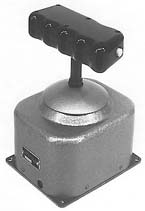
controller? Gerovitch: According to the candidate
cosmonaut Valentina Ponomareva's
recollections, the design of the hand controller on
the Vostok spacecraft differed significantly from the
design of a regular aircraft control column. The back-and-forth movement had the same function on both: it
regulated
the pitch. The functions of the right-to-left movement,
however,
turned out to be different: on aircraft it was the roll (if
the column is pushed to the left, the aircraft rolls to the
left), while on Vostok it was the yaw (if the controller is
pushed to the left, the nose of the aircraft turns to the
left). The roll on Vostok was controlled with the rotating
knob of the hand controller - the third axis, which, as
Ponomareva thought, could have been used to control the yaw
(which on aircraft was controlled by pedals). As a pilot,
she was used to the regular aircraft hand controls and had
difficulty adjusting to the new design. Why was this
specific design chosen for the spacecraft hand
controller?
Tiapchenko:
Aircraft are controlled according to the laws of
aerodynamics, while spacecraft are controlled according to
the laws of rocket technology and celestial mechanics.
Aircraft have a two-axis hand control column, which, along
with the aircraft engines, controls movement in all
directions. On spacecraft, three-axis hand controllers are
used. To control the position of a spacecraft with respect
to its own axes and its longitudinal movement, one needs
two three-axis hand controllers. As you can see, there is a
huge difference right there.
On Vostok, the hand controller is located roughly
parallel to the longitudinal axis, while an aircraft
control column is located perpendicular to the longitudinal
axis [see the Vostok-Mercury comparison
page]. On aircraft, the pilot looks forward through
the cockpit glass, while on spacecraft the cosmonaut looks
at the Earth downward through an observation porthole. On
Vostok, this optical orientation device was called Vzor.
The hand controller was designed in such a way that the
movements of the spacecraft would correspond closely to the
direction of the hand movement. If the hand controller is
located parallel to the longitudinal axis, the
right-to-left movement of the hand should correspond to the
right-to-left movement of the spacecraft nose (the yaw),
and the rotating knob should correspond to the rotation of
the spacecraft (the roll).
There could be no mistake here, since this design was
developed by experts in aviation technology in consultation
with the well-known test pilot Mark Gallai and with
specialists from the Institute of Aviation and Space
Medicine and from the Zhukovskii Air Force Engineering Academy. The
first group of cosmonauts participated in the evaluation of
this system. All their suggestions were taken into
account.
Gerovitch:
Did any cosmonauts later complain about this design?
Tiapchenko:
Let me quote the leading specialist in spacecraft
simulator design Dr. Evgenii Konstantinovich Nikonov, a
senior researcher at the Scientific Research Institute of
Aviation Equipment. He recalls training sessions on the TDK-7K simulator at the Gagarin Cosmonaut Training Center:
The
cosmonaut Georgii Beregovoi was the first to point out to
me that the yaw and the roll controls were rearranged. I
remember how he climbed into a simulator cabin and asked me
bluntly, in his usual manner: "Listen, I am controlling the
yaw, and the picture is rotating as if I were controlling
the roll. What is this?" I answered by quoting the stand-up
comedian Arkadii Raikin: "'Forget the induction, just give
me production.' Forget words like yaw and roll and
all the thetas and gammas from technical manuals and
instructions. Those were written by engineers in a hurry
under deadlines, and they did not know engineering
psychology (there was no ergonomics back then). Just look:
you push the controller to the left, and the picture goes
to the left, correct? You rotate the knob, and the picture
rotates, correct? Then all this must be correct!" He
thought it over and understood. Later other cosmonauts also
came to me for explanations.
There were
also many questions about the orientation and approach
modes. The orientation hand controller was called RUO;
previously it had been called RUP-2M (the right hand
controller). In the orientation mode, pushing this
controller to the left makes the spacecraft rotate about
the longitudinal axis (the roll); that is, the picture in
the porthole goes to the left. If you switch from the
orientation mode to the approach control mode, the onboard
control system would switch to a different mode of
processing the electrical signals from the controller. The
same hand controller, without changing its location, would
then change its functions: pushing it to the left would
make the spacecraft rotate about the perpendicular axis
(the yaw), while the picture in the porthole would again go
to the left (because the optical channels in the porthole
would at the same time be switched with a turning prism).
All this is done in order to preserve the correspondence
between the hand controller movement and the movement of a picture
visible through the porthole.
This is a very telling example, since Beregovoi also
played a role in other significant events. The IDS that we
designed included many innovations, which were quickly
accepted by younger cosmonauts but criticized by more
experienced pilots. Beregovoi was the first to give a
negative evaluation of command-signal devices and finger
controllers. The rejection of command-signal devices
stopped the further development of IDS for more than thirty
years. Finger controllers are currently used on all space
ships without exception. Of course, this is not the best
solution, and now we have more successful designs, but
those finger controllers have really paved the road toward
the design of "lateral" controllers on modern aircraft.
Gerovitch:
How did the design of hand controllers for Soviet spacecraft evolve?
Tiapchenko: We always tried to coordinate hand movements with the
movements of the object of control. For example, on the
space ship Soyuz-7K we decided at first not to install an
additional three-axis hand controller for longitudinal
movement for this very reason. In order to control one of
the axes, we added a tumbler switch. Later we designed a
hand controller in which longitudinal movement was
controlled by pulling out the controller or by pushing it
in. It was obviously best to locate this controller
parallel to the longitudinal axis of the spacecraft. This
new controller was never used on a space ship or a space
station. After the closing of the Almaz program, all work
on hand controllers at the Bureau of Space Technology
was terminated. The specialists in this field had to look
for a job in other departments of the Institute of Aviation
Equipment or elsewhere. Unfortunately, this was a typical
project outcome in Soviet space ergonomics.
Gerovitch: The hand controller on the Mercury spacecraft bears more
similarity to aircraft controls than that on Vostok (see
the Vostok-Mercury
comparison page). Did Soviet engineers take into
account information about American designs?
Tiapchenko: At first, we had no access to American sources
on piloted space vehicles. Several types of information
display systems, including hand controllers, were developed
in the Soviet Union independently. Later on, it turned out
that the design of hand controllers in aviation advanced
much more rapidly than in cosmonautics.
Gerovitch: Who was the author of the idea to introduce a hand
controller?
Tiapchenko: The idea to introduce electric remote control and a
compact
hand controller belonged to Dmitrii Nikolaevich Lavrov, a
talented engineer and organizer. He worked at Darevskii's
laboratory at the Zhukovsky branch of the Flight Research Institute. Lavrov also
designed the integrated chronometer and the layout of the instrument board on the
Vostok space ship. He was the first to study seriously the
human-machine problem. He created a unique inspired group,
which included professional designers, human engineering
experts, and other specialists.
Gerovitch: Thank you very much for the interview.
See also essays by Yurii Tiapchenko:
Information Display Systems
for Russian Spacecraft: An Overview
Information Display Systems for Russian Spacecraft: Generations I and II
Information Display Systems for Russian Spacecraft: Generations III, IV and V
Information Display Systems for
the MIR Space Station and
the Soyuz Transport Ship
Information Display Systems for Soyuz-TMA and
the International Space Station
|