Richard St. Clair
"I believe that I was
destined, all along, for a career in music."
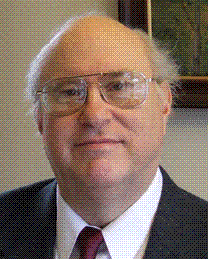
-Richard St. Clair
Richard St. Clair
was born
in
St. Clair's
esthetic is
comprehensive. He is equally comfortable composing twelve-tone
music as
he is composing in more traditional language. He believes that
style is
not the determinant but quality is: If the music has heart, depth, and
integrity, if it speaks from the heart and to the heart, if it says
something
that can be understood by others than one's peers, that is an
achievement; music is the universal language. A recurring theme
in Richard
St. Clair's music is Love. He has composed numerous songs and
choral
pieces which are intended to confirm the importance of love in human
experience. Equally present in St. Clair's music is the theme of Buddha
Dharma,
several song cycles on Buddhist texts. St. Clair is a confirmed Jodo
Shinshu Buddhist.
Richard St. Clair
has
composed over 130 compositions since the early 1960s, including 8 song
cycles,
4 string quartets, 8 piano sonatas, other chamber works, numerous works
for
chorus, and works for orchestra and band. St. Clair made his debut as
composer
and pianist at the Marlboro Festival of Music in 1967. His works have
been
featured in a number of venues through
As a pianist
himself, St. Clair writes idiomatically for the piano and understands
the technical challenges his music poses for the soloist. Much of his
music is for solo piano or piano in combination with voices or other
instruments. His works span
styles from atonal serialism to a more
stylistically eclectic orientation in
recent years.
Lately, St.
Clair's music is increasingly challenging,
with elements of dissonance and tonal references intermixed. Of his
1997 work
"Lamentations of Shinran" based on confessional poems by the great
Japanese Jodo Shinshu
Buddhist sage, Shinran Shonin (1173-1262),
Boston Phoenix music critic
Lloyd Schwartz wrote, "St. Clair
has created a fascinating sound world, both charged and atmospheric;
His is a
stirring and original voice." This song cycle is characteristic of St.
Clair's
more recent work. Even more challenging are his recent Piano Sonata no.
8, Six Strange Waltzes, Bachiana Dodecafonica, and Animations - all for
solo piano.
LIST OF MUSICAL WORKS
ԇ
Prophecy
of
Micah [Opus 1] -- 1963-1964, dur: 5:30.
Mixed chorus
SATB, Organ or Piano accompaniment.
ԇ
Lamb
of God
[Opus 1A] -- 1963-1964 dur: 1:45.
Mixed chorus
SATB a cappella.
ԇ
Statement
for
Bells [Opus 2] -- 1964 dur: 1:00 for
Keyboard
Carillon
ԇ
Piano
Piece
no. 1 [Opus 3] -- 1966-7 Dur: 6:00. Solo
piano.
Featured at the Marlboro Festival of Music in the summer of 1967, the
composer
performing, as part of the Contemporary
Composers
Program under a Rockefeller Foundation grant.
ԇ
Piano
Piece
no. 2 [Opus 4] -- 1967 Dur: 7:00. Solo
piano.
Commissioned by the
ԇ
She
Weeps over
Rahoon [Opus 5] (Poem by James Joyce) - 1968 Dur: 2:00. Contralto/Piano.
ԇ
Dreamscapes
[Opus 6] -- 1967-8 Dur: 14:00 For Violin
and Piano.
ԇ
Three
Movements [Opus 7] -- 1968 Dur: 6:00. For
Violin and
Piano.
ԇ
Piano
Sonata
no. 1 [Opus 8] -- mp3
recording  performed by the composer. 1968-9
Dur: 20:00. Review of
Premiere, Dec.
8, 1970
performed by the composer. 1968-9
Dur: 20:00. Review of
Premiere, Dec.
8, 1970
ԇ
Serenade
Opus
[9] -- 1969 Dur: 9:00 For solo piano. Review of
Premiere, Dec.
8, 1970
ԇ
Fantasy [Opus 10] -- 1969 Dur:
3:30 Piano solo. Review of
Premiere, Dec.
8, 1970
ԇ
Two
Songs
[Opus 11] (Poem by William Mullen) -- 1969 Dur:
4:00. Baritone with Piano accompaniment.
ԇ
Images
of Tintern Abbey [Opus 12] (Poem by William
Wordsworth) -- 1968-9 Dur: 14:00.
Ten/Cl/2Vln/Va/Vlc.
ԇ
Medley
[Opus
13] -- 1969 Dur: 9:00. Piano
4-hands. Review of
Premiere, Dec.
8, 1970
ԇ
Toccata
Rag [Opus 14] -- 1969
Dur: 2:00. Piano solo, performed by the composer. Review of
Premiere, Dec.
8, 1970
ԇ
Four
Concert Dances [Opus 15]
-- 1968-70 Dur: 8:00. Piano
solo. Review
of Premiere, Dec.
8, 1970
ԇ
Concerto
a
Capriccio [Opus 16] -- 1969-70 Dur: 15:00. Piano and Orchestra.
ԇ
Two
Piano
Pieces [Opus 17] -- 1970 Dur: 10:00. Piano
solo.
Dedicated to Roger Sessions.
ԇ
Piano
Sonata
no. 2 [Opus 18] -- mp3
recording 1970
Dur: 25:00. Piano solo, performed by Trevor Barnard. Review of
Concert
Premiere, Dec. 8, 1970
ԇ
Four
Short
Pieces [Opus 19] -- 1970 Dur: 3:00.
Musical
impressions or take-offs of four songs by the Beatles. They present the
tunes
in a disguised or paraphrased style. 5/71
ԇ
Duo-Sonata
[Opus 20] -- 1970 Dur: 15:00. Two violins.
ԇ
Eight
Piano
Pieces for Children [Opus 21] -- 1970 Dur:
6:00.
ԇ
Songs
of a
Wayside Inn [Opus 22] (Poems by Henry
Wadsworth
Longfellow) -- 1970 12:00
For
Mezzo-soprano and Piano.
ԇ
Five
Folk-Pieces [Opus 23] -- 1970 Dur: 8:00
Piano solo.
ԇ
Four
Preludes
and Counterpoints [Opus 24] -- 1970. Dur:
8:00. Piano
solo.
ԇ
Christmas
Trio
[Opus 25]
-- mp3
1970 Dur: 16:00
For Flute, Cello and
Piano.
ԇ
Allegro
in F
[Opus 26] -- 1970 Dur: 2:30. Piano solo, a
rondo.
ԇ
Piano
Sonata
no. 3 [Opus 27] -- mp3
recording 1971 Dur: 12:00. Piano
solo. Performed by the composer.
ԇ
Six
Songs
[Opus 28] (poems by Kenneth
Patchen) -- 1970-71, Dur:
14:00, Soprano and Piano (read)
ԇ
Peace
Is Life
[Opus 29] (anonymous text) -- 1971. Dur:
1:00.
ԇ
Yonder
[Opus
30] (poem by Gerard Manley Hopkins, "The Leaden Echo and the Golden
Echo") -- 1971-72, Dur.: 14:00, Chorus a
cappella SSAATTBB
ԇ
Double
Concerto ["Amen Concerto"] [Opus 31] -- 1971-2 Dur:
25:00 For 2 Pianos and Concert Band.
ԇ
Batik
[Opus
32] -- 1972 04:00 Piano solo.
ԇ
Color
Studies
["Transfiguration"] [Opus 33] -- 1972 Dur:
10:00. For string trio (Violin, Viola, Cello).
ԇ
Piano
Sonata
no. 4 [Opus 34] -- 1973 Dur: 23:00. Piano
solo.
ԇ
Piano
Sonata
no. 5 [Opus 35]-- 1974 Dur: 07:30. Piano
solo.
ԇ
Canzona [Opus 36]
-- 1975, Dur: 04:00 for String
Quartet.
ԇ
Soliloquies [Opus 37] -- 1975 (rev.) Dir: 15:00.
Flute solo.
ԇ
Notes
from
Captivity [Opus 38] -- 1976 Dur: 3:00
Clarinet solo.
ԇ
Seven
Dedications [Opus 39] -- 1973-6 Dur: 7:00
Piano
pieces in honor of Copland, Stravinsky, Ruggles,
Ives, Hovhaness, Sessions and Schoenberg.
ԇ
A
Round for Machaut [Opus 40] -- 1975/89 Dur:
2:00. SATB soli or Small Chorus.
ԇ
Help
Me, O
Power Above [Opus 41] (Poem by R.St.Clair)
-- 1989 Dur: 01:00 Chorus SATB
ԇ
Ragañera [Opus 42]
-- 1989 4:00 Piano solo. Classical ragtime style. Performed by the
composer.
ԇ
Champion
Rag [Opus 43] -- 1989
Dur: 3:00, Piano solo. Performed by the composer.
ԇ
Ragtime
Serenade [Opus 44] --
1989 Dur: 3:30, Piano solo.
ԇ
Blue
Rag Espagnole
[Opus 45] --
1989 Dur: 4:30, Piano solo. Performed by the composer.
ԇ
The
Twenty-Third Psalm [Opus 46] -- (Bible KJV) -- 1989-90 Dur:
7:00 Chorus SAATBB.
ԇ
The
Twenty-Third Psalm [Opus 46a] -- (Bible/KJV) -- 1989-90 Dur:
7:00 Same as above, but for Chorus SATB with Horn and Trombone.
ԇ
Sentimental
Rag [Opus 42] -- 1989 3:30,
Piano solo. Performed by the composer.
ԇ
Testimonium [Opus
48] -- 1990 Dur: 4:00 Organ solo. Written
in honor of
John Raymond Ferris, who was then retiring as director of the
ԇ
Starry-Eyed
Rag [Opus 49] -- 1989-90
3:00 Piano solo. Performed by the composer.
ԇ
The
Windhover [Opus 50] -- (Poem by Gerard
Manley Hopkins) -- 1990 Dur: 4:00
Chorus SSAA.
(for women's chorus).
ԇ
Missa
Syllabica [Opus 51] -- mp3
recording
1990-1 15:00 Chorus SATB, a cappella Latin Mass. Performed by Convivium
Musicum, David Hodgkins, cond.
ԇ
Lord,
Make Me
An Instrument [Opus 52] -- (St.Francis) --
1990 Dir:
2:00. Chorus SATB a cappella.
ԇ
Heaven
[Opus
52a] (George Herbert) -- 1990 Dur: 3:00.
Dialogue
piece between a choir and an echo choir. SATB/SATB a cappella
ԇ
Three
Prayers
(Serenity Prayer, The Lord's Prayer, Benediction) [Opus 53] -- 1990 Dur: 8:00. Chorus SATB a cappella
ԇ
Jubilant
Rag [Opus 54] -- Piano
Solo. 1990 Dur: 3:30. Performed by the composer.
ԇ
Peloponnesian
Rag [Opus 55] -- 1990 Dir:
4:00. Piano solo. Performed by the composer.
ԇ
Magnificat [Opus
56] -- (Bible KJV) -- 1990 05:30 Chorus SSAA (women's chorus) a
cappella.
ԇ
Heavenly
Rag
[Opus 57] -- 1990 Dir: 4:00. Piano solo.
ԇ
Elegy
[Opus
58] -- 1990 Dur: 7:00 Full orchestra or
string
orchestra versions. In memory of Leonard Bernstein.
ԇ
String
Quartet no. 1 [Opus 59] --
mp3
1990 Dur:
18:00. In 3
movements.
ԇ
Iron
Filings
[Opus 60] -- 1989. Piano solo. Dur: ca.
3:00. Performed by the composer.
ԇ
Madrigals
for Spring [Opus 61] (Poetic fragments by Percy
Bysshe Shelley) -- 1990 Dur:
15:00 Chorus SSAT a cappella.
ԇ
Love-Canzonettes [Opus 62] (Poems by John Dryden) --
1990 Dur: 25:00 Chorus SSAATTBB a cappella.
ԇ
Overture
to
'Beowulf' [Opus 63] -- 1990 Dur: 6:00
Full-size
Concert Band.
ԇ
The
Clear
Vision [Opus 64] -- (Poem by John
Greenleaf Whittier) -- 1990 Dur: 7:00.
Chorus
TTBB (men's chorus) a cappella.
ԇ
Amendments [Opus 65] -- 1990 Dur:
11:00 Piano solo. 12-tone
(strict
'row' technique) style.
ԇ
Moabit
Liederbuch [Opus 66] -- (Sonnets by Albrecht Haushofer ) -- 1990 Dur:
16:00. Soprano and
Piano.
ԇ
Sonata
for
Solo Violin [Opus 67] -- 1991 Dur: 10:00.
ԇ
Variations
on
a Hallowe'en Costume [Opus 68]
-- 1991-2 Dur: 14:00 Piano solo,
variations on a tune my wife, Janice
Ellison, wrote several years earlier. She went to a costume party
dressed as a
piano, and using her basic knowledge of music she designed a decoration
for the
music stand which had scales, motifs and counterpoint.
ԇ
Plaint
for
ԇ
Short
and Sweet [Opus 70] -- 1989
Dur: 3:30.
Solo Piano.
ԇ
String
Quartet
no. 2 [Opus 71] --
1991-93 Dur:
16:00, based
upon the 12-tone row of a string quartet (destroyed) which I wrote as a
student
composer in 1964-69.
ԇ
Sparkling
Rag
[Opus 72] -- 1989 Dur: 3:30. Solo Piano.
Performed by the Composer.
ԇ
...suggestions...
[Opus 73] -- 1994 Dur: 4:00. Piano solo. zen-like pieces
ԇ
Moon
Flowers
(50 Haiku-Moments for Solo Piano) [Opus 74] -- 1994 Dur:
23:00 These pieces were written to commemorate the 300th year after
haiku
master Matsuo Basho's passing (1644-1694).
ԇ
Persistence Rag
[Opus 75] -- 1989 Dur: 3:00 Piano Solo.
ԇ
ԇ
Ballade
no. 1 in D
for Piano [Opus 77] - 1993/94 - 1999. Dur.:
ca. 6:00.
ԇ
Desert
Hallucinations [Opus 78] (Poems by Donald Rubinstein) -- 1994-5. Dur: 6:00 For Baritone voice and Cello.
ԇ
Song
of
Tolerance [Opus 79] (Poem by R. St. Clair) -- 1995 Dur:
5:00. for SATB with Piano.
ԇ
Etiquette
Rag [Opus 80] --
1989-90 Dur: 4:30 Piano Solo. Performed by the composer.
ԇ
High
Flight
[Opus 81] (Poem by John G. Magee, Jr.) -- 1990-95 Dur:
3:00. SATB/Solo Soprano. In memory of the crew of the space
shuttle, USS
Challenger, which was destroyed in 1986 after launch.
ԇ
A
Higher Glory
[Opus 82] (New Testament, adapted) -- 1975/95 Dur:
2:00. SATB a capella
ԇ
Alas,
Good
Friend [Opus 83] (Poem by Percy Bysshe
Shelley) --
1969/95 Dur: 2:00. SATB a capella.
ԇ
Piano
Sonata
no. 6 [Opus 84] -- mp3
recording
1994-95 17:00. Performed by Andrew Anderson, piano solo.
ԇ
Evening
Anthem
[Opus 85] (poem by Richard St. Clair) -- 1994-95 Dur:
3:00 SATB a capella.
ԇ
Three
Meditations for String Orchestra [Opus 86] -- 1990-95 14:00 String
orchestra.
[Work in progress].
ԇ
Ricercare for
Orchestra [Opus 87] -- mp3
recording 1995 Dur: 7:00,
Full
orchestra. Performance by University of North Carolina Philharmonic
Orchestra, Tonu Kalam, cond.
ԇ
Equinox
(poem
by William Mullen) [Opus 88] -- 1996, Dur:
12:00 Tenor and Piano.
ԇ
Eucaphonies
(previous title: The Ancient Art: Hocquetus-Motet)
[Opus 89] -- 1990-96 Dur: 9:00.
Brass Quintet
(2Tpt/Hn/Tbn/Tuba).
ԇ
In
Praise of
Our Loves [Opus 90] -- 1995-6 34:00 SATB with chamber orchestra.
ԇ
Three
Short
Sandburg Choruses ("Fog," "Nocturne in a Deserted
Brickyard," and "Grass" from Sandburg's
ԇ
Inventings [Opus
92] -- 1996 10:00 Flute and Oboe.
ԇ
Flower
of the
Dharma [Opus 93] -- 1997 20:00 Chorus SATB, Piano and Percussion. Also
available for Chorus and Orchestra.
ԇ
Diamond
Cutter
[Opus 94] -- 1997 11:00 Carillon.
ԇ
Jeux d'Esprit
(Concerto for Clarinet and Orchestra) [Opus 95] --
begun 1990, completed 1997. Dur: ca. 18:00
ԇ
Today's
Lord's
Prayer [Opus 96] -- 1997. Dur: ca. 8:00
For SATB
chorus, a cappella.
ԇ
Ragtime
Sonata
(Piano Sonata no. 7) [Opus 97] -- mp3
recording 1997. Dur:
ca.
14:00 (Order the sheet music for Ragtime Sonata from The
Ragtime
Store.) Performance by the composer.
ԇ
Beautiful
Mountain Rag [Opus 98] -- 1997. Dur: ca.
5:30 Piano
Solo. A classical slow rag, the melody (and interlacing inner voices)
based
upon the 12-tone row used by
ԇ
Two
Songs of
Innocence [Opus 99] -- 1997. Dur: ca.
7:30. For a
cappella chorus (SATB). Settings of two of William Blake's "Songs of
Innocence." No. 1: On the Ecchoing Green;
no. 2:
Night.
ԇ
Ascent
[Opus
100] -- 1993-97. Dur: ca. 4:00 For small
chorus of
high voices, or for two sopranos and alto soli. Setting of poem by Anne
Morrow
Lindbergh.
ԇ
Songs
of the
Pure Land [Opus 101] -- 1997.
mp3
recording
Dur: ca.
11:00.
For
Mezzo-soprano and piano. Settings of English translations of short
Japanese
poems by Honen Shonin (1133-1212), a
leading teacher
of Buddhism in medieval
ԇ
Suite
for the
Piano Alone [Opus 102] -- 1990-97 [Revised 2010]. Dur:
ca. 19:00.
Piano solo. A work generally patterned after Baroque keyboard suites
complete with sarabande,
gavotte and other dance movements in a distinctly modern "accent".
ԇ
Tango
Request,
for Piano [Opus 103] -- 1998. Dur: ca.
5:00 Piano
solo.
ԇ
The
Lamentations of Shinran [Opus 104] --
1998. mp3
recording Dur: ca. 27:00
. For Soprano, Tenor
and String Quartet.
From Shozomatsu Wasan
by Shinran Shonin
(1173-1262), in Japanese. Review
in
ԇ
Toccata
Moderna [Opus 105] -- 1990/1998, Dur.
5:00, Harpsichord
solo.
ԇ
Songlets [Opus 106]
-- 1999, Dur. 12:00, for Mezzo Soprano, Bb
Clarinet
and Piano, on haiku poems by Issa Kobayashi
ԇ
Seven
Dhamma Lessons [ Opus 107] -- 1999, Dur.:
8:00, for Reciter, Flute, Oboe, Piano and
Percussion.
ԇ
Sonata
for
Clarinet [in B-flat] and Piano [Opus 108] -- 2000, Dur.:
ca. 15:00.
ԇ
Nocturne
in G
for Piano [Opus 109] - 2000, Dur.: ca.
3:30.
ԇ
Odysseus
Rag
for Piano [Opus 110] - 2000, Dur.: ca.
5:00. Performed by the composer.
ԇ
Penelope
Rag for Piano [Opus 110a] - 2000, Dur. ca. 4:30
ԇ
Five
Thoughtful Pieces for Piano [Opus 111] - 2000, Dur.:
ca. 10 min.
ԇ
Owl
Night, for
Soprano and Piano [Opus 112] - 2000, Dur.
ca. 10 min.
Poem by Susan Spilecki ("Owl Night").
ԇ
From
"Children of the Sparrow" [Opus 113] - 2000, Dur.
ca. 12 min. Musical reactions to haiku by Robert Gibson. For Flute,
Piano, and reciter.
ԇ
Song
of
Sorrow, In Memory of Sept. 11, 2001 mp3
[Opus
114] - 2001, Dur.
ca. 13 min. For Violin and Piano.
ԇ
Six
Whimsical
Miniatures for Harpsichord or Piano (2003-2005)
ԇ
String
Quartet
No. 3 (2005/2009) mp3
(10:00)
ԇ
Songs
from the
Chinese (2005) mp3
recording
10 Songs for Soprano, Flute, Double Bass, and Piano
based on San
Chu poems of the Yuan Dynasty (15:00). Performed by Row Twelve
Contemporary Music Ensemble.
ԇ
Surprises,
for Piano Solo (2008) (four short
pieces
for piano) (5:00)
ԇ
Piano Sonata
No. 8 (2008) mp3
(15:00)
ԇ
There Is A
Spirit, for Chorus SATB a cappella
(2009) (5:00)
ԇ
The
ԇ
Organ
Mass (1972/2009) (26:00).
ԇ
Six
Strange Waltzes for Piano Solo (2009) (7:00).
ԇ
Ballade
no. 2 for Piano Solo (1995-2009) (7:00).
ԇ
An
Idyll for Solo Flute (2009) (9:00).
ԇ
Animations,
12 pieces for solo piano (2009) (dur.: 17:00)
ԇ
Bachiana
Dodecafonica for Solo Piano (2010) (dur.: 16:00)
ԇ
Kisamboge: A
Dharma
Celebration for Chorus, SATB (with or without piano accompaniment).
mp3
(dur.: 16:00) (2010). A setting
of a
gatha (Buddhist poem) of the
Buddhist monk and luminary, Shan-tao (China, 613-681 BCE)
ԇ
Energies:
Music for Flute, Violin, Double Bass, and Piano (2010) (dur.: ca. 9:00)
ԇ
Fantasy Impromptu for Solo Piano (2010)
(dur.: ca 8:00)
ԇ
Introduction to the
Piano: 32 Piano Pieces for Beginning Pianists (2010)
ԇ
Twelve Miniatures for Solo Piano (2011)
(dur.: ca. 8:00)
Last updated: 8 September 2012.
Dozens of Richard St. Clair's compositions can be heard for free and sheet music downloaded at The IMSLP Petrucci Library website
