Massachusetts Institute of Technology • Program in Science, Technology and Society
Science, Technology and Global Security Working Group
Home
People
Research
Downloads
Publications
Courses
Workshops
Contact Us
Downloads
Google Earth Tool Available!
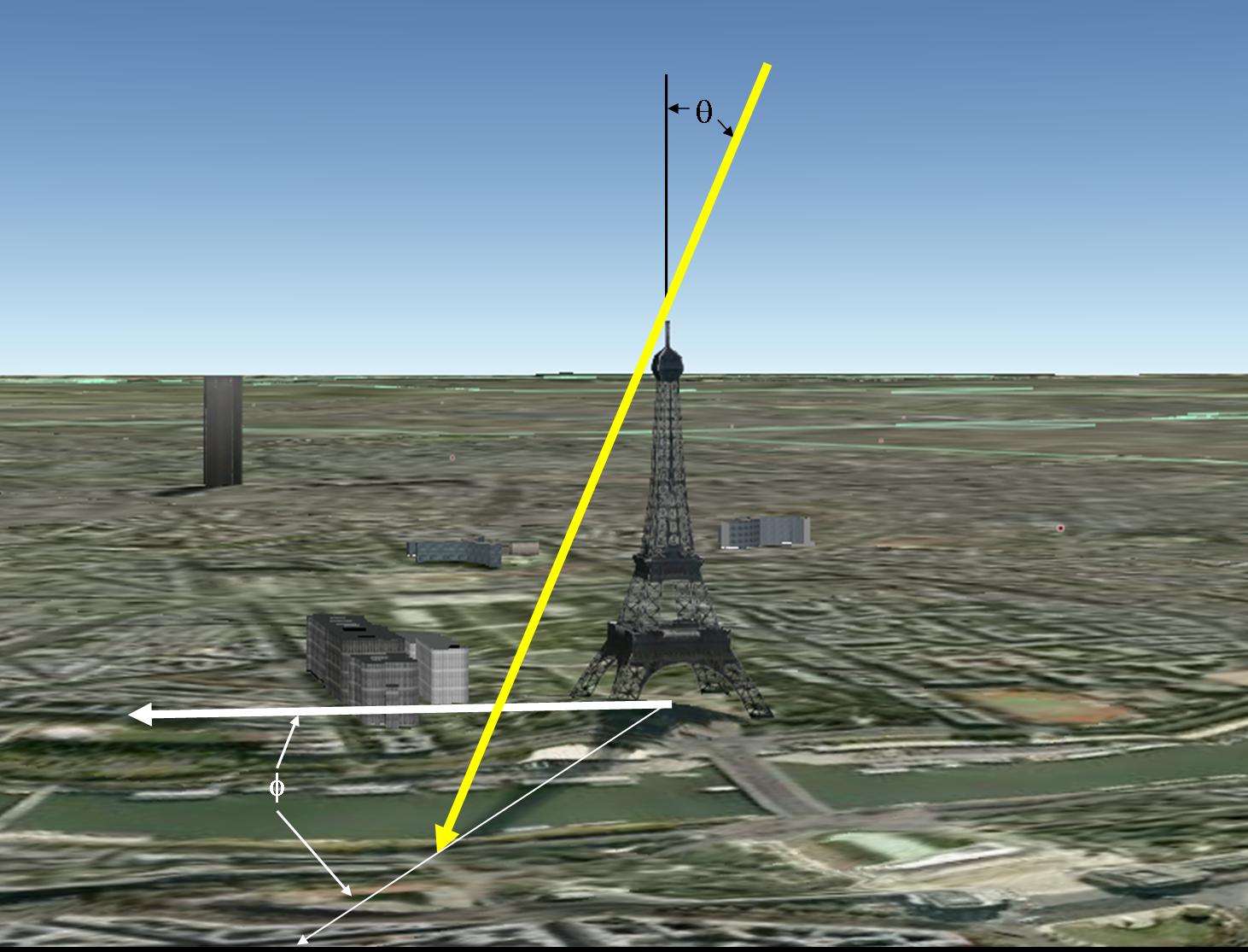
Measure Heights of Objects with calculateObjectFromShadow
Recent versions of GoogleEarth, show a date stamp of scenes that are close enough to the Earth’s surface for the scene appearing on the screen to come from a single image. If the day, month and year are given, it is possible to use the compass heading of the shadow itself to determine the effective local “time”, much like a sun dial can be used to determine the time at a given position. CalculateHeightFromShadow uses this heading, together with the latitude, longitude, and date of the scene, to determine the Sun’s elevation and from that to return the length of the object being studied.
Click here to download the program. (Note: you MUST have GUI_Missile_Flyout already installed for this program to work!)
Click here to download the help file for the program calculateObjectFromShadow
GUI_Missile_Flyout
Version 3.0 now available!
GUI_Missile_Flyout:
A General Program for Simulating Ballistic Missiles
GUI_Missile_Flyout is a stand-alone program running under Windows for
simulating ballistic missiles with 1, 2, or 3 stages in a framework with
a round, rotating Earth. Users can easily input all the necessary
parameters in an intuitive graphical user interface (GUI). A modest
number of quantities can be interactively plotted on the Interface but
the complete trajectory can be saved as either an Excel or Matlab file
for further analysis. The trajectory can also be directly displayed
in Google Earth for visualization. The GUI can be used to optimize
gravity turn parameters to maximize range or aim at a specific target
(entered, as is the launch site) through latitude-longitude pairs. In
addition to an introduction to using the program, this paper describes
the integration of the three-degrees-of-freedom equations of motion and
approximations made to the aerodynamic (such as a parameterized drag
coefficient, Cd).
Download the program by clicking here. Download the Landareas file here.
Please “register” by sending your name, email address, and institution (if applicable) to dmancini@MIT.EDU. This will help us continue to provide information and services to the arms control and national security community. You can also request a help file.
If you use this program for a publication, please reference: Geoffrey Forden, GUI_Missile Flyout: A General Program for Simulating Ballistic Missiles, Science and Global Security, Vol. 15, No. 2, December 2006, pp. 133-146.
A Quick Guide to Using GUI_Missile_Flyout:
To install:
Download the file GUI_missile_flyout_pkg.exe to a windows based computer
and run this self extracting file. Please keep the GUI_MISSILE_FLYOUT_3.0.ctf
file in the same path (usually, same directory is easiest) as the executable
image, GUI_MISSILE_FLYOUT_3.0.exe. The instillation package, GUI_MISSILE_FLYOUT_2.1_pkg, installs
the necessary files on your system and can be deleted (together with MCRInstaller.exe,
and _install.bat) after instillation.
Running the program:
Double click on GUI_MISSILE_FLYOUT_3.0.exe or use the “run program” from
the start menu. Two screens will appear: a DOS command prompt window
(which can be ignored but not deleted without stopping the program) and
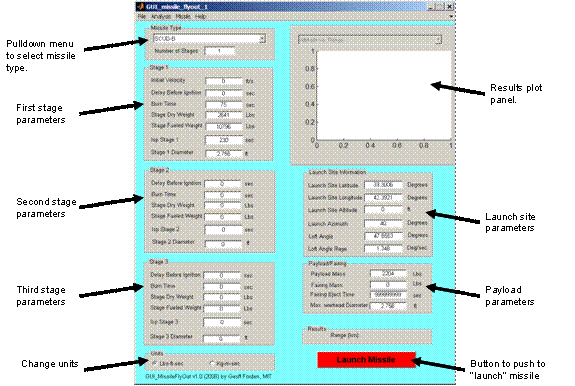
a Graphical User Interface (GUI) shown below. There are four missile
models already programmed into the GUI that can be selected using the
Missile Type pull-down menu. These can be run as is, or modified
to reflect the user’s preferred parameterizations. New missiles
can be entered into the program from the GUI by selecting “Create
New Missile” from the “Missile” pull-down menu. Missile
models can also be saved to the disk for future use.
 Massachusetts
Institute of Technology • Science, Technology and Global Security
Working Group
Massachusetts
Institute of Technology • Science, Technology and Global Security
Working Group
Building
E51-163 • 70 Memorial Drive • Cambridge,
MA 02142
Copyright © 2009
Last modified: 30 April 2009