The First Church of Christ Scientist Site was originally under water and was later filled due to the fast expansion that Boston was experiencing. The simple fact that this site is located on a land filled area, gave me an idea on what its characteristics regarding building structure and land use would be. All the land filled areas are flat and uniform, perfect for building in a structured and organized way. Boston on the other hand was not land filled and has some interesting characteristics. The natural processes in the areas that were originally above water took a great part in determining the structure and organization of the city. People settled there and coped with that organization that nature had left. The Back Bay area is the opposite. What made this site exist was the decision and hard work of man. Filling the land was a man made project so natural processes had no influence on what the resulting structure and shape of the land was going to be. Since it was a man made project, then obviously it would be made to favor the land use. This means that the plans for what was going to be made were already predicted. I pictured this land to be very structured and very much like a grid because that would be more efficient. Similar land usage was also expected. All of the plantation would be put there by someone’s decision, not by nature. Nature would have a more difficult time surviving in these conditions. The Granite Garden goes over this point. Author Anne Spirn states,”… human function and fashion are often more influential than natural processes in determining the location and arrangement of plants”. This was my impression on this part of Boston. This turned out to be true for most of the Back Bay. Most of the Back Bay is composed of a grid like pattern and most of the buildings are used for housing. There are a couple of stores like the ones on New Burry Street, but everything is mostly uniform. The First Church of Christ area, on the other hand, is not very organized. This area is no longer a grid but more of a strange intersection of different grids, each grid with its own different types and styles of buildings. What I also found interesting was that the land use is very different. There are commercial residential and public areas.
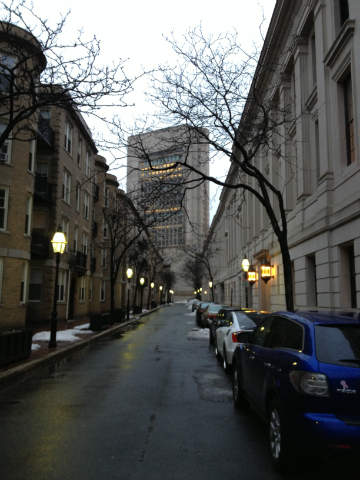
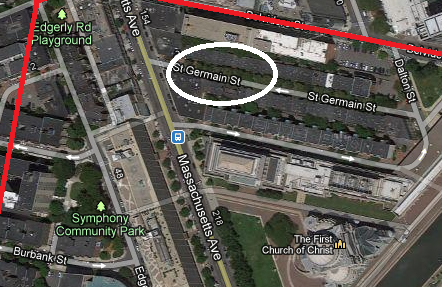
This Church area is located south of the Back Bay. When crossing the Harvard Bridge into Boston, The Back Bay is the first thing that is encountered. The Church area is located down a couple of blocks on that same road, passing the Prudential Center. The site is intersected diagonally by Massachusetts Avenue. The area that is enclosed by my boundaries is full of buildings with the exception of the garden/courtyard in front of the church. A neighborhood is located on the left side of the street at the beginning of the site. The neighborhood runs east to west and seems to be squeezed tight by the surrounding buildings. I noticed that the neighborhood seems to be out of place since all the surrounding buildings were taller and bulkier. The Northeastern University is located in front of these houses/apartments and on there are more commercial buildings on the back side. There is a row of trees that run down the street between the apartments and the University. They were obviously planted because they are all very organized and evenly spaced out along the street. What I noticed about these trees though, was that they are very tall and they are bending away from the buildings. This has to be because the trees need sunlight and the farther away branches are from the building, the more sunlight they will get. I noticed that all of the trees along this street were pointing the same direction (towards the street). These trees all seem to have been planted at the same time because all of them are relatively the same height. This also suggests that none of the trees have died and been replaced, which I find impressive considering that there is very small amounts of soil for the trees to grow on and a low amount sunlight. It seems that whoever planned to put the trees there, put them for decoration purposes, but must have had in mind that the trees would probably die prematurely due to the conditions and would have to be replaced at some point. If one of the trees had died, then there would be an uneven height between the trees but they all seem to be the same height.
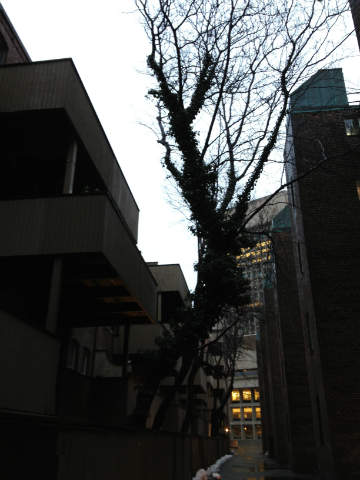
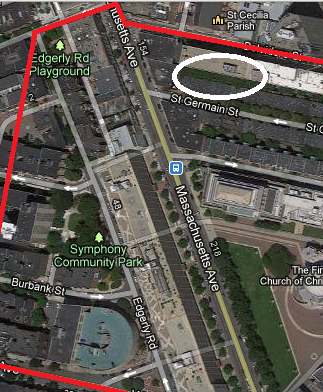
There is a side alley that leads to the back alley of the apartment buildings. I passed by it and saw there were a couple of dumpsters and thought that there would be no sign or evidence of natural processes. I walked down the neighborhood, and all of the trees were the same, nothing new. Walking back I went into the back alley. To my surprise, I found a couple of trees growing on the left side of the alley in between the apartments and the apartments’ fence that ran along the alley. The trees were very different than the trees from the previous street. What I found very interesting was that the conditions for growth here seemed more unfavorable since the alley was much narrower than the street and the two buildings on each side were very tall. These trees were much taller and greater than the ones on the street though. The other thing that I found impressive was that the trees only had a certain height they could grow to because after a certain height, it would hit the structure of the apartment building, as you can see on the picture. What the trees did was grow and bend outwards towards the alley, clearing the fence, then bend back up to reach for the sunlight, making an “s” shape. These trees seem to be placed in a somewhat even pattern like someone planted them there, but at the same time it seems like this is not a very smart place to plan a tree. Another thing that I found interesting was that there were about 6 of these trees running along this alley, but only the third and fourth trees had other plants and vines growing on the bark and branches; the rest just had a plain bark. This might be because there are different plants growing on the bottom of the third and fourth trees. Another explanation could be that those specific trees somehow get more water through drainage systems that that the building provides. I was not able to confirm this because there is a fence that prevents me from seeing the bottom half of the tree. I was also not able to see on how much soil the trees were growing in, and that might be good to find out because that might be an important factor in determining why the trees were able to grow successfully there.
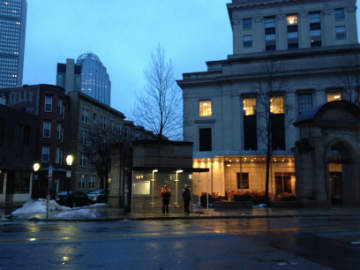
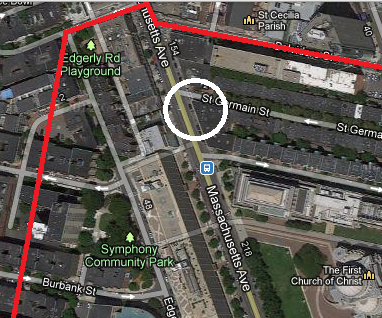
The line of trees along the apartment-University street extends around the corner of that street and Massachusetts Avenue. There is a big difference between the first tree in the neighborhood and the tree on the corner (outside of the neighborhood). The tree outside of the neighborhood has more space, soil, and sunlight to grow on. The tree outside of the neighborhood is bigger, but since the difference in height is too great, then I think that the trees in the neighborhood are much younger than the other ones.
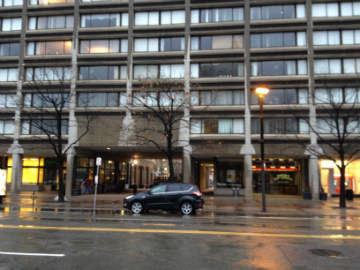
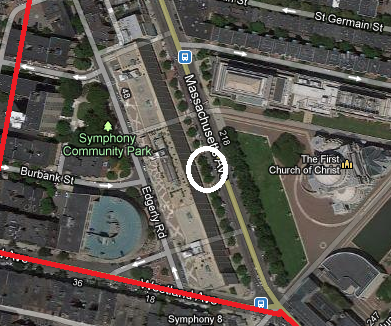
There is a huge building that runs along all of Massachusetts Avenue across the street from these larger trees that are in the corner of the street. There are trees evenly spaced out in front of this building. The pattern in these trees is the same as in the ones in the neighborhood. They all have their branches pointing away from the building, and they are all around the same height. They also have very little soil to grow in. There is one particular tree from these that caught my attention because it had significantly more leaves than the others. The conditions that it is growing in are practically the same as the rest but for some reason this one has more leave than all of the rest. I tried to come up with an explanation for this but I could not find a condition that differed from the rest of the trees.
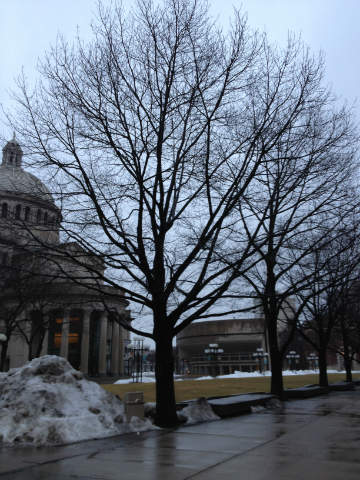
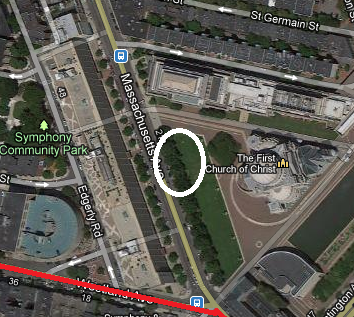
The Church is found a little further down the street to the left. The Church has a garden in front. It has a big area of grass and various trees planted. These trees are different from the previous ones. They seem to be older, bigger and stronger. These trees were probably chosen to be better quality trees because they are part of the garden of the church. Anne Stirn mentions in the Granite Garden that sometimes trees in a plaza may have worst conditions to grow in since “Most plazas are not built over soil, but are actually the roofs of basements or subways…”.These trees seem to definitely be doing better than the ones seen on the apartment street, and the ones seen on the back of the huge building that runs along Massachusetts avenue. These trees definitely have more soil to grow in and have a lot of open space around. This allows them to spread their branches and they do not have to bend anywhere. This gives this particular site a more grandiose feeling. The trees stand wide and tall and they are in front of the huge church that is also seems important and eye-catching.
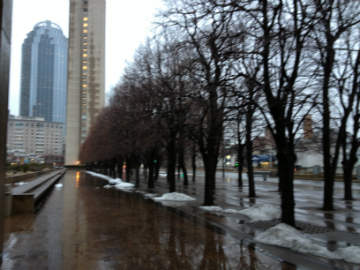
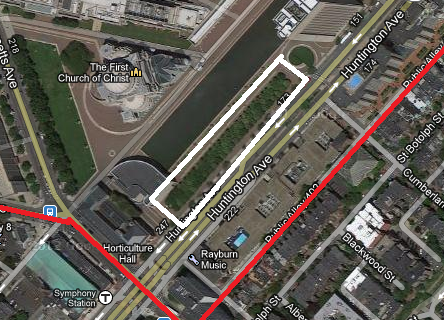
Next to the Church there is a reflecting pool with other decorations with different trees and bushes. There is a long row of trees that extend along a walkway. These have very little soil to grow in, but have a lot of open space around them. Like the trees in front of the church, these do not lean towards a certain way, they spread out their branches. The sight when standing in between the rows of trees and look down is very interesting. Since the trees spread out their branches, it looks like there is a uniform ceiling of branches all along the path.
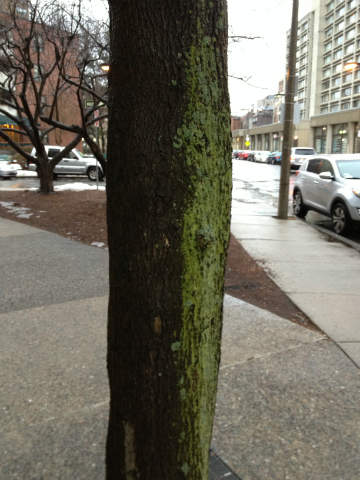
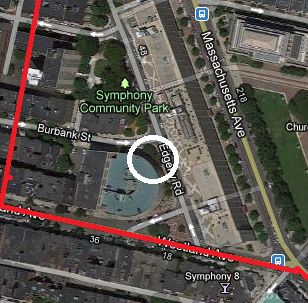
The effect of the sun shining in mostly one side can be noted in this case. There was a tree in the back side of the huge building that ran down Massachusetts Avenue that had a big change in moss on the bark. The bark was very green on the east side of the bark and brown on the west side. This might be because the tree has a building very close to it on the west side. The building on the east side is separated by a street and a sidewalk so it gets more sunlight on that side (east facing side). Again we see that the tree is surrounded by the sidewalk. It has again very little soil to grow in just like all the other trees that are planted along a road. The fact that there are not trees that are growing by themselves suggest that this whole site is very dense and that land is not wasted.
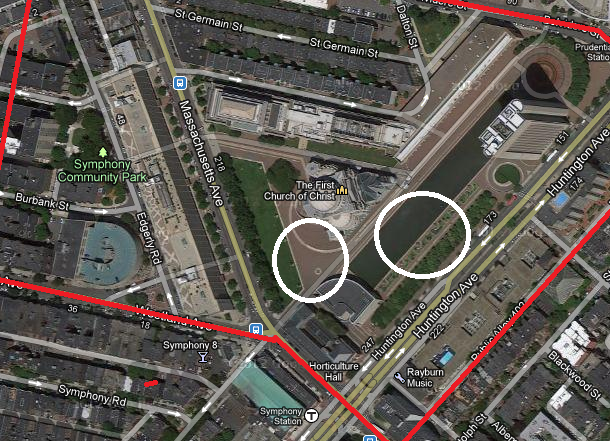
The wind patterns are very much affected by the buildings. The direction of the wind changed from place to place depending of the configuration of the buildings surrounding that particular place. The wind was felt much more in open areas like the garden in front of the Church, and around the trees aligned with the walkway on the Church grounds. These big gusts of wind made me feel like I was not in a closed space. Normally I felt that I was in a very closed space as I walked around the site because of the narrow streets and the tall buildings along them, but in this site if felt very different. The wind is another thing that I found depends heavily on the buildings and the surroundings.
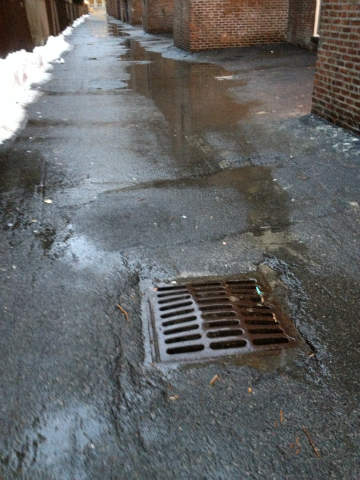
I got the chance to visit the site while it was raining, which this gave me the opportunity to investigate if there were any imperfections or small valleys where the water accumulated. My conclusion was that the area is pretty flat and there is a good drainage system. There was only one place where the water accumulated more and this was in the back alley of the apartments. The back alley actually has a lower elevation. There is a drainage system here too but sometimes the drain is not placed in the correct places. In this picture, you can see that the water starts to accumulate along the middle of the alley. This could be because that is where the construction sites of the buildings meet and therefore it leads to a slight change in ground elevation and forms a valley like structure. It is also important to note that there only seems to be snow accumulating on only one side of the alley. One explanation for this could be that the sun hits more on the side that has no snow and therefore has more chance of melting. This is another example of how the sun hitting one side more often that the other affects a place. Another explanation for this might be that the building on the right has some sort of heating system that radiates to the outside and makes this area a bit warmer. Overall though, the whole site is flat and that was supported by the fact that there was very little accumulation of water.
In the beginning, man had to deal with the problems that the natural processes placed, which was the fact that the land they wanted to build on was underwater. This was fixed by land fill and now the land was flat ready to be built on. Now that there are buildings everywhere in this place, it seems like man defines the natural processes now. The trees will grow depending on where man plants them and what we put in its surroundings. The air will flow somewhat depending on the organization of the buildings. Now it seems as if Nature has to deal with the problems that we present it. I believe that nature presented problems and we solved them. Now the natural processes have to deal with the problems that man presents.