|
Yasheng Huang (黄亚生)
MIT Sloan School of Management
Books Recent papers and book chapters Opinion pieces Cases
|
|
Yasheng Huang (黄亚生)
MIT Sloan School of Management
Books Recent papers and book chapters Opinion pieces Cases
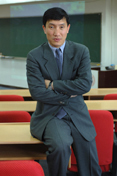
About Professor Yasheng Huang: Yasheng Huang is professor of political economy and international management and holds International Program Professorship in Chinese Economy and Business at Sloan School of Management, Massachusetts Institute of Technology. He also holds a special-term professorship at School of Management, Fudan University and an honorary professorship at Hunan University. His previous appointments include faculty positions at the University of Michigan and at Harvard University.In addition to academic journal articles, Professor Huang has published Inflation and Investment Controls in China (1996), FDI in China (1998), Selling China (2003, Chinese edition, 2005), Financial Reform in China (2005, co-edited with Tony Saich and Edward Steinfeld), and Capitalism with Chinese Characteristics (2008, Chinese edition, 2010).Capitalism with Chinese Characteristicsis a detailed narrative account of history of economic reforms in China. It is based on detailed archival and quantitative evidence spanning three decades of reforms. The book shows that private entrepreneurship, facilitated by financial liberalization and microeconomic flexibility, played a central role in China’s economic miracle. The book predicted and discusses in detail the current economic challenges facing China. The book was selected by the Economist magazine as one of the best books published in 2008 and was 2008 Finalist/Honorable Mention in Economics, Professional & Scholarly Publishing Division, Association of American Publishers, Inc. In collaborations with other scholars, Professor Huang is conducting research on a range of research projects including higher education in China, production of scientific knowledge in China, on entrepreneurship, and on FDI. His research has been profiled in many publications, including the Wall Street Journal, the Economist, Businessworld, Le Monde, Economic Times, Daily Telegraph, Bloomberg, Businessweek, Guardian, The Australian, Canberra Times, The Standard Financial Times, Times magazine as well as in numerous Chinese publications and publications in Germany, France, Sweden, Romania, Brazil, and Russia. He has published op-ed articles in Financial Times, New York Times, Wall Street Journal, and Foreign Policy. He is a columnist for Entrepreneurs and Global Entrepreneurs magazines in China. At MIT Sloan School, Professor Huang founded and runs China Lab and India Lab, which aim to help entrepreneurs in China and India improve their management. He has held or received prestigious fellowships such as National Fellowship at Stanford University and Social Science Research Council-MacArthur Fellowship. He is a member of MIT Entrepreneurship Center, a fellow at the Center for China in the World Economy at Tsinghua University, a fellow at William Davidson Institute at Michigan Business School, and a World Economic Forum Fellow. He has served as a consultant at World Bank and at OECD and is serving on a number of advisory boards of non-profit and for-profit organizations. 黄亚生教授简介: 黄亚生是美国麻省理工斯隆管理学院政治经济和国际管理教授,并任该学院中国经济和商业国际讲座教授. 他同时也是复旦管理学院兼职教授和湖南大学荣誉教授。黄亚生教授历任密歇根大学、哈佛大学教职和世界银行顾问。研究领域涉及国际商务管理、政治经济学和制度经济学。 他的最新著作是<<具有中国特色的资本主义>>(剑桥大学出版社2008年,中文版,2010年). 本书被英国<<经济学人>>评为2008年度最佳图书之一也是美国出版社协会2008年度最佳图书奖候选.他的《销售中国》)(英文版2003年; 中文版2005年)探讨了中国外商直接投资在制度上的驱动因素。该书的主要观点已经在众多刊物上发表,包括《华尔街日报》、《经济学家》、《商业世界》、《世界报》、《经济日报》, <<财经>>, <<21世纪经济论坛>>, <<经济观察家报>>, <<南方周末报>>, <<全球企业家>>, 和《瞭望》等。该书较早和系统性论述了内资企业,外资企业政策不平等的问题和对经济的影响. 近年来致力于将这样一种研究中国外商直接投资的思路(分析国内企业的竞争力)拓展到其他国家,分析那些国家本土企业的制度环境。目前正在主持进行关于中国和印度私营经济发展,外商所有权和外商直接投资制度上动因, 创业环境,科技发展,人力资本等的研究项目。 黄亚生教授曾获在研究领域享有重大声誉的研究金支持,如斯坦福大学的国家研究基金和社会科学研究协会的麦克阿瑟研究金。黄教授兼任清华大学中国经济研究中心研究员,北京大学国际关系学院研究员,密歇根商学院威廉大卫逊学院研究员,世界经济论坛研究员。在麻省理工斯隆管理学院, 黄亚生教授创办了”中国实验室”和”印度实验室,” 目的是帮助中小企业提高管理. 他是几家盈利性和非盈利性组织的顾问委员会的成员。
|
books | recent papers and book chapters| opinion pieces | cases |
MIT Sloan School of Management, 50 Memorial Drive, E52-551, Cambridge, MA 02142-1347
ph.617-253-9768 fax:617-253-2660 email: yshuang@mit.edu