Satellites and antennas
Satellite Network
Specifications
Satellite Network
For our mission a constant connection between the main base on Earth and the base on Mars was decided to be of a high importance, mainly because of the fact that there will be people working on Mars and a constant monitoring of their progress and health conditions is an essential part of the mission success. The worst case scenario will be an injury or a death of one of the crew members, and therefore the more we monitor them, the less chance of failing there is.
Issues Addressed
There are certain issues we cannot deal with, like the time delay (up to about 20 minutes) all transmissions from the surface of Mars to the Earth have. This is still a problem we cannot overcome, and there is no hope that it could be overcome in the next decade or so. A constant connection between the two bases could be maintained, with some delay on both ends. This will be a bit more expensive, but having in mind the risk the people will be exposed to the price was considered as reasonable.
Options
For the problem addressed in the previous paragraph several options were taken into account:
- Positioning one satellite in a polar orbit, one above the main base on Mars, and using the transportation spacecraft as a third satellite. This third satellite would have always stayed in position so it can have an open channel for a transmission to the Earth.
- One satellite always positioned at a place where it has a direct contact to the Earth and using AM band to transmit from the surface of Mars and bounce off its atmosphere to reach the satellite.
- Having three satellites, one above the main base (back-up) and two others positioned 65 degree on both sides, all in geosynchronous orbit.
Solution
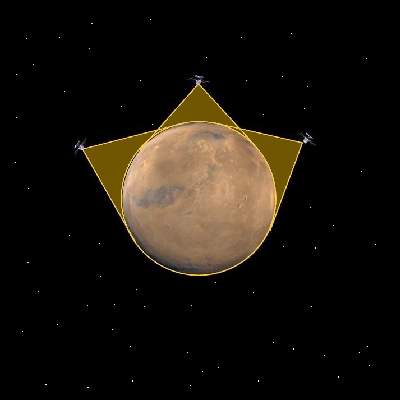
On the following graphics you could see a basic schematics of how our satellites will be positioned around Mars:
Satellite Network
The satellite, which is in the middle on the picture
will be the one right above the landing site and the main base. The other
two will be, as it was said before, 65 degrees on both sides. All the satellites
will be in geosynchronous orbit, which for Mars is 1.69*107m
above the surface of the planet. From this orbit each satellite will be
able to cover about 95% of their side of Mars (cover latitudes from 80.4
degrees South to 80.4 degrees North). The overall area being covered this
way is about 60% of the planet (see fig: Satellite Network) and includes
all the places our people and equipment could ever reach.
For the actual data transmissions only the two outside
satellites will be used. They are positioned in such way that no matter
how is Mars directed, one of them will always be in contact with Earth.
The third one will be basically used as a back-up. If one of the others
fail it will be able to move to the failed satellite's position and replace
it.
Authors: Jordan Brayanov and Artem Gleyzer