|
Introduction
Life Support |
The Human Factor
Inflight SuitHamilton Sundstrand is the primary manufacturer for the inflight suit, also known as the EVA. Other manufacturers contribute to the suit but Hamilton is responsible for the overall design. They have set the cost at $12 million per suit. The mass of the EVA is 90.8 kilograms for the 100 cm by 60 cm by 180 cm suit (each astonaut is custom-fitted for his suit). This mass includes the suit's cooling system, oxygen supply, communications system (two UHF channel transmitters), water tank, rechargable battery (capable of a maximum 8-hour mission), and waste disposal system.
Martian Suit Because the astronauts will be on a new environment they will need a suit which is specifically designed fro living in that environment. The Martian surfacerequires protection from dust storms and ultraviolet radiation while still maintaining reasonable mass and flexibility. There are two prototypes, designed by ILC Dover and Hamilton Sundstrand Systems, which will be combined for this mission. The estimated cost for this suit is also $12 million. Its dimensions are identical to those of the inflight suit and its mass is 65.8 kilograms. The Martian suit design uses the same materials as the EVA in thinner layers. The suit is also equipped with the same "backpack" as teh EVA. The suit itself is constrcted with plastics to make it lighter and more flexble while maintaining adequate protection from the elements. 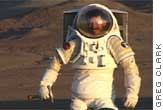 http://www.space.com/businesstechnology/technology/mars_spacesuit_000813.html |
