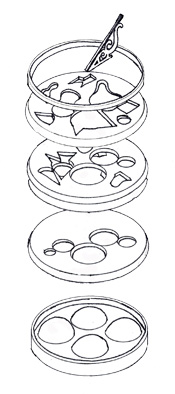
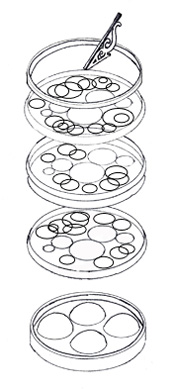
Jessica Vechakul : The following concept sketches pertain to the clock room . Please review the clock room storyboard prior to reviewing these concept sketches. Jessica's three concept sketches detail the grandfather clock puzzle in which spies have to place gears in the correct position to access the Secret Panel, and two possible puzzles that reveal the solution to the gear puzzle and illuminates the location of the Secret Panel when all the circular layers of a sundial are rotated to the correct orientation.


The Grandfather Clock Gear Puzzle

The spies must solve the Grandfather Clock puzzle open the Secret Panel and access the Director’s Office.
Inside the grandfather clock is a gear that is noticeably spinning and making whirring sounds. The inside is brightly lit. The spies notice that the door is slightly ajar. When they pull it open further and look inside the clock casing they see several other gears, all of different sizes. Whenever the door to the clock casing is open, the gear stops spinning and the clock is completely silent. If the spies close the clock door again, the light dims and the gear starts spinning again.


The gears are made out of either plastic or metal and each has a light tint of a different color. There are pegs sticking out of the back wall of the clock case. As the spies pick up the gears and try putting them on the pegs, they realize that this must be a puzzle that could lead to a clue or unlock the secret panel. The number of gears or layers of gears in the puzzle can be modified based on how difficult people find the puzzle to be. Trials would have to be conducted to determine how long it typically takes a group to solve the puzzle.


Once all the gears are in place, the clock door must be closed to allow the gears to turn. When the clock door is closed with all gears turning, it locks so no one can open the case and get their fingers caught in the gears. Once the top gear starts turning, the clock starts chiming to indicate that the spies have solved the puzzle. As the gears turn, the wall starts to move aside! Since all the gears are needed to solve the puzzle, and the door to the clock locks after the puzzle is solved, the spies are prevented from accidentally losing or taking a gear with them. There should only be one solution to the puzzle.


When the wall has finished moving, the pegs in the clock casing retract and gears fall back into the bottom of the clock. The door automatically unlocks and becomes slightly ajar, and the pegs reposition themselves in preparation for the next group.

The Sundial Puzzle


The purpose of the sundial puzzle is to engage some of the spies while other spies are working on the grandfather gear puzzle and the pendulum puzzle. The sundial puzzle does not have to be solved for the spies to access the Secret Panel. However, it will provide a clue about solving the grandfather clock puzzle so that the group may progress faster.
There is a light shining on the sundial, and draws the spies’ attention as they enter the room. When the spies look more closely, they realize that the face of the sundial rotates. The top surface of the sundial is a polarized light filter. When rotated to the right orientation, it allows light to pass through, but it always appears to be black without allowing the viewer to see anything behind it. You will see why this is important as the mechanism of this puzzle is explained further.

Concept 2: Cut out shapes in solid discs.
Concept 3: Dark circles drawn on transparent discs.


Rotating the sundial reveals a beam of light, which projects a strange image onto the ceiling. The sundial consists of four or five round discs, which are layers that can rotate concentrically one on top of the other. Each disc has a different pattern of shapes on it. The shapes on each disc interact concealing the solution which is shown on the bottom disc. Below the bottom disc is a set of lights or bulbs that would project the pattern of the discs onto the ceiling.

By aligning all the layers into the correct orientation, the light in the sundial reveals a pattern on the ceiling, which depicts the solution to the Grandfather Clock Gear puzzle. The solution image is a pattern of circles of different sizes. Since the gears are different sizes, the spies should be able to figure out which gear to put on which peg in the grandfather clock. If the spies have not already started working on the grandfather gear puzzle, seeing this image of gears should give them a hint that the grandfather clock without all of its gear is part of the key to the Secret Panel.


When all the discs are properly aligned, a detent locks the discs so that the solution is clearly illuminated on the ceiling. At the same time, a laser from the triangular piece on the sundial shines a red outline of the Secret Panel. This may cause some spies to inspect that area, looking for the seams of a door. Thus, when the wall actually moves aside rather having a door swing open, the spies are even more surprised.

One concept for the sundial puzzle is depicted by the expanded view on the right (shown above). Each disc is transparent except for the circles which drawn on the layers. As you rotate each disc of the sundial, the circles pass over one another, creating a kaliedscope-like image on the ceiling. The spies should notice that when two of the discs are lined up properly, one circle on one disc appears to merge with a circle on another disc. As they lined up each othe discs, the solution will appear as a pattern of full circles, none of which overlap. The area around this pattern would be maze of overlapping circles.

 

The third concept is the puzzle is shown above. The yellow is the animation on the left is the lighted image that the spies can see when they look up at the ceiling. The animation is a faster version of what the spies would see as they rotate the discs in different directions while they are trying to solve the puzzle.

The five small black circles above are what each disc may look like with the white sections being the areas which are cut out. Light may pass through these areas to form an image on the ceiling. When the spies look down at the face of the sundial, they can see nothing but a black surface because of the polarized light filter. Since the image is projected onto the ceiling, it allows more people to be involved in solving the puzzle even if only one person is the one rotating the discs.

The related storyboards can be found at the storyboard main page.