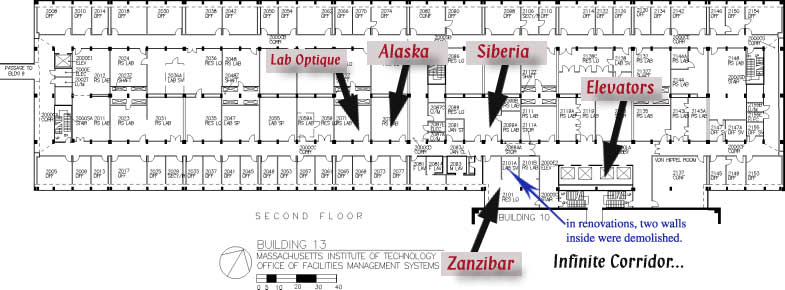
We currently occupy four labs on the second floor of Building 13.
- Siberia
BEC of atomic hydrogen was first studied in this lab using an Oxford 2000
Dilution Refrigerator to obtain the low temperatures needed for magnetic
trapping. Temperatures as low as
30µK were obtained in this apparatus by using evaporative cooling
techniques. Although this apparatus has been the workhorse for all of the
MIT ultra-cold hydrogen trapping experiments, we are in the process of transitioning
to a newer apparatus that will use buffer gas loading techniques for
creating and trapping samples of ultra-cold hydrogen atoms.
- Alaska
This is where Spin-Polarized Hydrogen was first
studied -- experiments to study the heat transport in Spin-Polarized gas
were carried out here. This lab is
currently the center of our experimental efforts. It contains the new buffer-gas loading apparatus
that will be used to perform our next generation experiments.
- Zanzibar
Unlike our other labs, this lab is not named after a cold location; it was
an executive decision over a lunch out in Killian Court where we realized
that a new optics lab could be named after a warm and sunny location. Zanzibar currently
houses a UV laser system which we are designing to achieve an order of
magnitude improvement in stability over our current UV system. It is also
the home of our new frequency comb. It is currently a testing ground for
the sundry diode lasers that will be required in the high precision
spectroscopy experiments.
- Lab
Optique
This lab houses a large optical table containing our current ultrastable UV laser system. A Coherent 699 ring dye
laser is doubled to produce 20mW of 243nm light with a 3kHz
linewidth. View the
optics table w/laser.