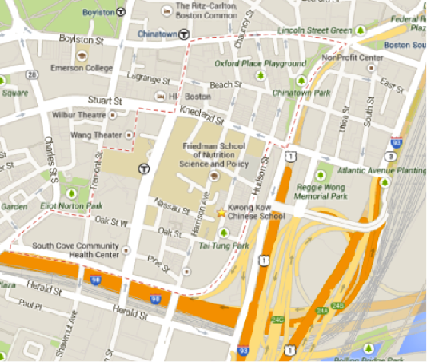
 Figure 1: Map of Boston taken on February 17, 2014 from maps.google.com. Note: Red dotted line depicts boundaries of Chinatown as according to GoogleMaps.
Type in “Chinatown” into GoogleMaps and a dotted red line appears, defining the borders of this cultural and historic area of Boston. In my mind, as an ABC (American born Chinese) growing up in the Boston suburbs, Chinatown is busy and crowded, full of shops and restaurants. However, that only applies to a few streets in Chinatown, mostly in the north, not the entire area depicted by GoogleMaps (Figure 1). I realized that, even after living here all my life, I’d forgotten about the rest of Chinatown. As I wondered how I could have overlooked more than half of the district, I began to wonder why the borders were drawn in this particular shape—did I really disregard so much of the city or are the defined borders of Chinatown arbitrary? So, I chose a vertical section following the border of Chinatown in order to further investigate areas I’d originally deemed ‘nonexistent’ as well as the line differentiating Chinatown from the rest of Boston.
 Figure 2: Map of Boston taken on February 17, 2014 from maps.google.com, edited by author. Note: Chinatown outlined in red, site shaded in pink.
My site starts at the Chinatown gate and follows Tremont St. all the way down to the southern border of Chinatown, where I-90 cuts across. On the east side, I-93 bounds my site. In my site, I included an additional block on the east side of I-93 so that I can explore the differences between Chinatown and its surrounding areas (Figure 2).
At the northern-most point of my site, stands the Chinatown Gate. Right beside the gate is a small park (Figure 3). In previous trips, I’d noticed the park filled with old men playing Chinese chess at all times of the day—this particular trip was no different. However, I visited Chinatown right after a snowstorm the night before. The chairs and tables in the park were still covered with snow and the elderly had just begun to file in. As shown in the picture below, some elderly have begun to play cards while others are still shoveling. I found this fascinating—if I were one of these men, I would not voluntarily sit outside in the cold, surrounded by piles of snow, just to play chess. And yet, here they were.
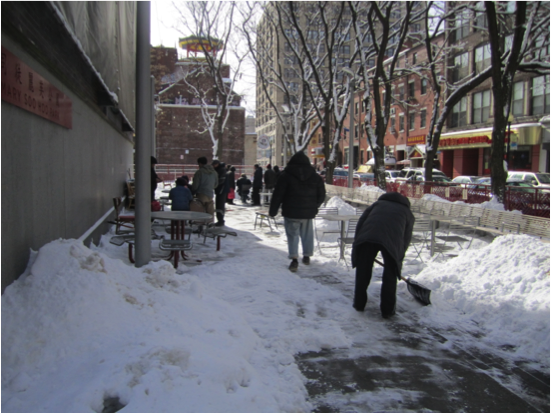 Figure 3: Park by Chinatown Gate. Source: Author.
Grady Clay describes epitome districts to be places where formal and informal rituals, and other symbolic activities occur—small spaces that pack much emotion and energy (39, 38). This junction is just that—-it’s a place that holds significance, emotions, and history for the people that live there; if not, there wouldn’t be shoveling on a Sunday morning. Moreover, the iconic Chinatown Gate stands as a beacon to tourists, and the surrounding shops attract shoppers and diners.
Traveling south, down Tremont street, there is a multitude of building materials and styles. Although many buildings are red brick, there are also cement buildings, and materials that I could not identify, all mismatched together. Further down the street, the surrounding area suddenly becomes extremely quiet as we leave the busy parts of Chinatown and we are surrounded by parking lots the backs of buildings, which slowly transitions to residential areas. Somewhere along here, the streets and sidewalks stopped being plowed. Along this street, you can also find the Kwong Kow Chinese School (Figure 4) and a very large, well-kept apartment complex (Figure 5), giving a good spectrum of building uses.
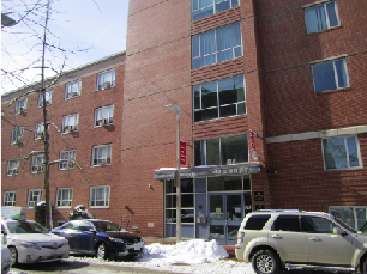 Figure 4: Kwong Kow Chinese School. Source: Author.
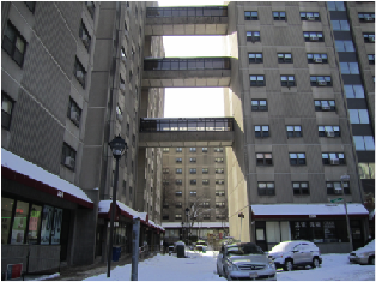 Figure 5: Large apartment complex at end of Tremont St. Source: Author.
Walking through Chinatown brought several questions to mind. Chinatown has a strong history rooted in immigration, which has definitely shaped the physical form of the district today—who was here before the Chinese? Will there be another group coming into Chinatown? Major highways mark a significant portion of the boundaries to Chinatown—when were they built? How was Chinatown affected by it? How much interaction does Chinatown have with the rest of the city? What defines Chinatown? Learning Chinatown’s past and seeing clues on how it was formed could help explain the process by which immigrants enter a city and also the history of a people who have made a part of Boston their own. If there are any patterns to be found, this could hint at the future of Chinatown and how it will develop later on.
Bibliography:
Clay, Grady. Close-Up: How to Read the American City. The University of Chicago Press: Chicago, IL. 1980: pp. 11-16, 38-65.