|
Photo: Bob Kusik
|
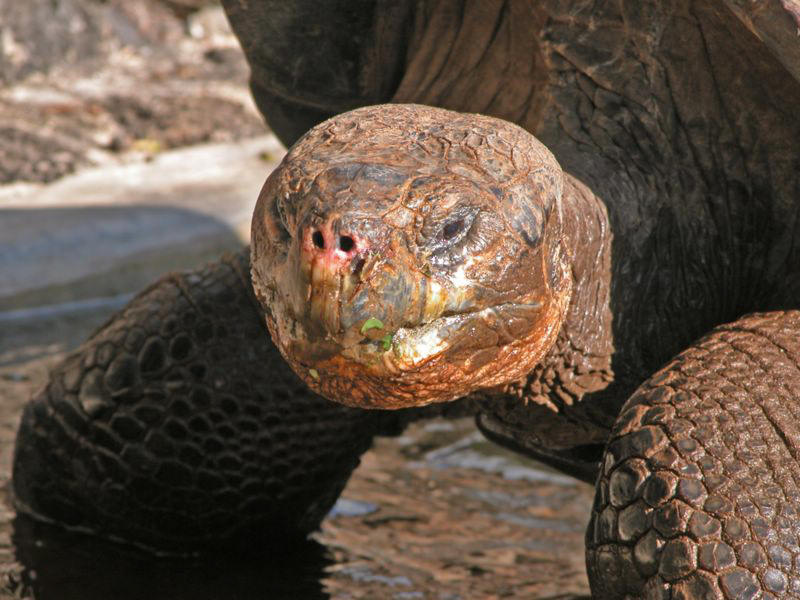
The Galapagos Islands are located in the Pacific ocean, 600 miles west of Ecuador's coast. The recorded discovery of the Islands was by Fray Tomas de Berlanga on March 10, 1535. He came upon them accidentally while sailing from Panama to Peru.
During the year 1570, mapmaker Abraham Ortelius mapped the islands, naming them the Galapagos Islands meaning "Islands of Tortoises," based on descriptions of the many tortoises on the islands. By the 17the century, the islands were used by buccaneers as a hideout place and a source of food on long journeys.
In 1835, naturalist Charles Darwin visited the islands while on a five-year long voyage of the H.M.S. Beagle. It was during his time spent on the islands that he formed his theory of biological adaptation, natural selection ,and evolution. He was able to form his theories after noticing the distinctness of the species that lived on different islands and realizing that their differences could not be attributed to the fact that they were on different islands, but to their feeding habits.
Since the Galapagos became a National Park in 1959 and the subsequent establishment of the Charles Darwin Research Station in 1964, the Islands have been a primary site of increased scientific study and tourism.
- - - - - - - - - - - - - - - - - - - - - - - - - - - - - - - - - - - - - - - - - -
ISABELA
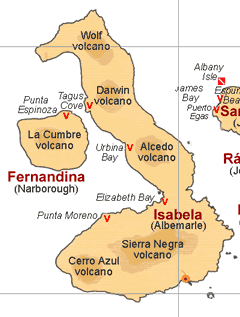
Extending 80 miles and having an area of 1800 square miles, Isabela
is the largest of the Galapagos Islands and lies on the
western edge of the archipelago. It was created by the lava of
six volcanoes flowing together. Some of the volcanoes are as high as
1,700m. It is home to the volcano with the second largest crater in
the world, the Sierra Negra Volcano; Its crater measures 10km (6
miles) in diameter.
FERNANDINA
Fernandina is located on the west side of Isabela and is the most western island in the Galápagos. It is one of the largest still-pristine islands in the world, currently having no introduced species. Its volcano is still very active and is quite young in age. From the base of the volcano into the sea extends a spit of sand and lava rock known as Punta Espinosa, which is often visited for black lava rock, mangroves, a variety of herons, yellow warblers, pelicans, frigates, the mangrove finch, petrels, shearwaters and the large population of marine iguanas. Fernandina holds the largest colony of marine iguanas.
|