REFLECTIVE MEMO
UNIFIED PROPULSION
Spring Term 2003, Ian Waitz
Learning Objectives
1. What are the learning objectives (expressed as measurable outcomes)
for this subject?
The subject learning objectives are contained on the course web page. A recommendation is made below about presenting these in a more compact manner. Note that these objectives represent a wide range of new topics relative to the time available for the students to learn the material. The objectives thus correspond to lower levels of cognitive ability (explain, describe, estimate, apply).
2. To what extent were you able to integrate the CDIO skills specified
for this subject in the Curriculum Plan of 2002?
I did not specifically implement any CDIO syllabus items since these are largely covered in the systems portion of Unified. However, some of the in-class concept questions and homeworks required 2.1.2 Modeling and 2.1.3 Estimation and Qualitative Analysis. I would say both skills were taught at the "Introduce" level.
Teaching Methods
3. What teaching methods did you use and what evidence indicates these
methods were successful or not?
a) Prepared lecture notes were available on the web for all
of the material: http://web.mit.edu/16.unified/www/SPRING/propulsion/index.html.
These notes have envolved over several years starting with a set of handwritten
lecture notes. Each year I try to augment them when I find specific areas of
difficulty from mud responses, etc. I am quite happy with them at this point.
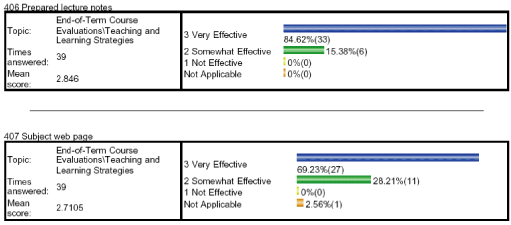
In the end-of-term evaluations 97% of the respondents rated the web page (for
all of Unified) Somewhat Effective or Very Effective. 100% of the respondents
rated the prepared lecture notes (for all of Unified) Somewhat Effective or
Very Effective.
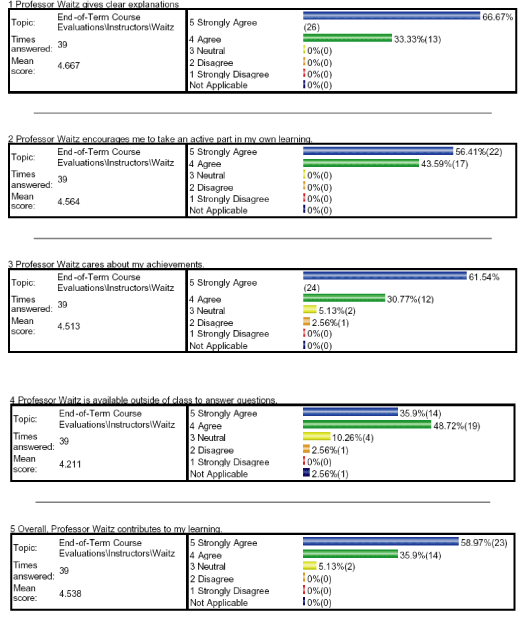
b) I used 16 concept questions over the 9 lectures with responses taken on the PRS system. The performance and answers to these were provided on the web page. I continue to find these very useful for engaging the class in the material while I am lecturing. 95% of the respondents on the SEF rated the in-class exercises as Very Effective or Somewhat Effective. Also several positive comments were made about the PRS/concept questions in the written comments from the end-of-term evaluations. In general my teaching reviews were good (see below), so I think the students found my lectures to be helpful to them.

c) I used mud cards for each lecture and responded to them the evening the lecture was delivered and put the responses up on web. These responses were linked to the relevant areas of the online notes. See for example P1 mud responses. 71% of the respondents on the end-of-term evaluations said the mud cards were Very Effective or Somewhat Effective, however the majority (61%) found they were only Somewhat Effective. Nonetheless, I still found the mud cards to be valuable to me for providing feedback on each lecture. Even in cases where there were very few respondents it was helpful, therefore I will continue to use these.

d) I wrote short assessments of each lecture (how they went). See for example P4 mud responses. This was mostly helpful for me, although I did use it to stress the important points from the lecture. I am not sure how many students read these responses. In general, I think that we have saturated the students in terms of available material on the web. Further information goes un-read.
e) I spent $1000 to have the CFM56 engine moved out of the lab and into the hallway outside of the classroom. For 4 of the lectures the students and I wheeled this into the classroom so I could point to specific features as I was presenting material. The comments from the students on this were very positive. It was particularly helpful for the section on ideal cycle analysis and the section on velocity triangles. On several occasions I found myself having conversations with students both in class and after class that would not have happened if not motivated by the presence of the engine (e.g. "Why are all the blades loose?", "How do they light the combustor?", and "How much does one of these cost?"). I was very pleased with how this worked out. I also gave a homework assignment that required the students to take measurements on the engine so they could directly see how the models (in this case velocity triangles) applied to the real article. Since no one has complained, I intend to leave the engine parked in the hallway since it gets much higher visibility there vs. the hangar.
Assessment Methods
4. How was each subject learning objective assessed and what evidence
indicates students achieved these outcomes?
The use of the PRS system in-class and the collection of, and response to, the mud cards gave me a large amount of data on the class performance (formative and summative). Also, as in the past in Unified, we collected data on time spent on various activities (its primary use is to make sure the class stays within bounds).
| Data Source | Formative |
Summative |
Feedback for Me |
| PRS System |
X |
. |
X |
| Time spent |
X |
. |
X |
| Muddiest Part of the Lecture |
X |
. |
X |
| Homework | X |
X |
X |
| Quiz | . |
X |
X |
| End-of-term SEF data | . |
. |
X |
| Class attendance | X |
The performance on the learning objectives was overall good with 33 out of 69 students in the class scoring above the Joe B (middle B=76.8 for propulsion) level on the propulsion section of Unified. Class average was 74 with a median of 75.8. the homeworks we all generally within the specified time bounds. In general, I continue to be frustrated with the wide array of learning objectives and the lack of depth in each. I am only able to devote 50 minutes of lecture and a one-hour homework to each topic. Specific comments on the learning objectives follow:
A. To be able to explain at a level understandable by a high school senior or non-technical person what the various terms are in the integral momentum equation and how jet propulsion works. (Quiz Problem 1). The mean performance on the quiz was 88% on this problem. Each year I stress to them that I will ask this on the quiz -- they seemed to get the message. Most even practiced writing out an answer before the quiz. The very few who did not do well on this really missed the boat -- not even describing forces relating to changes in momentum.
B. To be able to apply control volume analysis and the integral momentum equation to estimate the forces produced by aerospace propulsion systems (Homeworks P1, P2, P3 and Quiz Problem 2). I was a little disappointed in the performance on this material. It gets covered in Fluids also, and I devoted 3 out of 9 homeworks to it. Yet on the quiz when I gave a straight-forward uni-axial control volume many students forgot the pressure terms or had sign errors. The average performance was 81%. I was hoping they would have done better. (The homework scores were 89%, 70%, 76% for P1-P3.)
C. To be able to describe the principal figures of merit for aircraft engine and rocket motor performance and explain how they are related to vehicle performance. (Quiz Problems 3 and 4) This learning objective represents a fairly low level of cognitive ability. Nonetheless it was where most of the points on the quiz were lost. However, there was a very strong correlation with performance on these problems and attendance in class. Instead of giving a numerical problem, I gave two short discussion questions for the quiz. The questions were identical to examples I discussed in class. Those who attended the lectures did very well. Those who did not, did not. The average on the quiz for these two problems was 64% and 67% for the aircraft/gas turbines and rockets questions, respectively.
D. Given weight, geometry, and aerodynamic and propulsion system performance information, to be able to estimate the power required for flight, the range, the endurance, and the time-to-climb for an aircraft. (Homeworks P4 and P5, and Quiz Problems 3 and 4). The students performed fairly well on the homework problems (71% and 75%). These are applications of straightforward dynamics problems and they seem to do well with the mechanics of solving the problems. However, their shortcomings in explaining the underlying concepts (objective C above) are a concern.
E. To be able to explain at a level understandable by a high school senior or non-technical person the arrangement and layout of the major components of gas turbine and rocket engines. (Not assessed) Although this was not assessed, I spent more time discussing rocket engine pieces and parts than in the past. Combined with the presence of the gas turbine engine in class I hope that most of the students would be able to describe the overall layout of rocket engines and gas turbines-- but I have no evidence.
F. Given mass fractions, and propulsion system performance information, to be able to estimate the range and velocity of single-stage rockets. (Homework P6, Quiz Problem 4). They did well on P6 (80%) which is to be expected since they also saw this material in Dynamics, but note concerns relative to conceptual understanding as discussed for item C above.
G. To be able to describe the principal design parameters and constraints that set the performance of gas turbine engines. (Homework P7). I think the students may have difficulty with this. The one problem I gave them with this as a focus involved a bit of crunching in Excel/Matlab. Since they only had about an hour for the homework assignment, I think they spent most of the time worrying about Excel/Matlab and very little time thinking about the results. The average on the homework was 66%.
H. To be able to apply ideal-cycle analysis to a gas turbine engine to relate thrust and fuel burn to component-level performance parameters and flight conditions. (Homework P7). See discussion for G.
I. To be able to explain at a level understandable by a high school senior or non-technical person the energy exchange processes that underlie the workings of a multistage compressor or turbine. (Homeworks P8 and P9, Quiz Problem 5) Historically the students have had difficulty with this section, but I have developed enough visial aids (including the engine) and examples that they seemed to get a better understanding this year. While the performance on the homeworks was borderline (61% and 70%), I was pleased with the performance on the quiz. The class average on this problem was 77% and the median was 88%. I saw several students the evening before the quiz using some of the web materials and they said they were helpful.
J. To be able to use velocity triangles and the Euler Turbine Equation to estimate the performance of a compressor or turbine stage. (Homeworks P8 and P9, Quiz Problem 5) See discussion of item I. above.
Continuous Improvement
5. What actions did you take this semester to improve the subject as
a result of previous reflections or input from students or colleagues?
a) I located the engine within the classroom for several lectures for both motivational and explanatory purposes.
b) I increased the focus on space propulsion versus airbreathing propulsion (added one lecture on nozzle performance). This was in direct response to student comments from two years ago. This was enabled by two factors: first the appropriate phasing of the compressible fluid dynamics lectures prior to the propulsion lectures (I did not have to cover the introductory material), and second the coverage of most of the rocket equation material in the Dynamics section.
6. What did you learn about your teaching and assessment
methods this semester?
a) I learned that it is possible to reuse homework problems from 2 years ago
without many of the students going and digging up the old solutions. This is
beneficial because it allows me to develop and refine over several years two
series of effective homework problems and then alternate them every other year.
b) As noted above, I was pleased with the student performance on velocity triangles (after many years of struggling with how to present this material in only two lectures). I noticed many of them using the on-line tools including a Java applet for velocity triangles, and two animated tutorials (Tutorial 1 and Tutorial 2 ) that instruct the students on how to draw velocity triangles.
7. What actions do you recommend to improve this
subject in the future?
a) I recommend this material receive two additional lectures (11 instead
of 9). I believe that much of the reason for the lackluster performance on some
of the learning objectives is that I am stuffing too much into 9 lectures. Alternatively,
we could cut the a/c performance part and put it into systems? fluids? Unified
lectures? This needs to be someplace because it ties everything together, but
it doesn't necessarily have to be part of the propulsion lectures.
b) Develop a thermodynamics/cycle problem for a space propulsion application.
c) Investigate coordinating with Kristina Lundqvist to apply programming tools to the cycle analysis or rocket (perhaps multistage) performance material.
d) It may be helpful to combine learning objectives G & H, I & J and do-away with E. This is not proposed as a change in content so much as a way to group the content together in a more natural and more compact way.
Information Sharing
8. To whom have you forwarded this reflective
memo?
a) Unified teaching staff
b) 16.50 instructor
c) 16.050 instructor
d) Doris Brodeur and Diane Soderholm
Appendix: Subject Syllabus
• All course materials (syllabus, notes, homework, solutions, quiz) can be found on the Unified web page.

