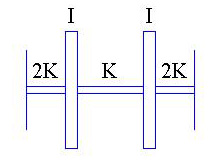
Problem 4.2 deals specifically with a symmetric system.
By 'boundary conditions' (for a symmetric system) I mean both:
Where and/or how is the system fixed/constrained to any points outside the system (globally)?
What are the boundary conditions at the center-point of the system for either:
An odd mode shape
An even mode shape
Here's a simple example of a symmetric (rotational) system, which is fixed at either end:
By symmetry arguments, you can say each mode for a symmetric system will be either 'odd' or 'even'.
Using the system above as an example (with I_1 and I_2 having rotations theta_1 and theta_2):
For an even mode:
Therefore, the system acts as if no spring is in the center, in our example.
(There is never any difference in rotation between theta_1 and theta_2, so the spring stores no energy. It may as well not be there if this is the case.)
For an odd mode:
Therefore, the center-point of the system must stay fixed at 'zero'.
(For an odd shape function, you have to go through zero at the center-point, so the system may as well be fixed in the center, if this is the case.)
To see some examples of odd and even mode shapes 'in action':