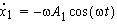
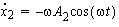
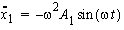
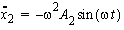
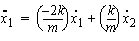
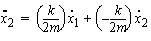
to get frequencies and relative amplitudes associated with the modes.
Now that you have your equations of state, you can perform some algebraic gymnastics.
This should be relatively straight-forward (but potentially prone to simple math errors).
Here is a sequence of manipulations I used for the translational system. An outline of my thinking is:
Realize (largely from experience) that the solutions will clearly be SINE WAVES.
At each mode's natural frequency, each of the masses will have the same frequency of oscillation but typically different amplitudes.
I want to solve to find:
Each modal frequency that satisfies my state equations.
The relative amplitudes of all masses (wrt one another) at each modal frequency.
(Note that the masses can be in-phase (amplitudes have same sign) or out-of-phase (amplitudes have opposite sign).)
I care about the ratios of the amplitudes involved, so I can just set A1 = 1 and solve for A2. (I just want to get A2 relative to whatever A1 is.).
Now that we have the game plan, let's go!
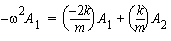
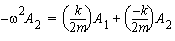
Recall your relations from the 'A' matrix (or other format of state equations), and then plug in values for x and d2x/dt2 from above:
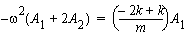
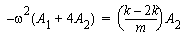
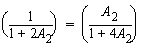
Now, use/add those bottom two equations to eliminate either the 'A2' (at left below) or 'A1' (at right below) term on the righthand side:
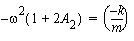
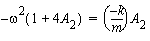
Set "A1=1"
Now, since "w^2" is in each of the last two equations, you can relate the two equations. Then reduce to get a quadratic expression for A2.
Finally, you can plug each solution for A2 back into an equation to solve for each, respective frequency (associated with each solution to A2). [Using, for instance, either of expressions on the second-to-last equation line on this page...]
Clearly, you don't have to use the same steps I did here! The main thing to keep in mind is your own 'game plan' for finding solutions (A2 and w for each mode shape) to satisfy the state equations.