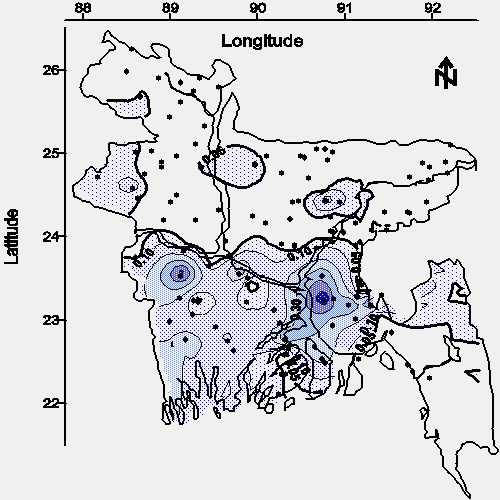
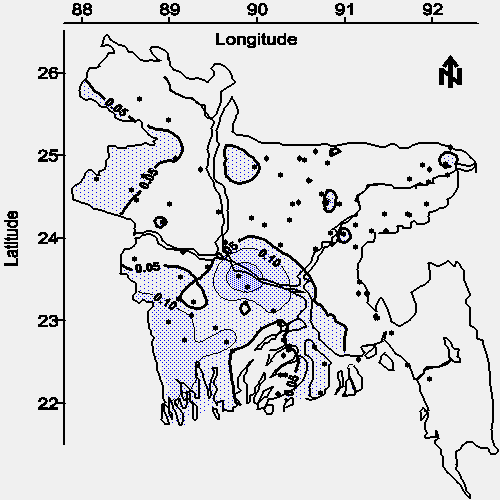
The Government of Bangladesh and various nongovernmental organizations are currently evaluating a policy of drilling deeper tubewells to access drinking water with arsenic concentrations less than the 0.05 mg/L national standard. Our findings suggest that drilling deeper tubewells will sometimes access "cleaner" water, but will seldom provide ready access to drinking water with arsenic concentrations less than the national standard.
Drilling deeper tubewells will sometimes access groundwater with less arsenic than adjacent shallower tubewells. This benefit is suggested by superimposing Figures 2 and 3, which yields significant areas with higher average arsenic concentrations in shallow tubewells and lower average arsenic concentrations in deep tubewells.
|
|
Moreover, the negative correlation (r = -0.19) between arsenic concentration and tubewell depth shown in Table 3 suggests that arsenic concentration may decrease with depth in some areas of Bangladesh. Exceptions to this slight trend are noteworthy. The superimposition of Figures 2 and 3 also suggests that drilling shallower tubewells may access water with less arsenic in a relatively small portion of northwestern Bangladesh and other localized areas.
Nevertheless, the success of drilling deeper tubewells will likely be limited because the drinking water it provides will often have arsenic concentrations greater than the national standard. This limitation is suggested by superimposing Figures 2 and 3, which yields significant areas with average arsenic concentrations above 0.05 mg/L in both shallow and deep tubewells. Moreover, this limitation is also suggested by the repeated arsenic concentrations greater than 0.05 mg/L at depths more than 250 m (820 feet) bgs (see Figure 4).
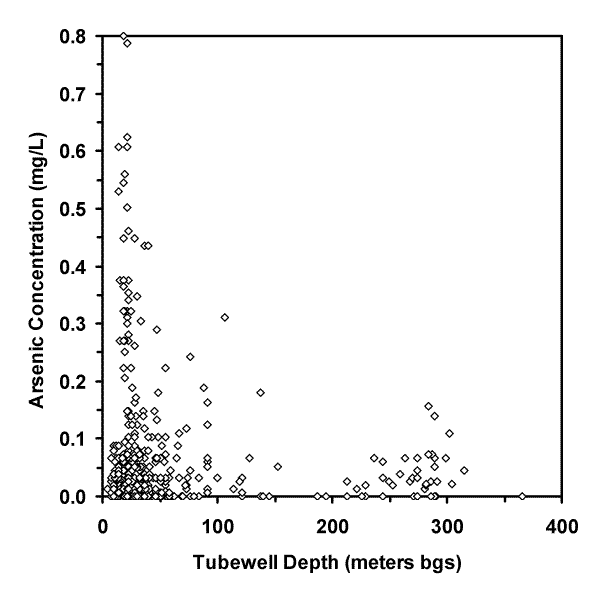 |
| Figure 4. Graph of arsenic concentration (mg/L) versus tubewell depth (meters below ground surface, bgs). |
The success rate of drilling deeper tubewells was estimated using Figure 5.
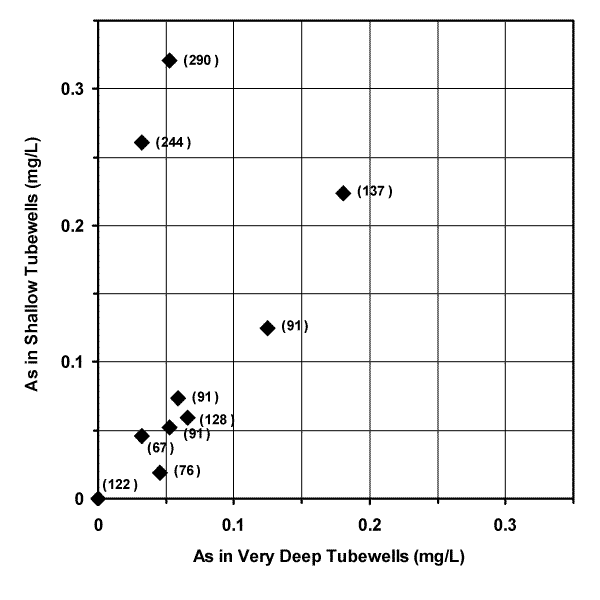 |
| Figure 5. The vertical distribution of arsenic in groundwater based on adjacent pairs (< 100 m or < 328 feet apart) of "very deep" (67.1 to 290 m bgs or 220 to 950 feet bgs) and shallow (< 30.5 m or < 100 feet bgs) tubewells. The depth of each "very deep" tubewell in meters is shown next to the corresponding data point. |
These results suggest that drilling deeper tubewells provided access to water with markedly less arsenic in only 2 of 10 cases; however, this frequency may increase by installing even deeper tubewells. The 2 "very deep" tubewells which yielded this improvement were significantly deeper (244 and 290 meters bgs, or 800 and 950 feet bgs) than the remaining 8 "very deep" (67 and 137 meters bgs, or 220 to 450 feet bgs) tubewells. Only 1 of these 2 "very deep" tubewells successfully accessed drinking water with arsenic concentrations less than the 0.05 mg/L national standard. A more extensive study of arsenic concentrations in adjacent "shallow" and "very deep" tubewells should be done to better estimate the success rate of drilling deeper tubewells to access safe drinking water.
Nevertheless, this relatively low apparent success rate coupled with the potential of a prolonged effort at a high cost suggest that drilling deeper tubewells should be a minor component of an overall strategy used to provide safe drinking water to the people of Bangladesh. This approach should likely be restricted to the estimated 15% of Bangladesh that cannot find drinking water with arsenic concentrations less than the 0.05 mg/L national standard from existing tubewells within their villages. Therefore, drilling deeper tubewells will likely complement groundwater treatment to provide safe drinking water for this 15% of Bangladesh.