






| State of the Industry | Common Services Layer |
| Case Studies |
Economic
Realities
The convention
and trade show industry is in an unprecedented slump resulting from an
economic downturn, decreased willingness to travel due to fear of terrorist
attacks or contageous diseases. For the first time, the industry needs
to find new ways to attract customers.
Strong
need for a new market approach
"Trade
shows simply are so 'first half of the 20th century'; they're still bazaars,"
said Gary Slack, chairman-CEO of marketing agency Slack Barshinger . .
. Slack said trade shows were in danger of no longer being a primary marketing
vehicle and that the industry needs more innovation, standardization and
an auditing feature, as exists in other marketing media".
BtoB, 87 : 3, August 12, 2002
The convention, exhibition and meeting industry has been
slow to innovate and currently has no accepted model to drive innovation.
Case Studies
The research team investigated existing use of technology in the convention industry by looking at two important industry players, the general services contractor and the show management company. Observing show operations during the International Boston Seafood Show and conducting interviews with company executives and employees, the team documented current processes and identified technology needs and opportunities for revenue growth through increased efficiency and more effective business-to-business communications.
General Services Contractor - The Freeman Corporation
Freeman Corporation,
a general services contractor, is recognized as one of few leaders in
a highly fragmented industry. The company provides a wide variety of services
through its own business units. With regards to information technology,
Freeman emerged as an industry leader in managing BOH processes and offering
customer-facing applications to enhance interaction with exhibitors. Among
software applications used by Freeman is a proprietary enterprise system
that includes exhibitor services, sales, accounting and material handling
modules.
The Freeman case confirmed a need for the following applications and technologies:
• Web Applications (Web Services) that integrate and allow communication
between vendor and exhibitor
• Wireless Tools to be used by both Exhibitor Services and Exhibitors
Onsite
• RFID (Radio Frequency Identification) use in Material Handling
Processes
Show Mangement - Diversified Business Communications
Diversified
Business Communications provides information and market access through
trade exhibitions, publications, and online resources. The company has
been in the show management businesses for over 30 years and currently
provides market access at over 40 shows worldwide.
DBC relies on commercial CRM and accounting software and is in the process
of database consolidation and integration. To provide additional services
to its customer, the company is moving from web publishing to more interactive
communications via the web.
The DBC case pointed towards the following potential technology applications:
• Web
Applications (WebServices) that integrate and further facilitate communication
between exhibitors, visitors, show management and third party vendors
- Sharing of databases, floor plans
- One-stop shopping for registration, travel services, personal calendar
• Wireless Tools to be used onsite to facilitate show logistics
as well as visitor/exhibitor communications (peer-to-peer applications)
Value Drivers for Conventions and Trade Shows
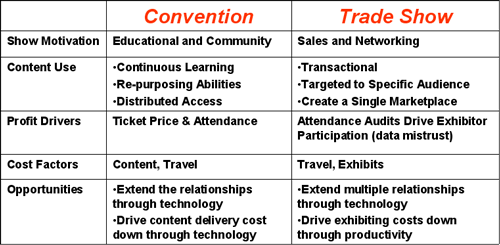
As part of the research, the team evaluated the need for convention and trade show companies to respond to different value drivers in order to stay competitive in the future. While the results point to differences in applications, both segments of the industry can expect significant gains from use of technology in their day-to-day operations.
Convention of the Future would draw on MIT research to create an industry-wide service-based architecture, clearly defining points of interoperability as the basis for creating swappable modular bundles of new and existing software. Among the benefits would be reduced long-term cost of information technology ownership and operation, as well as creation of an entirely new market to drive software development.
Click
here for the diagram showing the relationship of the architecture’s
components.