Southern California
The timeliness of the recent wildfires in Southern California makes this area worth exploring further. While California has an extensive history of wildfires that have burned throughout the state at different scales, two recent years stand out: 2003 and 2007. Below is a brief overview of the significant events during each year’s wildfire season.
October 2003
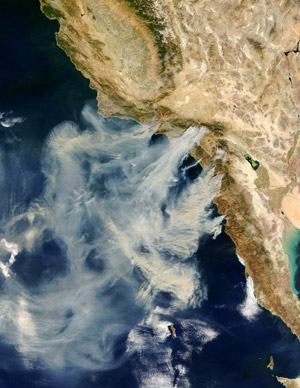
Source: http://earthobservatory.nasa.gov/NaturalHazards/Archive/Oct2003/California.TMOA2003299_lrg.jpg
In October 2003, more than a dozen wildfires burned throughout Southern California.
The largest fire, the Cedar Fire, began on October 21st and burned almost 300,000 acres. It destroyed more than 2,200 homes and fifteen individuals died. It remains the largest fire in recorded California history.
Other fires included the Roblar 2, Pass, Grand Prix/Padua, Piru, Verdale, Happey, Old, Simi, Paradise, Mountain, Otay, and Wellman. These fires were located in the following counties: San Diego, Riverside, San Bernardino, Los Angeles, Ventura, and Santa Barbara. The majority of these fires were believed to be caused by humans, either accidentally or intentionally. In total, more than 750,000 acres burned during what is now referred to as the “2003 Fire Siege” or “2003 Firestorm”.
October 2007
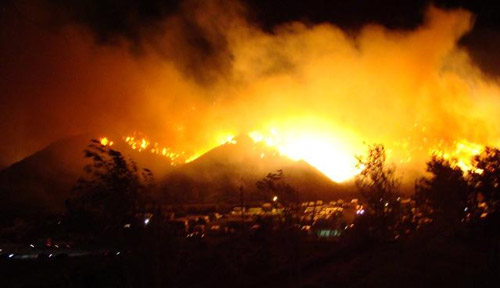
Source: http://www.knbc.com/news/14389059/detail.html#
Beginning on October 20th, a series of wildfires once again began burning across Southern California. These fires included Witch (Creek), Harris, Poomacha, Horno/Ammo, Rice, McCoy, Coronado Hills, and Wilcox. While none of these fires quite rivaled the size of the Cedar Fire in 2003, they nonetheless burned more than 500,000 acres. Over 900,000 people were evacuated at different times (reported to be the largest number of evacuees in California history), and at least 1,500 homes were destroyed. Nine lives were lost in the fires and dozens more were injured, including 61 fire fighters.
Seven counties in Southern California were declared to be in a state of emergency. It was not until several weeks later on November 6th that the fires were reported to be under control. Once again, many of the sources were a result of human activities: overturned semi, power lines, matches, arson, and more.
More information about the Southern California wildfires can be found here.