The Aftermath
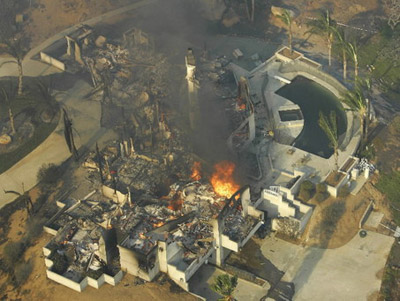
Source: http://blog.pennlive.com/lehighvalley/2007/10/at_least_half_million_flee_rag.html
Following what became known as the “2003 Firestorm,” Dr. Jon Keeley, professor and research scientist, highlighted three important lessons to be learned from the October 2003 wildfire season:
1) Although these fires were massive, their size was not unprecedented, and thus we can expect similar fire events in the future.
2) The current fire management policy is not effective at preventing these massive fires.
3) Future developments need to plan for these natural fire events much the same way we currently incorporate engineering solutions to earthquakes and other natural catastrophes.
Another report released after the Firestorm of 2003 (called the Lessons Learned Report), said that firefighters needed the concept of “safety” better defined in severe fire situation. This report was written for the Wildland Fire Lessons Learned Center and outlines how the wildland/urban interface poses a new frontier for firefighters and that today’s challenge is to define the rules of engagement.
“It’s a whole new world and people are put increasingly into situations that are outside their norm of experience,” he says. “How does a 24-year-old Fire Captain rolling into an area that’s been evacuated determine the level of risk needed for people who have chosen to stay? How much risk should be taken for a home? What are the expectations for a firefighting force in the WUI?” Smith further states, “The game is different now, we’ve had interface fires for years but not these mega fires.”
A third report, 2003 San Diego County Fire Siege Fire Safety Review, was prepared and presented to the Governor's Blue Ribbon Fire Commission. This report criticized the overall response. It stated that though the fire conditions and severity should have been expected, the responsible agencies were not properly prepared when the fire broke out, and radio communications problems exacerbated the problem. The report cited disorganization, inconsistent or outdated policies as the major hindrance to mobilizing resources and standing in the way of effective planning.
How far have we come with these lessons? The wildfires in October 2007 made it clear that we can expect similar fire events in the future.
However, compared to the Cedar Fire, resources were more efficiently used and evacuations were organized much more quickly. A computerized Reverse 911 phone call system in San Diego County enabled residents to be notified more efficiently for evacuation.
Governor Arnold Schwarzenegger has requested that the Blue Ribbon Task Force review the Governor’s Blue Ribbon Fire Commission’s 2003 recommendations to evaluate if these recommendations are still the best and most effective ways in preventing and fighting fires and assess the next steps to take at federal, state and local levels of government to prevent and fight future fires.
From all of this, one thing is certain. Despite our sophisticated mitigation techniques, we are still putting people in harm’s way by allowing development to continue in fire prone areas. An article in the February 13, 1994 edition of the Los Angeles Times summarized the problem succinctly:
“Southern California’s stored hillsides nurture native vegetation that is literally explosive. Many types of chaparral plants reproduce only after a wildfire has moved through. But these hillsides also provide what much of the area can’t: a rural feel, scented air, scenic views of ocean and city. They are the most desirable, expensive real estate in California. And they burn.”
Although this was written more than ten years ago, it’s clear that risks have increased.
Why is this? Understanding perceptions of risk and other factors, including the economics, is an important part of the story. Clearly there is a strong desire to live in these areas. However, on the flip side of the short term gains to allowing development in these areas, the cost and resources required to protect lives and homes from wildfire should not go underestimated.
All of this underscores the importance of recognizing wildfires as a serious natural hazard.