Next-Generation AI for High-Dimensional Biomedical Data: Towards Interpretable and Data-Efficient Discovery
2nd April 2026
Timing : 1 pm ET
Please use this zoom link for joining the webinar
For a list of all talks at the NanoBio seminar series Spring'26, see here
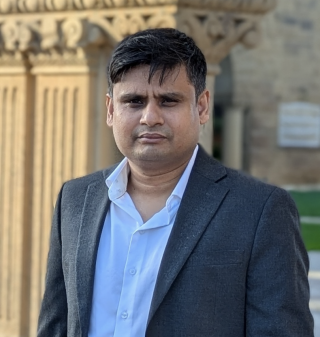
Dr. Md Tauhidul Islam
Md Tauhidul Islam is an Assistant Professor in the Department of Radiation Oncology at Stanford University, where he develops artificial intelligence methods for high-dimensional biomedical data analysis. His work centers on interpretable and data-efficient AI for medical image analysis, genomics, spatial omics, single-cell data, and graph-structured biological systems. He has introduced novel frameworks that transform biomedical data into spatially semantic image representations, making them more informative, interpretable, and amenable to deep learning. His research has contributed to advances in medical AI, structured data analysis, unstructured data analysis, and multimodal biomedical modeling. Dr. Islam has authored numerous peer-reviewed papers in top venues, including Nature Biomedical Engineering, Nature Computational Science, Nature Communications, Science Advances, and IEEE Transactions on Pattern Analysis and Machine Intelligence. He received the Amato Giaccia Award for Excellence in Translational Research in the Radiation Sciences in 2024 and currently leads an NIH/NLM R00-funded project on high-performance deep neural networks for medical image analysis.
Md Tauhidul Islam is an Assistant Professor in the Department of Radiation Oncology at Stanford University, where he develops artificial intelligence methods for high-dimensional biomedical data analysis. His work centers on interpretable and data-efficient AI for medical image analysis, genomics, spatial omics, single-cell data, and graph-structured biological systems. He has introduced novel frameworks that transform biomedical data into spatially semantic image representations, making them more informative, interpretable, and amenable to deep learning. His research has contributed to advances in medical AI, structured data analysis, unstructured data analysis, and multimodal biomedical modeling. Dr. Islam has authored numerous peer-reviewed papers in top venues, including Nature Biomedical Engineering, Nature Computational Science, Nature Communications, Science Advances, and IEEE Transactions on Pattern Analysis and Machine Intelligence. He received the Amato Giaccia Award for Excellence in Translational Research in the Radiation Sciences in 2024 and currently leads an NIH/NLM R00-funded project on high-performance deep neural networks for medical image analysis.