|
summer 2007
issue 13.1
|
||||
|
Patient to patient | MIT Medical and beyond | Both sides of the story | Getfit@mit 2007: Another successful challenge | Meet the getfit@mit winners
{ print
version
 } }MIT Medical and beyondPatients have a guide in MIT Medical's care manager Navigating the healthcare system outside of one's primary care provider and usual specialists can be like a trek into uncharted territory. But members of the MIT Health Plans who must venture into this wilderness are lucky enough to have a guide-Kim Carroll, R.N., MIT Medical's care manager. "Basically, I'm a resource for coordinating any care patients need to receive outside and inside MIT Medical," Carroll says. "For example, if a patient is seen in Urgent Care and referred out to a hospital on an emergency basis, I follow up with the hospital to see if the patient has been admitted. If so, I contact the patient and his or her outside clinicians to coordinate what happens next, whether he or she comes back to us, goes home, or moves to another facility. "If the patient has been discharged," Carroll continues, "I get the discharge information from the hospital and follow up with the patient to make sure, first of all, that he or she is clear on the discharge instructions and is getting necessary medications. And I plug the patient in with whomever he or she needs to see for follow-up care here at MIT Medical." Carroll is also a valuable resource for patients having elective surgery. "Surgery patients are usually referred to me by their primary care physicians," Carroll says, "but any MIT Medical patient can also contact me directly." Involving a care manager can be an important part of the planning process for a scheduled operation, she notes. "For example, I take care of referrals for outside services patients are expected to need during recovery," she explains. "This would include things like home care or visiting nurses." To cut expenses, most insurance plans now mandate very short hospital stays for many surgical procedures and designate other operations as "day surgery." But for MIT Health Plan members and students, Carroll can often arrange discharge from the outside hospital to an overnight stay in MIT Medical's Infirmary for further recuperation, rather than an immediate return home. "This can be a good option for someone who needs pain management, for example, or has developed nausea and vomiting after anesthesia," Carroll explains. "And, of course, my job includes discharge planning and coordination of outpatient services for all patients going home from here." MIT employee Janet Snover, a 32-year member of the MIT Health Plan, was grateful to spend several days at the MIT Medical Infirmary after undergoing emergency surgery two years ago. "Being in the Infirmary was an incredible benefit for me," she recalls. "It was much quieter than the hospital; the staff had time to really help me; and my husband and MIT friends could visit me during the day. "And being back on campus did wonders for my recovery," she adds. My eyes filled with tears as the ambulance bringing me from the hospital pulled up to Medical to bring me to the infirmary, because I felt like I was 'home.'" Though Carroll was trained as a nurse, her care coordinator role has made her a communications and health insurance specialist as well. "Much of what I do involves managing information," she notes. This includes helping to make sure medical information from outside providers is entered into MIT Medical patient medical records and working directly with health insurance representatives to get answers on coverage questions. "When patients are sick or need to have surgery, we want them to be able to concentrate on getting better," Carroll says. "My job is to give them one less thing to worry about."
{ print version
} |
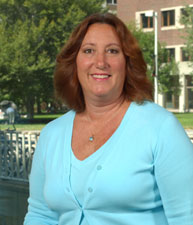 MIT Medical's care manager, Kim Carroll, R.N., describers
her job as giving patients who are dealing with surgery or illness "one less
thing to worry about."

|
|||
 |
 |
 |
 |
|


Building E23, 25 Carleton St. (Mail to 77 Mass Ave.)
Cambridge MA 02139-4307 Telephone 617-253-4481 |
||||

