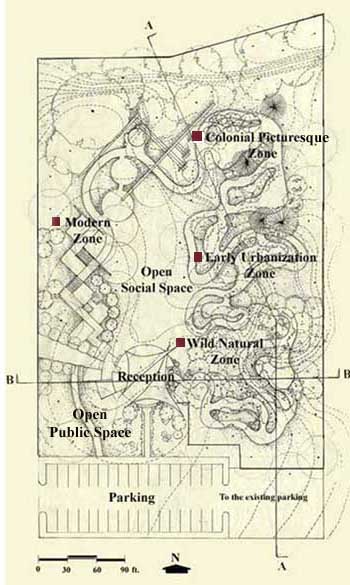
The next three holes are of the pre-colonial period. To represent that
period a natural setting was used, with less floral diversity. Some shaped
natural materials are used as furniture and pavement.The colonial zone is
next. It is the era where human beings were able to change the natural setting,
but that was minimal.In this part of the design I am presenting the colonial
picturesque style with large enclosed open spaces by dense trees, a lagoon
and winding paths.
The urban zone is next. The industrial revolution era in that wheel like
shapes were used to symbolize the industry, since it is the main common
item in all factories. The path to this zone is relatively tall from the
colonial zone, that is to give a chance for purity in thinking and to enhance
the since of contrast. The ground is elevated before the industrial area
to assure separation. All that is necessary because what is coming is the
main cause of the declination of nature in the area.
The modern urban zone is next. That will be discussed in detail later.
The setting is simple, strait forward to resemble a line of production in
a factory, never the less the holes are much harder than before. Following
that is the earl 19th century style urbanization, that is were speed became
a major factor in life. That caused the invention of the grid pattern
layout, which is all over the Mill Creek community. The grid like path is
resembling the lack of identity in such a layout, that is why I had all
the halls in an identical squares. Following that is the modern era where
environmental awareness became a trend, and some times an act to follow
the up to date fashion. Nature is a symbol in that zone fighting the walls
of urbanization. That will summarize the role of humanity in the environmental
statues in that community and in the globe, and hopefully will expose the
visitors to the importance of Nature. |