REFLECTIVE MEMO
UNIFIED PROPULSION
Spring Term 2006, Ian Waitz
(Previous Reflective Memo is here)
Learning Objectives
1. What are the learning objectives (expressed as measurable outcomes)
for this subject?
The subject learning objectives are contained on the course web page. Note that these objectives represent a wide range of new topics relative to the time available for the students to learn the material. The objectives thus correspond to lower levels of cognitive ability (explain, describe, estimate, apply).
2. To what extent were you able to integrate the CDIO skills specified
for this subject in the Curriculum Plan of 2002?
I did not specifically implement any CDIO syllabus items since these are largely covered in the systems portion of Unified. However, some of the in-class concept questions and homeworks required 2.1.2 Modeling and 2.1.3 Estimation and Qualitative Analysis. I would say both skills were taught at the "Introduce" level.
Teaching and Assessment Methods
3. What teaching and assessment methods did you use and what evidence indicates
these methods were successful or not?
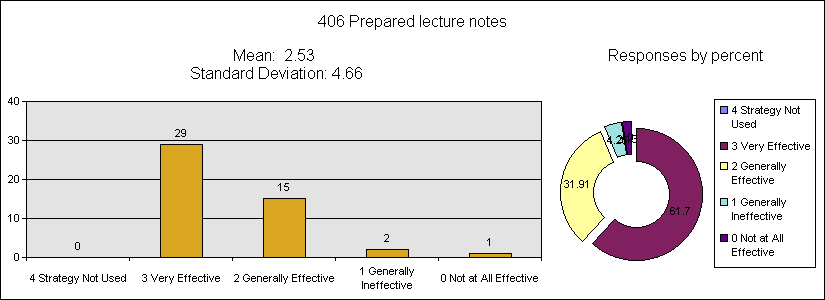
a) Prepared lecture notes were available on the web for all
of the material: http://web.mit.edu/16.unified/www/SPRING/propulsion/index.html.
These notes have envolved over several years starting with a set of handwritten
lecture notes. Each year I try to augment them when I find specific areas of
difficulty from mud responses, etc. I am quite happy with them at this point.
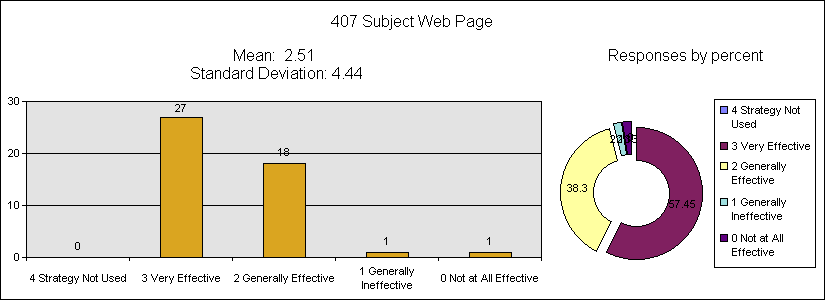
In the end-of-term evaluations 96% of the respondents rated the web page (for
all of Unified) Generally Effective or Very Effective. 94% of the respondents
rated the prepared lecture notes (for all of Unified) Generally Effective or
Very Effective.
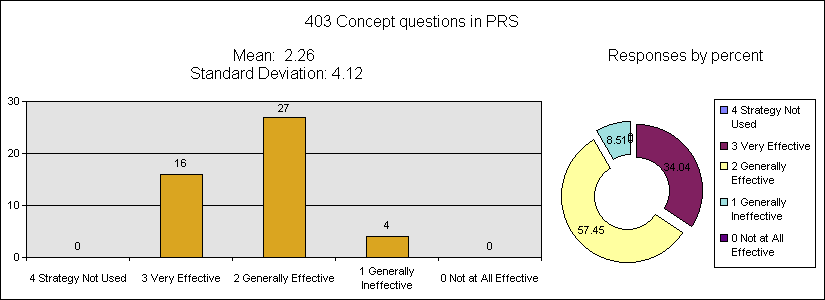
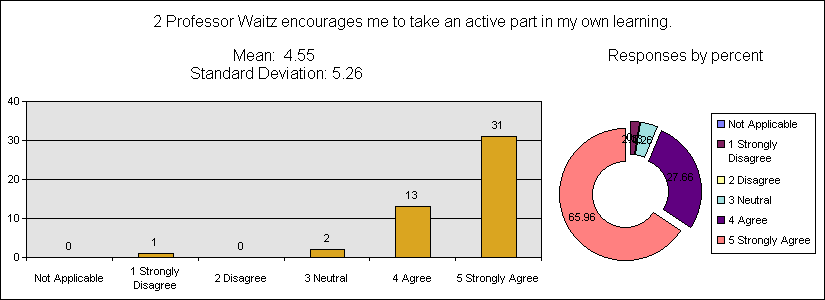
b) I used 16 concept questions over the 9 lectures with responses taken on the PRS system. The performance and answers to these were provided on the web page. I continue to find these very useful for engaging the class in the material while I am lecturing. 91% of the respondents on the SEF rated the concept questions in PRS (for all of Unified) as Very Effective or Generally Effective. Also several positive comments were made about the Propulsion lectures and active learning in the written comments from the end-of-term evaluations. 94% of the respondents to the SEF Agreed or Strongly Agreed that I encourage them to take an active part in their own learning. In general my teaching reviews were good (see below), so I think the students found my lectures and homework assignments to be helpful to them.
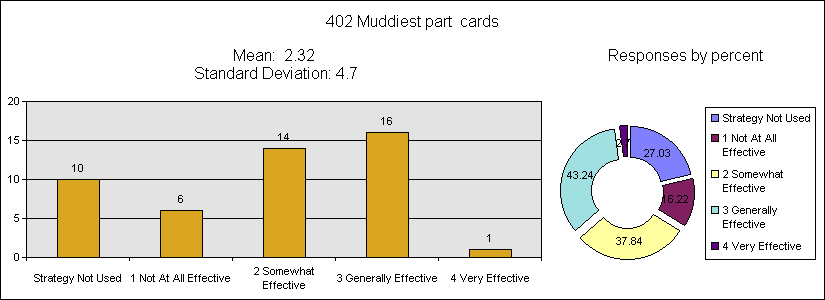
c) I used mud cards for about half the lectures. This is following a 3-year trend of both the students and the instructors finding them to be less valuable (see prior Reflective memos). The reviews below reflect this. I typically received 4-5 cards on the days that I used them.
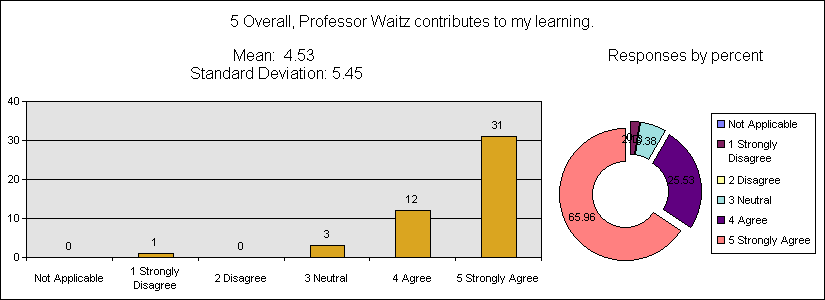
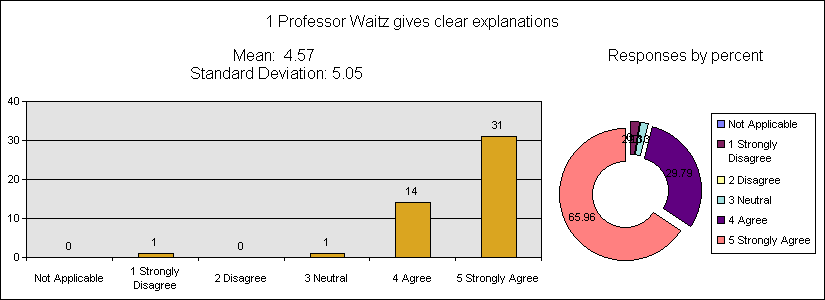
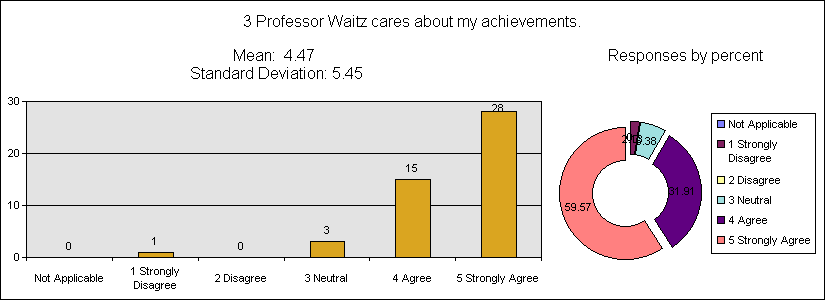
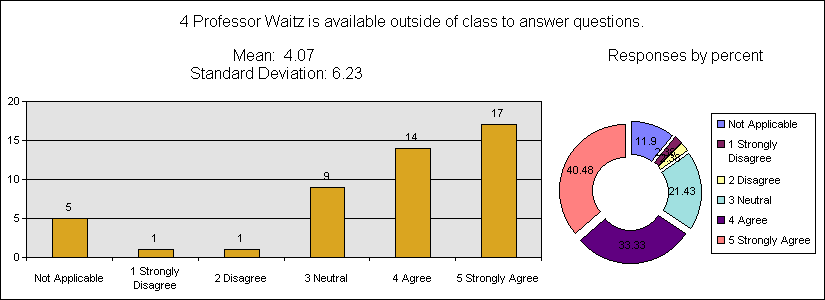
d) My other teaching reviews were also good (overall rating of 4.53 out of 5) and there were several specific positive comments in the essay responses to the SEF. Details follow.
e) For 2 of the lectures, the students and I wheeled the CFM56 engine into the classroom so I could point to specific features as I was presenting material. As in the past, the comments from the students on this were very positive. It was particularly helpful for the section on velocity triangles. On several occasions I found myself having conversations with students both in class and after class that would not have happened if not motivated by the presence of the engine (e.g. "Why are all the blades loose?", "How do they light the combustor?", and "How much does one of these cost?").
f) Based on Steve Hall's suggestion in a prior year (and data collection -- see ST2004 reflective memo) and good experience with the technique, I continued to use a method of getting the students actively involved in the recitation sections. Instead of doing any lecturing, I brought in old exam questions and had them all break-up into groups of 2-4 and work the questions at the board while I roamed around and provided advice. In most cases we made it through 2 questions.
g) Based on recommendations from prior years, I removed the lecture on ideal cycle analysis of gas turbines for jet propulsion. In the past there was little time to do anything other than push a large amount of new nomenclature and equations at the students. This was also motivated by losing part of a lecture. Something had to come out.
h) As we did in the fall, we continued to use unannounced bonus quizzes to encourage studying the material and attending class. The students responded well to this (see fall 2005 Reflective Memo for data). The additional points (5%) were added to the quiz score, but not to the Joe B score. Of the students who took the bonus quiz, the median score was 3/5. When including those who did not take the quiz, the median score was 2/5.
i) I bought the class a pizza lunch and hosted the demonstration of the Sophia micro-turbine and the firing of a rocket motor on the front lawn. This was loud and fun.
Student Learning
4. How well did the students perform on each subject learning objective? (Where possible, make reference to specific data to support your conclusion.)
The use of the PRS system in-class and occasional collection of the mud cards gave me a large amount of data on the class performance (formative and summative). Also, as in the past in Unified, we collected data on time spent on various activities (its primary use is to make sure the class stays within bounds).
| Data Source | Formative |
Summative |
Feedback for Me |
| PRS System |
X |
. |
X |
| Time spent |
X |
. |
X |
| Muddiest Part of the Lecture |
X |
. |
X |
| Homework | X |
X |
X |
| Quiz | . |
X |
X |
| End-of-term SEF data | . |
. |
X |
| Class attendance | X |
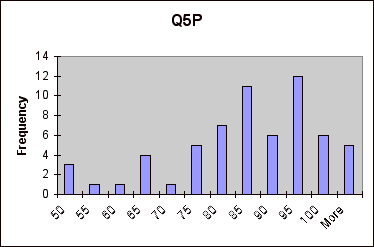
The performance on the learning objectives overall was good. I will address the performance on each of the learning objectives in greater detail below. Before I do, I will provide some of the summary data. The following figure shows the performance on the Propulsion Quiz. Overall I was pleased with the class performance. Joe B on the quiz was 79. The median score was 85 (this includes a 2-3% increase of the the potential 5% bonus for the unannounced in-class quizzes).
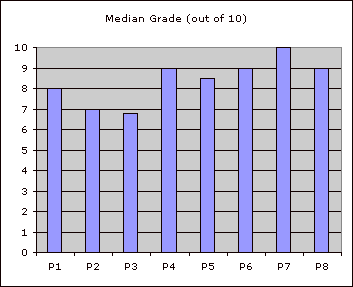
The homework scores (below) were all very good:
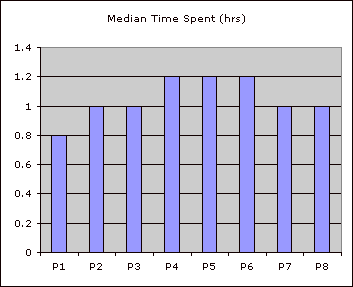
Even though all the homework problems were new, most of them were completed by the students within the expected time bounds (it is always a challenge to get this right when designing the problems from scratch):
Specific comments on the learning objectives follow:
A. To be able to explain at a level understandable by a high school senior or non-technical person what the various terms are in the integral momentum equation and how jet propulsion works (Homeworks P1, P2, P3 and Quiz Problem 1). The students did well on the homeworks related to this learning objective and achieved a median score of 28 out of 40 on the first problem of the quiz which was an integral control volume problem for a device with one inlet and two exits at different angles. However, I did not directly test them on this learning objective (e.g. by asking them to explain this). While they seem to have a grasp of the overall relationships they still have deficiencies in applying the integral momentum equation to a control volume as discussed below.
B. To be able to apply control volume analysis and the integral momentum equation to estimate the forces produced by aerospace propulsion systems (Homeworks P1, P2, P3 and Quiz Problem 1). This continues to be an area of concern. The students did about the same this year as last year on the quiz problem (about 70% median score). The students make many mistakes in applying the integral momentum theorem (sign errors, incorrect evaluation of dot-products, and missing or extra terms). It gets covered in Fluids also, and 3 out of 8 homeworks were devoted to it. Notably, the performance on these three homework problems (8, 7, 6.8 respectively) is the lowest of all 8 of the homeowrk problems. The median score of 28 of 40 on the quiz suggests that about half the students are below Joe B on this learning objective. I think they need more practice to be comfortable with applying the integral momentum equation (about double the number of homework problems).
C. To be able to describe the principal figures of merit for aircraft engine and rocket motor performance and explain how they are related to vehicle performance. (Homeworks P4 and P5 and Quiz Problem 2) I believe most of the students achieved this learning objective. The students did well on the homework problems. The median performance on the quiz for the second problem was 22/25 (this problem focused on rockets).
D. Given weight, geometry, and aerodynamic and propulsion system performance information, to be able to estimate the power required for flight, the range, the endurance, and the time-to-climb for an aircraft. (Homework P4). I believe most of the students achieved this learning objective based on their performance on the homework question. I tailored the homework question to be directly relevant for the airplane they were designing for the spring systems problems. I did not directly assess the student understanding of this on the quiz.
E. Given mass fractions, and propulsion system performance information, to be able to estimate the range and velocity of single-stage rockets. (Homework P5, Quiz Problem 2). Most of the students achieved this learning objective based on the good performance on the homeowork (8.5/10 median) and on the excellent performance on the quiz problem (22/25 median score).
F. To be able to describe the principal design parameters and constraints that set the performance of gas turbine engines, and to apply ideal-cycle analysis to a gas turbine engine to relate thrust and fuel burn to component-level performance parameters and flight conditions. As noted above, due to losing part of a lecture, I had to remove something. This was it. I did not teach this material or assess it.
G. To be able to explain at a level understandable by a high school senior or non-technical person the energy exchange processes that underlie the workings of multistage compressor or turbine, and to be able to use velocity triangles and the Euler Turbine Equation to estimate the performance of a compressor or turbine stage. (Homeworks P3, P7 and P8 , Quiz Problem 4) Most of the students achieved this learning objective. The performance on the quiz was excellent (a median of 34 out of 35 points). The performance on the homeworks was also good. This is an area where I have provided many different learning aids to the students. A video of the lecture is available thanks to OCW.
Continuous Improvement
5. What actions did you take this semester to improve the subject as a result of previous reflections or input from students or colleagues?
a) I used Bonus Quizzes in this section of Unified for the first time.
b) I (finally) removed some material (ideal cycle analysis) after struggling to fit everything in for many years.
c) I bought the class lunch and hosted a demo of the small gas turbine engine and the firing of a rocket motor.
6. What did you learn about your teaching and assessment
methods this semester?
a) I learned (through participation in 16.62x) that I am a little bored and set in my ways after having taught Unified for 11 years. This motivated by request to move out of Unified. It is a great experience, but my energy level for it is waning.
7. What actions do you recommend to improve this
subject in the future?
a) The Unified thermo and propulsion material will be significantly revised next year with the removal of C&P and the incorporation of some of the 16.05 material. The fall term is fairly straightforward (add the Second Law). The decisions for the spring term are less clear -- relative to the balance between more advanced thermo, propulsion and heat transfer. I will provide input to Professor Spakovszky as he develops this material.
Information Sharing
8. To whom have you forwarded this reflective memo?
a) Unified teaching staff
b) 16.50 instructor
c) 16.05 instructor
d) Doris Brodeur and Diane Soderholm
Appendix: Subject Syllabus
• All course materials (syllabus, notes, homework, solutions, quiz) can be found on the Unified web page.