Dmytro Taranovsky
January 2026 Update: My website is now at https://taranovsky.github.io
(Mostly same webpage names, but changed htm to html extension)
While I agree with most people on most issues, those issues are already covered by other people. The value of my papers, besides the technical insight, is for the issues on which most people are ignorant or wrong.
Note: The papers were written at different times, and they are not always updated as my understanding of the subject evolves.
Special Notes provides miscellaneous useful and profound information that is not well known to the society; organized by topic.
Fundamental Rights describes, explains, and justifies fundamental human rights and their protection by the United States Constitution.
Philosophy contains and explains basic philosophical truths; unfinished.
Abortion resolves the controversy about abortion and answers the fundamental question: Who is a person?
Psychology presents basic theory of human thought and behavior.
Electing Presidents suggests a much better way of electing the United States President.
Changes for the Future explains and corrects some of the flaws of the current American society.
Copyright Laws explains that copyright laws harm the society, and that they violate freedom of the press.
Utilitarianism explains, justifies, and defends the correct theory of morality.
Human Rights and the Problem of Evil explains why human rights must be followed by people but are not binding on God.
Free Will explains why free will is highly philosophically problematic but must exist anyway.
Measure and Integration (pdf) concisely explains the topic in nine pages.
Determinacy Maximum proposes a new determinacy hypothesis for transfinite games.
Determinacy and Fast-growing Sequences of Turing Degrees applies determinacy of transfinite games to sequences of Turing degrees.
Finistic Properties of High Complexity extends the language of arithmetic without using infinite sets.
Constructive Mathematical Truth defines constructive truth for arithmetical statements and also for analysis.
New Axioms for Set Theory (an old draft)Extending the Language of Set Theory proposes extensions to the language of set theory.
Reflective Cardinals presents and axiomatizes higher order set theory using reflective cardinals. See Reflective Sequences for further extensions with reflective sequences of ordinals.
Ordinal Notation introduces a family of strong ordinal notation systems.
OrdinalArithmetic.py (python module/script) implements ordinal arithmetic up to a very large ordinal (conjectured to reach full second order arithmetic); uses notation from the paper above.
Arithmetic with Limited Exponentiation presents and analyzes a hierarchy of weak theories of arithmetic and higher types.
Elementarily self-embeddable models of ZFC proves a number of correspondences between such models and large cardinal axioms.
Asymptotic Optimal Sphericity provides asymptotic analysis for maximum sphericity and related problems.
Foundations of Physics presents the foundations and philosophy of science, particularly physics, with emphasis on physical quantities.
Quantum Mechanics presents non-relativistic quantum mechanics (requires linear algebra and some calculus).
General Relativity fully defines general theory of relativity (requires calculus).
Applications of General Relativity presents applications such as linear approximation, spherical distribution, and gravitational waves (requires some knowledge of general relativity).
Essentially Stable explains that many of the elements considered to be stable are actually radioactive but with an extremely long half-life.
Classical Mechanics formally explains explains classical mechanics of point objects.
Future Computers (2002) predicts how computers will be used in 2009.
Secure Operating System Architecture explains how the operating system should work to be secure.
Space-Efficient Circuit Evaluation (computational complexity theory)
Sorting with lg(n!) + o(n) comparisons — proves that this is possible
AI Notes (2024) (includes both technical and societal aspects)
Some of these papers are short or incomplete or problematic, but they still contain important information.
Consequences of Utilitarianism and Belief in God
The Nature of being a Person
Language explains the basic structure of human language.
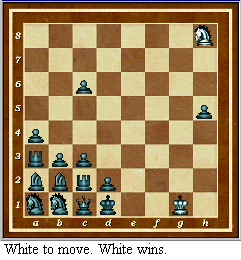
Chess Composition (image)
In addition to these papers, I made a number of postings to FOM (Foundations of Mathematics) mailing list. My Wikipedia user page is here. My stackexchange page is here.
I was born on November 22, 1983 in Kiev, Ukraine. In 1996, my family and I immigrated to the United States. My father (1954-2005) was a computer programmer with a passion for artificial intelligence. He died in accident while kayaking. I have a loving and supportive mother. From July 1996 through August 2001, I lived in the village of Columbia in the state of Maryland. While I was at high school, I studied advanced topics both independently and as a concurrent student in college. In June 2002, my parents and I moved to Salt Lake City, Utah. In 2005, I received a Bachelor of Science in Mathematics from Massachusetts Institute of Technology. In MIT, I majored in mathematics, and also studied computer science and physics. I am interested, however, in many fields of knowledge, such as philosophy and human rights. At MIT, I completed classes in mathematical analysis and abstract algebra, topology, algorithms, advanced classical mechanics, quantum and statistical physics, and many other topics. After MIT, I continued to live in Massachusetts engaged in independent mathematical research, specifically, in foundations of mathematics, mathematical logic, and set theory. In August 2006, I obtained employment in eScription (now part of Nuance), and until June 2011, worked in speech recognition for medical transcription.
Politics: I am a Democrat with libertarian leanings.
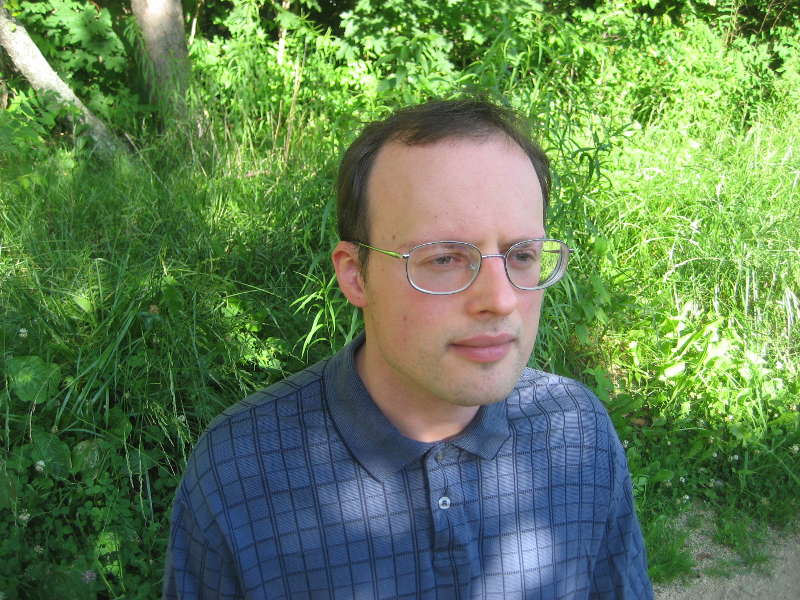
Here is my picture.
See my resume. For more on my research, see my research statement.
I had perfect GPA (all of my grades were A) when I graduated from high school.
1998 Howard County Science Fair (among high school students):
First Place in Computer Science
Note: I wrote a program that answered questions in the natural language.
Physics: In 1999, I was a member of the United States Physics Team. Twenty-four high school students in the USA were selected based on their performance in the US Physics Olympiad.
Mathematics
University Of Maryland High School Mathematics Competition (among high school students in Maryland):
2000 First Place
1997, 1999 Honorable Mention
Howard County Mathematics League (among high school students in Howard County, Maryland):
1998 Top Score in Oakland Mills High School
1999, 2000 Third Place
2001 Second Place
You can contact me by email at dmytro@alum.mit.edu.
Your feedback is appreciated.
Last modified date for web pages was not necessarily updated when minor changes were made.
This website is hosted by Massachusetts Institute of Technology.