
HomeSearch Sitemap Contact

Shortcuts Go
   Request Services Maps & Floor Plans In Development & Construction Sustainability About Us Parking and Transportation For Facilities Employees  
 
nav bullet off Cogeneration Plant
nav bullet off Conservation
nav bullet off Landscaping Initiatives
nav bullet off Recycling
nav bullet off Solar Power
nav bullet on Sustainable Design
 - Sustainable Buildings

New Construction Aims for Sustainable Goal

Several new or upcoming MIT buildings illustrate the many environmentally conscious practices MIT is adopting. Most of them will help the projects achieve LEED Silver Certification. MIT established the U.S. Green Building Council’s Leadership in Energy and Environmental Design (LEED) Silver Certification as a minimum standard for all new Capital Projects in design from 2001 forward.

The Brain and Cognitive Science Complex

  • Received a LEED Silver rating by the USGBC in January of 2008
  • A nearly 70 percent reduction in potable water use was achieved through:

    • Reusing wastewater reject from RODI (reverse osmosis and de-ionization) for gray water
    • Rainwater collection for water recycling
    • Low-flow water fixtures
    • Control of lab wastes
    • Connecting the irrigation system to the central weather station
  • Storm water management was implemented to improve the health of the Charles River
  • Heat recovery methods incorporated into HVAC (heating, ventilation, and air conditioning) systems
  • Variable air volume (VAV) system and right sizing of HVAC equipment to reduce energy use
  • Fully commissioning the building in accordance with MIT standards
  • Building flush-out before occupancy
  • Efficient lighting design, controls and daylight controls
  • Low emitting materials including low volatile organic compounds (VOC) paints, adhesives and sealants
  • Recycled content and regional materials
  • With a construction waste management plan in place, demolition of Building 45 achieved a 96 percent recycling rate
  • Eliminated all on-site parking for the project
  • Light pollution reduction

NW35 - New Graduate Student Housing

  • Redeveloping a brownfield site
  • Large courtyards that maximize the open space on the site
  • A storm water management system that reduces the quantity of storm water and improves the quality of the storm water that does leave the site through a filtration system
  • Reflective roof material which will reduce the heat island effect
  • Provisions made for future addition of solar thermal panels on the roofs
  • Light pollution reduction
  • Irrigation system connected to central weather station for minimization of watering
  • Construction waste management plan which states that at least 75 percent of the waste will be recycled or salvaged
  • Low emitting materials including low VOC paints, adhesives and sealants
  • Recycled content and regional materials
  • Operable windows for natural ventilation and individual control
  • Installation of Energy Star appliances in the apartments

Sloan School

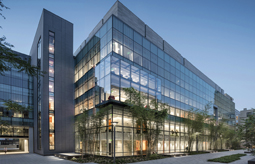
The Sloan School project is unlike any building project that MIT has undertaken before. From the start, a high level of green design was set as a goal, and in order to achieve that goal the team departed from the conventional design practices. Instead they adopted a version of the integrated design process. In the typical design process, work is linear, so that each discipline works one after the other. the integrated process includes all of the architects and engineers from the beginning, so that they can more effectively work as a team. From this new process, the designers for the Sloan School project were able to develop what is probably the greenest building at MIT.
  • Brownfield redevelopment
  • Light pollution reduction
  • Irrigation system connected to central weather station for minimization of watering
  • Low-flow urinals, toilets and showers are a few of the measures that will reduce the buildings water use by 20 percent
  • Storm water filtration system that will improve the quality of water that reaches the Charles River
  • Right sizing of HVAC equipment to reduce energy use
  • Roof designed for the possibility of later addition of photovoltaic panels and with a reflective material to reduce the heat island effect
  • Operable windows to provide natural ventilation and individual control
  • Sunshades and screens on the southern façade of the building to improve daylighting while reducing the heat gain from the sun
  • Daylighting controls on lighting and window shades to reduce the energy use of the building
  • High performance curtain wall to reduce the heat gain from the sun
  • Fully commissioning the building in accordance to MIT standards
  • Construction waste management plan which states that at least 75 percent of the waste will be recycled or salvaged
  • Facilities’ Repair and Maintenance removed doors, locks, and other equipment before the demolition of Building E56 to be reused elsewhere on campus
  • Much of the landscaping around the former Building E56 was saved and moved to create a new park next to Building E33
  • Low-emitting materials including adhesives, sealants, paints, and carpets
  • Using the building as an education tool about sustainable design

Koch Institute

Like the Sloan School project, the Koch Institute design team has been using a version of the integrated design process in order to achieve a green building

  • Brownfield redevelopment
  • Storm water filtration system that will improve the quality of water that reaches the Charles River
  • Reflective roof material which will reduce the heat island effect
  • Heat recovery methods incorporated into HVAC systems
  • VAV system and right sizing of HVAC equipment used to reduce energy use
  • Fully commissioning the building in accordance to MIT standards
  • Developing a construction waste management plan that will require at least 75 percent of the waste will be recycled or salvaged
  • Low-emitting materials including adhesives, sealants, paints, and carpets
  • Low flow fume hoods to reduce ventilation requirements
  • Low velocity duct work to reduce fan energy

Before the LEED Standard was adopted, MIT had recently built two buildings that included green design measures.

Stata Center

  • Innovative storm water retention and management system that employs biofiltration and which services several of the surrounding buildings as well as the Stata Center. It recirculates storm water with a solar powered pump for irrigation and flushing toilets, and helps improve the health of the Charles River by filtering the storm water before any water not reused on site enters the storm water drainage pipes
  • Extensive use of displacement ventilation utilizing a raised floor system
  • Monitoring and controlling CO levels in garage through a demand controlled ventilation system
  • Minimizing refrigerants and eliminating Halon, a fire retardant, in the building
  • Fully commissioning the building in accordance with MIT standards including planning by Facilities’ Engineering Division, use of an independent commissioning agent, and improved monitoring systems for follow up after occupancy
  • Operable windows for natural ventilation and individual control, and which provide an abundant use of daylight in all interior spaces
  • Landscape design for Northeast Sector that uses native vegetation and water-efficient design
  • Roof design that incorporates landscaping for shading and storm water retention and a white reflective surface to reduce heat island effect
  • Irrigation system connected to central weather station for minimization of watering. System uses weather data and rain gauges to control water flow and can identify leaks and cut off water flow
  • Light pollution reduction
  • Construction waste management plan by contractor to recycle construction waste, which, for example, achieved a near 100 percent recycling rate for the demolition of the garage
  • Demolished an above grade parking structure and replaced with a park. All new parking is below grade
  • Recycled timbers from Building 20 for flooring

Simmons Hall

  • 6,000 Operable windows with solar shading provide natural ventilation
  • A low-energy ventilation and dehumidification mechanical design supplement natural ventilation. This combination allows the dormitory to be used year-round without requiring air conditioning
  • The concrete walls of the building also help to maintain the occupants’ comfort. Exposed interior concrete takes advantage of night ventilation to cool and the thermal lag of the concrete to maintain cooler temperatures during the day
 Related Links
 Building Technology at MIT
 US Green Building Council
 Contact Info

Facilities

Department Directory

Engineering

Walt Henry
Director of Engineering

Peter Cooper
Manager, Sustainability
Engineering & Utility Planning

Project Management

Julia Ledewitz
LEED & Project Assistant
making MIT work Massachusetts Institute of Technology

