HomeSearch Sitemap Contact

Shortcuts Go
   Request Services Maps & Floor Plans In Development & Construction Sustainability About Us Parking and Transportation For Facilities Employees  
 
nav bullet off Cogeneration Plant
nav bullet off Conservation
nav bullet off Landscaping Initiatives
nav bullet off Recycling
nav bullet off Solar Power
nav bullet on Sustainable Design
 - Sustainable Buildings

New Sustainable Buildings Rise and Revive on Campus

In 2001 MIT’s Green Building Task Force (GBTF) developed Institute environmental goals and standards including broad aims such as conserving energy and reducing green house gas emissions. Since then many programs have grown to support those goals, especially the effort to construct green buildings on campus.

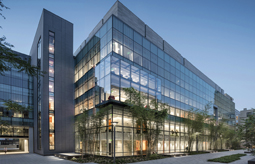
Because buildings are some of the largest energy consumers, one of the goals on the GBTF’s list states that all new capital projects and major renovations must earn at least a Silver certification from the US Green Building Council’s (USBGC) Leadership in Energy and Environmental Design (LEED) rating system. Even with this goal, LEED is not a driving force in the design process. It is meant to be a yardstick with which the projects can be compared and measured. Several projects on campus have been registered, which is the first step towards certification, and one project, the Brain and Cognitive Science project (BCSp), is currently under review by the USGBC. BCSp is expected to receive a Silver certification.

Integrated Design Process
Developing sustainable buildings requires attention to many systems and the interdependence between them. However, that relationship often can not be addressed in standard design practices because the engineers and consultants are asked to create systems for a design that may already include general massing scheme, orientation, exterior appearance, and basic materials, which all influence and may limit what they are able to achieve. Therefore, a different course, often referred to as the integrated design process, needs to be followed in order to reach a project’s sustainability goals. In an integrated design process the design team utilizes the expertise of each member from the beginning to create the best possible building for the site and program. Two of the most recent projects at MIT have used versions of the integrated process, the Sloan School and the Koch Institute. The process used for the Sloan School, which is much further along than Koch Institute, has been heralded as a success by its team members.

Other recent building projects at MIT have also used a variety of innovative technologies and systems to increase their level of sustainable design and therefore help them achieve the LEED Silver goal. They included heat recovery methods and efficient lighting design in the BCSp; light pollution reduction and Energy Star appliances in NW35 Graduate Residence Hall; and brownfield redevelopment and operable windows in the Sloan School. Even before the LEED standard was adopted several buildings included green features. The Stata Center has an innovative storm water management system and a white reflective roof and vegetated surfaces to reduce the heat island effect. Also, Simmons Hall features a unique structural system that integrates ventilation, 6,000 operable windows, and solar shading.

MIT plans to green older buildings, too. The PDSI project is a good example of this work since it was a major renovation project between Buildings 4, 6, and 8, which are a part of the original Main Group buildings built in 1916. The largest of those efforts is a more energy-efficient air conditioning system. The new system employs chilled beams, which are a type of radiator that uses cold water to cool the rising warm air in a room. Another advantage of this energy efficient system is that it requires less duct work and therefore less space. In the tight quarters of these historical buildings that is important, because the conventional system would have impacted the project’s design and destroyed the character of the old buildings.

Building Systems Design Handbook
These projects are built by many hands, and so in order to reach their sustainability goals, MIT needs to make sure that their consultants are aware of them. Those goals are passed on through the guidance in the Facilities’ Building Systems Design Handbook, which outlines both the campus’ general environmental standards and specific information for each CSI division. One lesson that MIT learned from the Stata Center, which is shared with each project, is the necessity of commissioning sustainable buildings. Many systems in high performance buildings are different than in a typical building, and so they may need special attention. For example, in Stata it took about a year after occupancy to fine tune the systems, such as the underfloor air system, to reach their high performance targets.

 Related Links
 Building Technology at MIT
 US Green Building Council
 Contact Info

Engineering

Walt Henry
Director of Engineering
Phone: 617-452-5060
Fax: 617-452-2323
Building: NE49-2400
Email: whenry@mit.edu

Peter Cooper
Manager, Sustainability
Engineering & Utility Planning
Phone: 617-258-8317
Fax: 617-452-2342
Building: NE49-2400
Email: plcooper@mit.edu

Project Management

Julia Ledewitz
LEED & Project Assistant
Phone: 617-324-5483
Fax: 617-452-2342
Building: NE49-2100
Email: ledewitz@mit.edu
making MIT work Massachusetts Institute of Technology