
News and Events
MIT President Susan Hockfield Serves on Zayed Future Energy Prize Jury and Visits Masdar Institute, Abu Dhabi
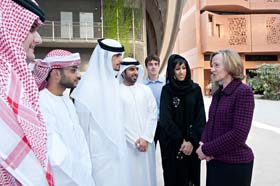
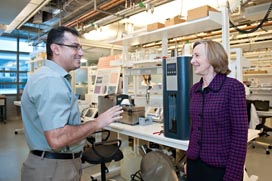
December 2011
MIT President Susan Hockfield traveled to Abu Dhabi to serve on the Zayed Future Energy Prize jury, an award aimed to drive innovation, leadership, long-term vision, and impact in renewable energy and sustainability. (http://www.zayedfutureenergyprize.com/index.php)
President Hockfield toured the Masdar Institute campus and met with faculty, students, and staff and was briefed on the progress of the research projects between Masdar Institute and MIT faculty.
In addition, she spoke at the Eye on Earth 2011Summit and Exhibition in Abu Dhabi. The summit focuses on greater access to environmental and societal data by all of those who need it and was facilitated by Abu Dhabi Global Environmental Data Initiative, and hosted by Environment Agency - Abu Dhabi in partnership with the United Nations Environment Programme and under the patronage of the President of the UAE.
Mexico’s Deputy Minister of Energy Visits Masdar Institute
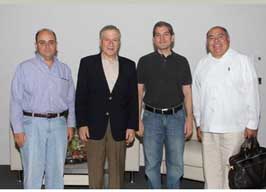
July 13 , 2011
His Excellency Sergio Alcocer, Deputy Minister of Energy in Mexico, as part of a mutual endeavor to enhance communication and cooperation between agencies in Mexico and MI.
Dr. Fred Moavenzadeh, President, Masdar Institute of Science and Technology and Director of MIT's Technology and Development Program (currently on leave) welcomed HE Sergio Alcocer and familiarized him with the MI campus through a site tour that included a visit to key energy management facilities..
Masdar Institute Holds First Graduation
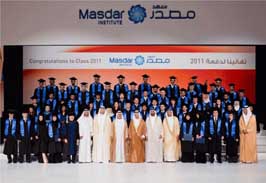
June 5, 2011
Over 70 students from five master’s programs graduated from the Masdar Institute of Science and Technology on Sunday, June 5, 2011. The gala cermony in Abu Dhabi was attended by senior government officials and dignitaries. The graduates received their certificates from Shaikh Hazza bin Zayed Al Nahyan, National Security Adviser and Vice-Chairman of the Abu Dhabi Executive Council.
“This occasion positions Masdar Institute as one of the rapidly emerging hubs for education in renewable energy-related fields. We are proud to have played our part in creating the next generation of leaders that will solve the manmade problems we are all experiencing,”said Dr. Fred Moavenzadeh, President of Masdar Institute and Director of MIT's Technology and Development Program (currently on leave).
MIT Professor Duane Boning to Serve as Director of the MIT Masdar Program
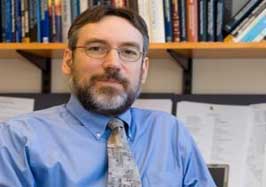
February 2011
Associate Provost Martin Schmidt announced that Duane Boning, Professor of Electrical Engineering and Computer Science, has agreed to serve as Director of the MIT Masdar Program. In this role, Professor Boning will help strengthen the growing rich collaboration in education and research between MIT, the Masdar Institute, and Abu Dhabi.
As Director, Boning will build on the assistance MIT has provided to the Masdar Institute, including establishment of a range of new graduate programs at Masdar spanning topics of energy, smart grid, materials and microsystems engineering, that have been successfully launched under the leadership of Professor Fred Moavenzadeh, previous Director of the MIT Masdar Program who has taken a leave of absence to serve as the President of Masdar Institute. Boning will work with the Masdar Program staff here at MIT under the Technology Development Program (TDP), with MIT faculty engaged in curricular development and joint research with Masdar, with Masdar Institute students interacting with MIT, and with Masdar Institute leadership to explore new collaboration opportunities. In addition to a strong administrative background, Boning brings to this role experiences with several international programs at MIT. Over the last two years, he has worked with the Masdar Program and faculty at MIT to help define and ramp up the Microsystems Engineering graduate degree program at Masdar Institute in Abu Dhabi. He has recently contributed to the assessment of MIT-Russia research and education engagement opportunities. Duane has also participated in the Singapore-MIT Alliance since 2004, through SMA1 and SMA2 programs in manufacturing science and technology, and he served as Co-Director for Education in the Cambridge-MIT Initiative from 2003 to 2004.
Boning will continue as Associate Department Head of EECS, a position he has held since 2004. He has also served as Associate Director of the MIT Microsystems Technology Laboratories from 1998 to 2004, and as Chair of the MIT Committee on Undergraduate Admissions and Financial Aid (CUAFA) from 2008 to 2010.
Op-ed by Matteo Chiesa Published in The National
Masdar Institute Professor Matteo Chiesa authored an article entitled "A universal source of energy waiting to be harnessed", published in The National on February 9, 2011.
U.S Secretary of State Hillary Rodham Clinton Visits Masdar Institute
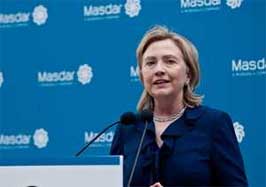
January 10, 2011
The Secretary of State of the United States of America, Hon. Hillary Rodham Clinton, delivered a speech on January 10, 2011 at the Masdar Institute of Science and Technology affirming the strong relationship between the United States and the United Arab Emirates. Secretary Clinton also commended Masdar's ambition and commitment to advancing and commercializing innovations in renewable energy and clean technology.
Read/View Secretary Clinton's Remarks >
MIT Professor Yet-Ming Chiang Speaks in Abu Dhabi about the Future of Clean Transport
Dr. Yet-Ming Chiang, Kyocera Professor, Massachusetts Institute of Technology (MIT) gave a lecture yesterday on Electrical Energy Storage to Enable Clean Transportation, as part of the Masdar Institute – MIT Energy Initiative, Distinguished Lecture Series, in Abu Dhabi on December 12, 2010.
Masdar Institute Press Release >
Op-ed by Masdar Institute Faculty Published in The National
Masdar Institute scientists including Dr Farrukh Ahmad, Dr Hassan Arafat, Dr Hassan Fath, Dr Hosni Ghedira, Dr Isam Janajreh and Dr Toufic Mezher authored an article entitled "The lifeblood of the UAE is at stake in today's science", published in The National on November 14, 2010.
Op-ed by Jacob Crandall Published in The National
Masdar Institute Assitant Professor Jacob Crandrall's article entitled "Masdar's plan for smart power" appears in the August 12, 2010 issue of The National.
Professor Fred Moavenzadeh Is Appointed President of Masdar Institute
Masdar Institute of Science and Technology has appointed Professor Fred Moavenzadeh from the Massachusetts Institute of Technology (MIT) as its President. Professor Moavenzadeh, James Mason Crafts Professor of Engineering and Director of the Technology and Development program at MIT, will support the institute’s mandate of transforming the emirate into a leading source of advanced technologies and highly skilled human capital.
Masdar Institute Press Release (PDF) >
Professor Ernie Moniz Speaks at Lecture Hosted by Masdar Institute
Speaking at a public lecture hosted by Masdar Instite of Science and Technology entitled "Clean Energy Technology and Policy: A Post-Copenhagen View", Professor Moniz, Director of the MIT Energy Initiative, commended Abu Dhabi and the Masdar Institute for their visionary approach towards a strong knowledge and resource- based economy.
MIT Terrascope Class Visits Abu Dhabi and Masdar Institute
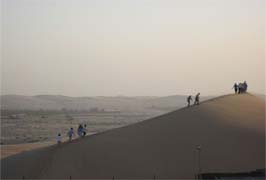
Terrascope is a learning program for MIT freshman. This year the class was charged with developing a comprehensive plan to deal with the global rise in CO2 and other greenhouse gases. For spring break 2010, the class traveled to the United Arab Emirates to explore Abu Dhabi’s efforts in the capture and storage of CO₂ and to gain practical knowledge in carbon sequestration.The study tour has included lectures presented by Masdar Executives and Masdar Institute faculty, as well as visits to various sites at Masdar City where testing of renewable energy technologies is taking place.
MIT Delegation Attends World Future Energy Summit 2010
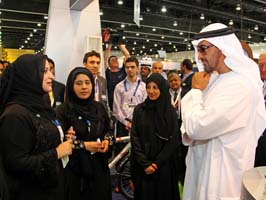
January 18 - 21, 2010
A delegation of MIT faculty and staff attended the World Future Energy Summit in Abu Dhabi. Among the many events surrounding the Summit, MIT and Masdar Institute organized a workshop on Strategies for Addressing Carbon Constraints in Commerical Aviation. The Workshop focussed on a "post-Copenhagen" era where environmental constraints and carbon emission resetrictions are likely to have a significant impact on the aviation industry.
MIT President Susan Hockfield Zayed Future Energy Prize Jury Member
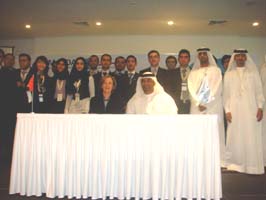
November 2009
MIT President Susan Hockfield visited Abu Dhabi in late November 2009 in her official capacity as a jury member of the Zayed Future Energy Prize (ZFEP). President Hockfield and the rest of the ZFEP panel gathered to determine the finalists of ZFEP. President Hockfield also met with His Highness Sheikh Mohammed bin Zayed Al Nahyan, Crown Prince of Abu Dhabi and Deputy Supreme Commander of the UAE Armed Forces, and His Excellency Sheikh Nahayan Mabarak Al Nahayan, Minister of Higher Education and Scientific Research.
(Pictured at right Dr. Hockfield and Dr. Al Jaber with Masdar Institute students earlier in 2009)
MIT Provost Rafael Reif Attends Masdar Institute Board Meeting and MIT Arab Alumni Association Conference
November 8- 9, 2009
On November 8, 2009 MIT Provost Rafael participated in the Masdar Institute's Board Meeting in Abu Dhabi. The following day, the sixth MIT Pan-Arab Conference: Global Energy Challenges & Opportunities, organized by the MIT Arab Alumni Association and sponsored by Masdar and the Masdar IInstitute of Science and Technology took place. The full day conference included notable speakers addressing: global energy strategy and policy; public and private sector developments; innovations in demand-side; and generation and carbon capture technologies. Regional government leaders, industry executives, entrepreneurs, investors, and the MIT Provost as well as MIT faculty and alumni attended.
MIT participants included (in order on agenda ):
 Rafael Reif, MIT Provost, who gave the welcome address
 Ernie Moniz, Director, MIT Energy Initiative, who spoke on Energy Innovation for a Low-Carbon World
Mujid Kazimi, Professor, MIT, Director, Center for Advanced Nuclear Energy Systems who discussed the topic: Clean Energy Systems
 Fred Moavenzadeh, Director, MIT Technology and Development Program, who took part in apanel on Systems for Innovation
 Subra Suresh, Dean, MIT School of Engineering, whose presentation was entitled: Leading into the Future
John Parsons; Executive Director, MIT Center for Energy & Environmental Policy Research who took part in a panel on Carbon Management.
For for information, including videos and/or pdfs of the presentations, go to: http://www.mitpanarabconf.org/
Classes Begin at Madar Institute of Science and Technology
September 6, 2009
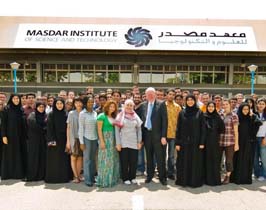
The Masdar Institute of Science and Technology commenced classes on September 6, 2009. The students are part of the Madar Institute's two-year Master's program and were selected from more than 1,200 applicants, representing 22 different nations.
Dr. John Perkins, Provost of Masdar Institute (pictured with students, right), said: “Masdar Institute aims to become a world-class university and research institution that will create and shape a new generation of leaders and critical thinkers in science and technology. We are tasked with responding to one of the most important challenges facing our planet – the need to develop sustainable energy solutions that ensure economic growth and prosperity for all nations, without damaging the environment.”
Masdar Institute Press Release (PDF)>
Professor John Perkins Named Provost of Masdar Institute
May 2009
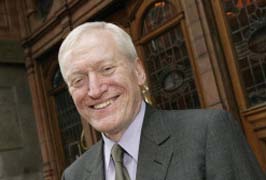
Professor John Perkins has been named the Provost of the Masdar Institute of Science and Technology in Abu Dhabi. Prior to joining the Masdar Institute, Professor Perkins led the Faculty of Engineering and Physical Sciences at The University of Manchester, one of four faculties in the new institution created following the merger of UMIST and the Victoria University of Manchester. From 2001-2004 Professor Perkins served as Principal, Faculty of Engineering, Imperial College London. The Faculty of Engineering was created in 2001 as part of a new management structure for the College.
"Masdar City: Zero Carbon, Zero Waste -- Someday Is Today"
Khaled Awad, Director of Property Development, Masdar Initiative
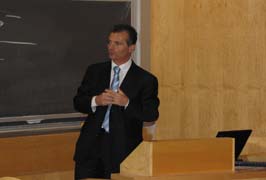
May 8, 2009
Khaled Awad spoke to MIT students and faculty regarding the Masdar City project -- a six square kilometer sustainable development site that uses the traditional planning principles of a walled city, along with existing technologies, to achieve a zero carbon and zero waste community.
Masdar Institute Joins MIT Energy Initiative
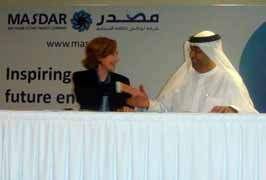
January 19, 2009
The Masdar Institute became the inaugural founding public member of the MIT Energy Initiative. Photo at right: MIT President Dr. Susan Hockfield and Dr. Sultan Al Jaber, CEO, Masdar Initiative at the signing ceremony.
More >
Seminar Calls for UK to Follow Abu Dhabi's Lead on Future Energy
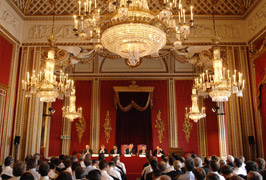
July 8 , 2008
Dr. Sultan Al Jaber, CEO of Abu Dhabi's Masdar Initiative, challenged the United Kingdom to follow Abu Dhabi's lead in developing an affordable and sustainable energy future for the world.
Hosted by HRH The Duke of York, Dr. Al Jaber was part of a wider Abu Dhabi delegation, which included HE Kahldoon Khalifa Al Mubarak, Chairman of the Executive Affairs Authority of Abu Dhabi, to address UK government, business, and academic leaders on the issue of sustainable energy at a seminar at Buckingham Palace. Masdar Institute Press Release>
MIT - Masdar Symposium
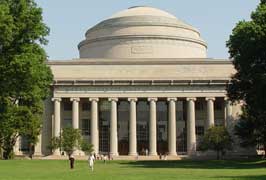
Abu Dhabi's Strategic Investment in Energy, Infrastructure and Education for the Future
May 5, 2008
Sponsored by: The Industrial Liaison Program and the MIT Technology and Development Program
Wong Auditorium - Tang Center
MIT and Masdar leaders discussed the shared roles of academia, industry, and government in solving the global challenges of long-term strategic development for alternative energy, sustainable infrastructure technologies, and education. More >
Masdar Institute of Science and Technology: Graduate Engineering Educational Opportunities in Abu Dhabi
May 6, 2008
Sponsored by: MIT Technology and Development Program
Bartos Theater, Wiesner Building, E15
12:30 - 4:45
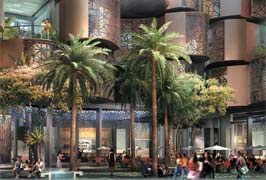
The Masdar Institute of Science and Technology held a session on Academic and Research Opportunities in Alternative Energy and Sustainable Technologies on May 6, 2008. Participants learned about studying at MIST, the curriculum and research, MIT's involvement, and living in Abu Dhabi. MIST faculty were on hand to answer questions.
MIT Space Solar Power Workshop
May 14-16, 2007
Sponsored by: MIT Technology and Development Program
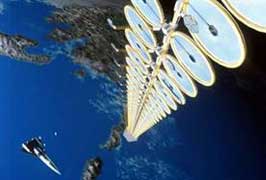
Leading experts from industry, government, and academia participated in this two day workshop motivated by the pressing need to develop alternative clean renewable energy supplies. The group agreed that exploring alternative energy sources (wind, hydro-electric, terrestrial solar power, geothermal, and bio-fuels) as well as promoting conservation are high priorities. And it stressed that space solar and existing sources of power are not competitors.
Working groups:
- Space Systems Technology for Space Solar Power
- Solar Energy Technology: Terrestrial vs. Space Solar Power
- Economics, the Environment, Public Policy, and Legal Issues
- Integration Strategies
Each working group discussed many topics, including: the advantages of space solar power, technical unknowns and challenges, what research needs to be done, and what issues are unresolved.
The Future Cannot Be Sustained by Present Technologies
Workshop participants concluded that the United States, Japan, and Europe must take the lead in Space Solar Power, but acceptance and active participation by developing countries is essential. Awareness of Space Solar Power must be increased, a goal this group and others may pursue with future workshops and initiatives.
For list of program committee members and participants, visit: http://web.mit.edu/space_solar_power/index.html
