Throughout my site, there is constant change and flux. The buildings are eroding and rust is everywhere. Small plants and weeds struggle to survive, pushing through the bricks of the sidewalk or cobblestone of the street. Puddles of water slowly evaporate or seep into the ground. There are natural processes occurring all over my site and they are slowly, but surely, changing the shape of the city.
Large concrete columns support many of the buildings in my area. The majority of these columns are on Fulton Street and Commercial Street. Most of these columns show several signs of decay and natural processes. The cement of the columns is chipped and rusted in many areas. Some of the columns seem to have had more than half of their cement chipped away. The chipping most likely is the result of wind and water erosion. Acid rain and rust could have also contributed to the weakening of the columns. The rust seems to come from long metal rods that are imbedded in the cement. The areas of cement around these rods are stained red with rust. A few of the rods are larger than the rest and have star-shaped designs on their ends. These metal stars are all completely rusted, as well as the cement around them. Interestingly, some of the columns seem to be in perfect condition. These faultless columns are often right next to the eroded ones. There does not seem to be any reason why some columns are highly eroded and others are not. The spared columns are exposed to the environment and natural processes as much as the others. The most likely explanation is that the faultless columns have recently been repaired.
The cement columns.
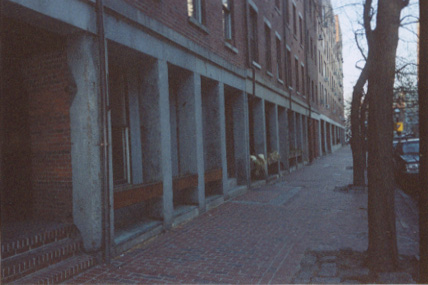
The main entrance to the Fulton Court apartments is a very good example of this phenomenon. There are two large cement columns that help support the main entrance. One of them is in perfect condition. The cement is smooth and there are no noticeable chips or cracks. However, the other column is very different. About one third of the column has been chipped off the back of it. It also has rust on it while the other has none. Interestingly, the bricks of the building near the eroded column are broken and cracked in many areas. However, the bricks near the faultless column are in perfect condition. The erosion and decay of the concrete columns shows how natural processes are affecting the appearance of my site.
Water pipes have been fitted into a few of the cement columns. The pipes run down from the gutters on the rooftops. These pipes are specially fitted into the cement columns. A section of the column has been carved out and the pipe placed inside of it. On every column that had a water pipe, the inner cement around the pipe was very heavily chipped and eroded. The decay was even more prevalent in these columns than in those that did not have pipes. Most likely, this additional erosion was caused by water that had leaked out of the pipes or had splashed out of the gutter and run down the outside of the pipes. The additional water erosion on these concrete columns further demonstrates how natural processes are affecting my site.
Many buildings on my site have stone placed around the windows. Two houses, one on Lewis Street and the other on Garden Court Street, have intricate stone carvings of plants and vines surrounding the windows. Another house, on Lewis Street, has two plain stone slabs on the top and bottom of each window. The stones on all three houses are heavily blackened. The stains are not uniform since some areas are much darker than others. Typically, areas that project out farther are more blackened. Also, most of the stones are slightly chipped and portions of the carvings and slabs are gone. Most likely, the blackening of the stones was caused by automobile and industrial pollution. The decay was probably caused by wind and water erosion. Possibly, the erosion was accelerated by the pollution that stained and weakened the stones. The natural processes that blackened and eroded the once-beautiful stone has had a deep impact on the shape and appearance of my site.
The house on Lewis Street.

The house on Garden Court Street.
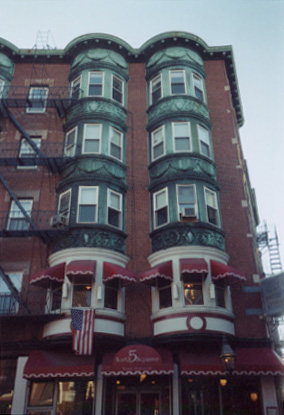
The other house on Lewis Street.
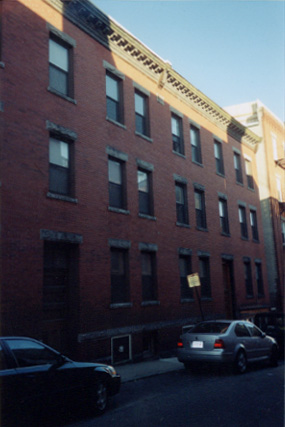
There is a plaque on Garden Court Street that marks the location of late Governor Thomas Hutchinson's house. This plaque, which seems to have been made of green marble, is now blackened and eroded. There are also white streaks that run down the plaque. Most likely, the blackening was caused by automobile and industrial pollution. The white streaks could have been caused by erosion from normal rainfall or acid rain. This plaque further demonstrates the affects of natural processes on my site.
Governor Thomas Hutchinson's plaque.

The sidewalks show the effects of many natural processes. On Commercial Street, there are bricks on the sidewalk. Some areas of this sidewalk have mortar between the bricks, while others do not. Moss is growing up between the bricks where there is no mortar. One section of the bricks has been torn up, exposing the sand underneath.
The sand underneath the bricks.
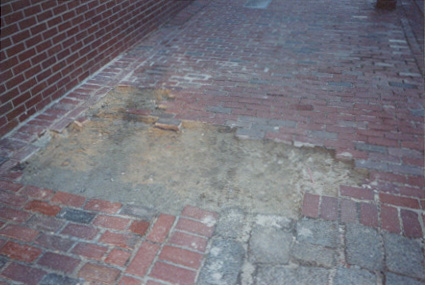
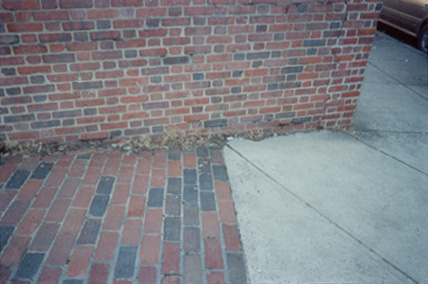
On the corner of Richmond Street and Atlantic Avenue, the sidewalk is brick and mortar. The land is not level and the bricks have been cracked in many areas where the ground changes in elevation. There is soil and mud between the cracks in the sidewalk. However, there is no plant growth in the soil.
Around the open space on the corner of North Street and Moon Street, there is a lot of plant growth. Both the sidewalk and the walls have been made with brick and mortar. However, there are several plants that have grown in the cracks between the sidewalk and the wall. Exposed soil and dirt can be seen at the roots of these plants.
Plant growth between the wall and sidewalk.
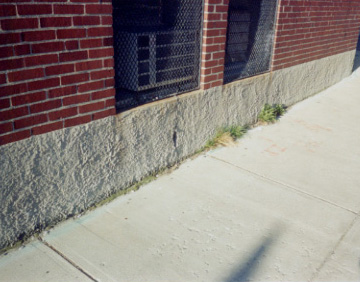
Also, there is plant growth around Sacred Heart Church. The wall is stone and the sidewalk is cement. However, moss and grass have pushed their way up in the cracks between the wall and the sidewalk. All of these examples show how natural processes have affected the sidewalks on my site. Also, they show what was put underneath the sidewalk to help or hinder plant growth.
More plant growth between the wall and sidewalk.
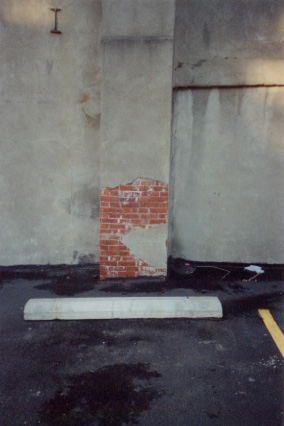
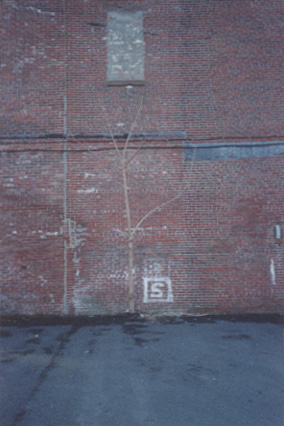
Parking lots are another place where the affects of natural processes are very apparent. On Fleet Street, there is a parking lot that shows many of these signs. The cement wall of a house bordering the parking lot has been chipped away in one area, exposing red bricks underneath. Probably, a cement layer was poured over the bricks to further reinforce the house. In the back of the parking lot, there is a single, bare tree that has somehow grown up between the cement wall of a bordering house and the thick blacktop of the parking lot. The blacktop at the base of the tree has been pushed upwards and is cracked at the edges, as if the tree forced its way up. It is the only tree in the whole parking lot. However, there are other, smaller plants that have grown up in the cracks between the cement sidewalk and the blacktop.
Red bricks under a cement wall.
A bare tree in the back of the parking lot.
Another parking lot on Garden Court Street has an alleyway right next to it. The alleyway used to be paved over with cement and blacktop. However, it has now been completely overgrown with thick grass. There are only a few chunks of cracked and split concrete and blacktop that can still be seen. Bare trees have sprouted from the sides of the alley, either on the side of the fence or the wall. However, no trees grow in the center of the alley. These two parking lots and their surrounding areas are further examples of how natural processes affect my site.
The alleyway next to the parking lot.
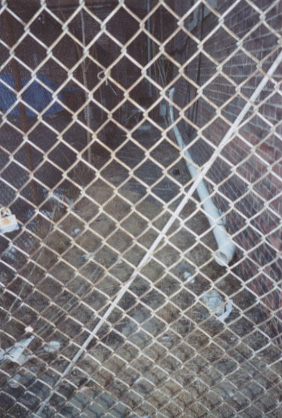
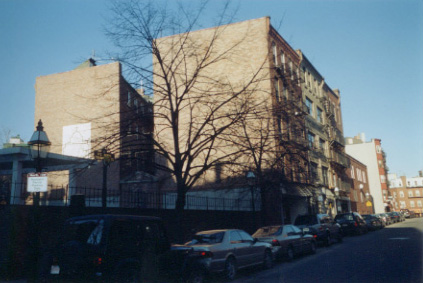
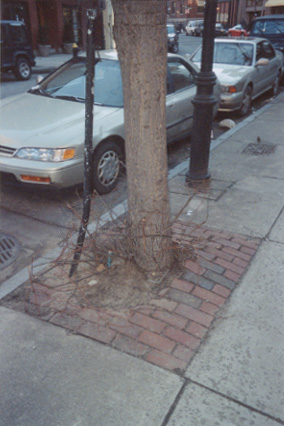
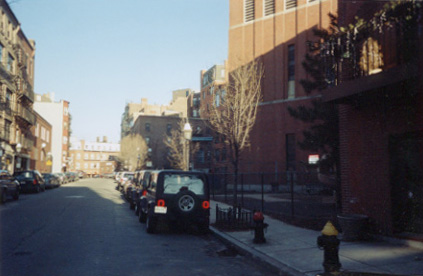
Interestingly, the trees on opposite sides of the streets were very noticeably different. The trees lining North Street are almost complete opposites. The trees on the south side of the street are much smaller. They are planted in a large square section of dirt. Surrounding the trees are large cement blocks that have dirt between them. A few plants and moss are growing on the outside of the soil near the sidewalk. The trees on this side of the street are right next to an open park, which allow their roots more room to grow. However, the trees on the north side of the street are much larger, even though they have much worse root conditions. These trees are planted in sand and dirt and do not have much open space. Smaller trees are sprouting out of the soil around the bases of the trees. Also, mortar-less bricks surround their bases. Around these bricks are large cement blocks with dirt between them. Plus, these trees are next to a wall, giving their roots much less open space. Even though the trees on the north side of the street have much worse root conditions, they have grown much larger. This is yet another affect of natural processes on my site.
The trees on the north side of North Street.
The roots of the trees on the north side of North Street.
The trees on the south side of North Street.
The roots of the trees on the south side of North Street.

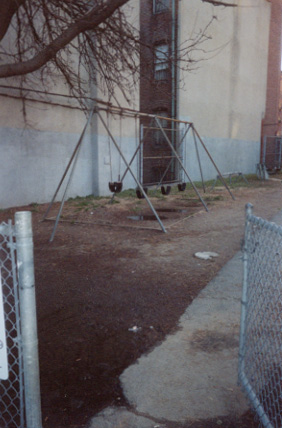
Parks are a very important place where natural processes occur. In one park, on the south side of North Street, there is a very large evergreen growing in the corner. It has been planted in dirt and seems to have a large root system. The majority of the park is dirt, except for a small cement path and a large rubber mat that a playground is on.
Another park, on Richmond Street, shows many affects of natural processes. Most of the small park is dirt and mulch. However, there are also several patches of grass and thick moss. There is one large tree that is growing in a corner by the fence of the park. Nearby, there is a dead tree stump. Apparently, one of the trees in the park survived while the other did not. Most likely, the tree that died did not get enough water since the area around its stump is dry while the area around the live tree is muddy and full of water.
The park on Richmond Street.
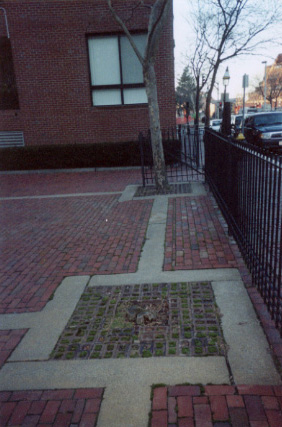
The Dog Park, on the corner of Fulton Street and Richmond Street, is very interesting. The park has been bricked over without the use of mortar. Lots of moss has grown in between the bricks. Several trees have been planted in the park. They were planted in normal dirt with hollow bricks all around their bases. However, most of these hollow bricks have been completely overgrown with moss. Two of the sixteen trees in the park have been cut down, with only their stumps remaining. Most likely, the moss growing amidst their roots killed them.
A tree and stump in the Dog Park.
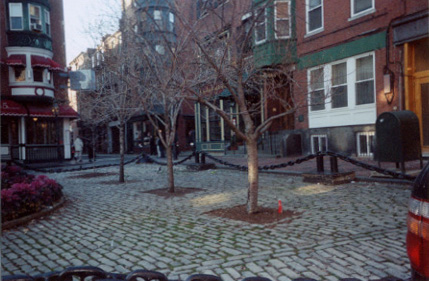
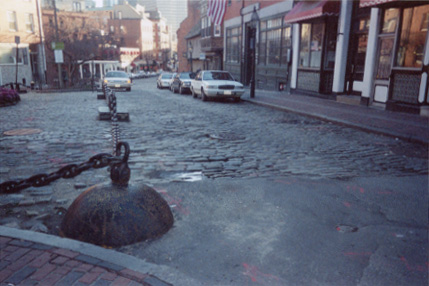
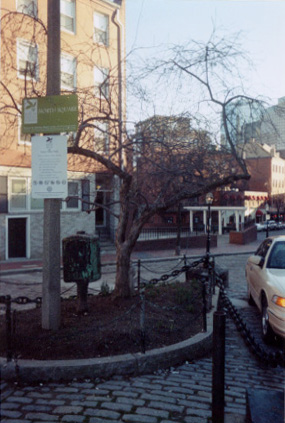
In another park, North Square, the affects of natural processes can be easily seen. The park is covered with cobblestones, although there are patches of sand, mud, and blacktop scattered about. Moss grows between the cobblestones and water collects in the low spots. The street surrounding North Square is also made of cobblestones. It dips up and down in many areas, most likely caused by the passage of carriages and automobiles. Also, the park is surrounded by large iron links, which are now heavily rusted. At the tip of the park, there is a fenced-in area of soil. Both the fence and the posts surrounding this small area are full of rust. In the center of the dirt and mulch there is a large tree with several smaller plants growing up around it. There appears to be an old telephone in this area. It is heavily rusted and full of peeling old paint. All of these parks have been changed over the years and continue to be changed by natural processes. This has seriously affected the shape and appearance of my site.
The cobblestones and trees of North Square.
The street surrounding North Square.
The tree and telephone in the area at the tip of North Square.
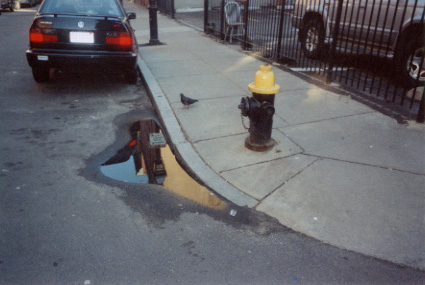
Finally, water drainage is another important aspect of my site. After rainfall, the water collects on the corners of streets. In the southern areas of my site, there are water drains that lead to the sewers on every street corner. The water empties into these and does not sit. However, in the northern areas of my site, there are no water drains. Instead, the water collects into puddles and sits. Since the northern areas of my site are higher in elevation than the southern areas, the water slowly trickles from these puddles into the drains further downhill. However, this process takes a long time and there are often many puddles in the northern areas that remain for days. There are many more potholes in the northern areas because of this. This shows how natural processes further affect my site.
A puddle on a corner in the northern section of my site.
My site has been and still is highly affected by natural processes. Wind erosion, water drainage, plant growth, rainfall, acid rain, and pollution all affect my site. No city, block, or building is immune to the many affects of natural processes.