Team HERDDStoryboardsIndividual Pages
|
|
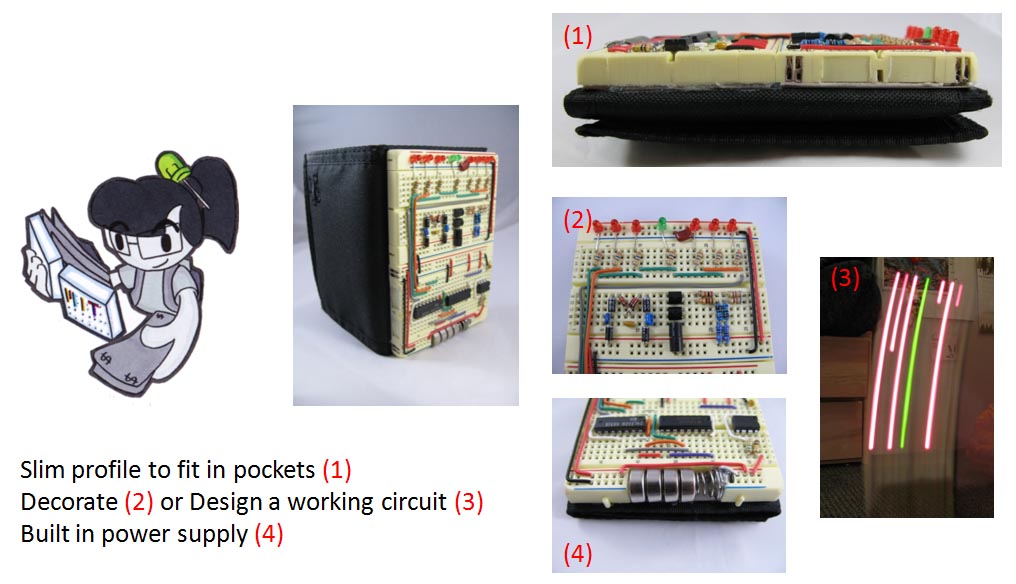
Breadboard WalletThe Breadboard Wallet is for the EE enthusiast. On multiple occasions I have needed an extra Breadboard in a pinch or a spare resistor or LED, and having these components at the ready would have really helped out! This sketch model was created by simply adhering a board to a wallet, and hacking it to size and modding it with a small power supply. The important issues that this model needs to answer are shown below.
First, the board and the wallet need to be small enough to fit into your pocket. The model shown here has 7 cards in it and there seems to be plenty of room for a credit card, debit card, a few RF IDs, etc. There is ample space for cash. My wallet is twice as large, but there are many non-essentials that I carry around.
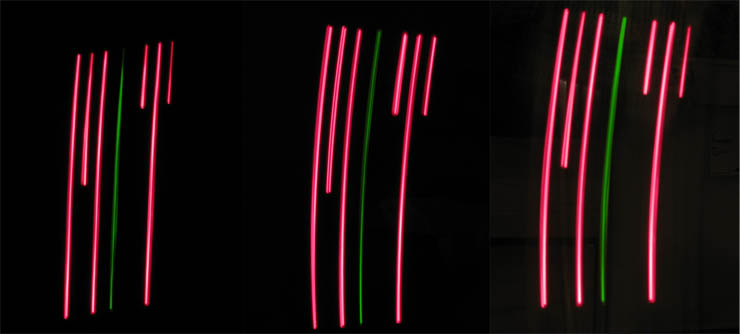
Second, the Breadboard needs to be useable. I have prototyped a circuit on the board to illustrate a casual use condition. The top 7 LEDs strobe to spell out MIT when you swing the wallet in the air (as seen above). The circuit is relatively simple, a binary counter, some digital logic, and a clock. For hackers, EE's, and DIYs, having your own custom circuit says a lot about the type of person you are when you show it off. For the more artistic user you can lump together components in an aesthetically pleasing configuration. Shown above, the components spell out MIT, but casual non EEs can make patterns and pictures dropping components onto the grid Finally, a built in power supply is needed to run the circuit. Currently, there are 4x1.5v watch cells making 6v supply. However, a fun, simple circuit could be to make a 5v boost converter from a single 1.5v cell. Or even make the wallet a pocket variable power supply. With a generic breadboard you can make anything you want! This model does not address the wallet ergonomics directly. Many users keep their wallet in their back pocket, and sitting on a breadboard is obviously not comfortable. Personally, my wallet is in my front pocket. Daily use could also accumulate considerable dirt and lint in the board crevices. Some protection method needs to be considered. I keep breadboards in my backpack regularly, and if you you build the circuit properly losing rogue components is not an issue, but it is not suggested for users to bring the wallet to the airport! Fire Hydrant Sippy Cup
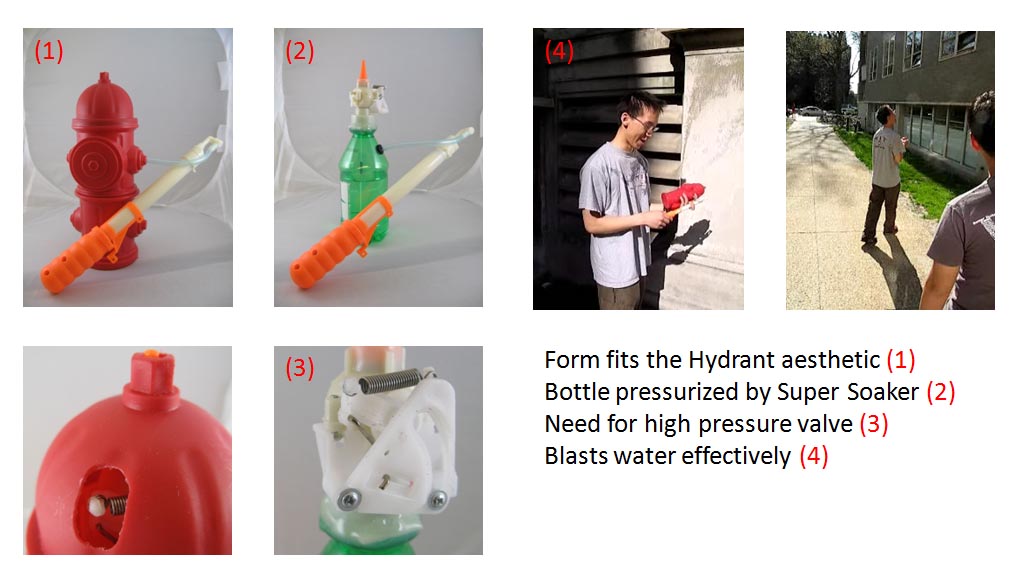
For the Hydrant Sippy Cup, we wanted to emphasize the difficulty of drinking from a fire hose. We used a fire hydrant form factor to communicate this challenge. This works-like sketch model is reapplication of the super-soaker mechanics. Ronan and I worked together to adapt the super-soaker into a small 13oz bottle, and make a proper seal at the neck. Then we used a rubber grommet to seal around the air pump into the bottle. This pressurizes the air in the bottle, and when the valve is release the air pressure will force the water up a lift tube and eject it out of the bottle.
This particular model accomplished the pressurized jet of water that we desired for the product. The squeeze bottle and water pistol implementations would be cheaper to produce, but lack the over-the-top spray of water we wanted to emphasize for the MIT education adage. Videos of the performance can be found here longevity, height, and just for fun. Some issues that need to be flushed out are pressure control. High pressure liquids are good for shooting, but dangerous for drinking. A safety pressure release valve can easily be added in future iterations. Also we would want to change our positioning of the pump and the output hose. This model has the two switched because of the super-soaker design. Instead, we want to valve to control a straw or hose in which to drink from, and we would like the pump to be built into the hydrant. The next model would implement an air pump that connects directly to the bottle neck, and that can be removed to fill the bottle. |