8.592J - HST.452J (Fall
2026)
Statistical
Physics in Biology
Lecture 1
Outline
A random walk in biological physics, motivated by statistical physics, and organized according to:
| I. Sequence |
nucleic acids in DNA/RNA; amino-acids in proteins, shaped by mutations and fixation [population genetics] |
information |
| II. Structure |
DNA double helix; RNA secondary form; protein folding [Polymer physics] |
interaction |
| III. Function |
building blocks of force and motion: membranes, tubules, motors, ... [non-equilibrium methods] |
cooperation |
| IV. Emergence |
networks: modules, patterns, collective dynamics, ... [emergent phenomena] |
complexity |
Preliminary schedule of activities
- Review of the central dogma
- Human genome consist of
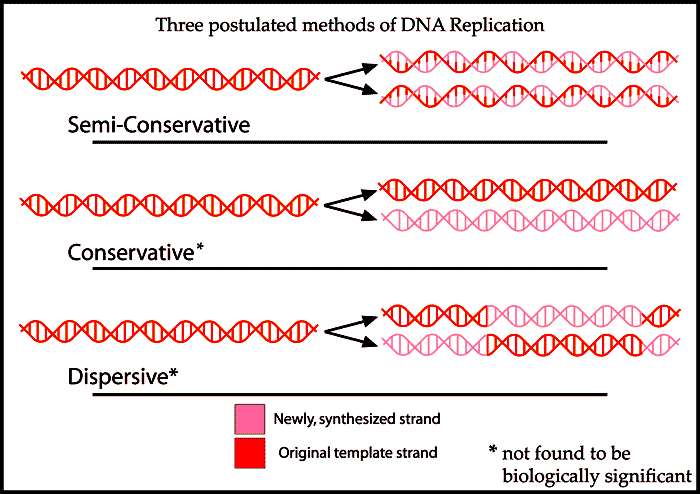
- Replication
- Coding
sequence
i. Gene
ii. Protein
iii. Genome
- Genetic code
- Genetic Variations
- Mutations,
DNA variation
- Human (diploid) genome consist of two copies of DNA [each 3x10^9 base pairs longs] inherited from father and mother
- Typical variations is around 3x10^6 Single Neucleoide Polymorphisms
- SNPs, obtained by genotyping: A list of SNPs with two letters for two nucleotides, for comparison with population frequency, X, of alleles
- Current understanding limited to x>10^{-5}
- alleles are possible states of a locas, mostly two-allele SNPs, with rare three allele cases
- Mutation rate in humans is roughly 2x10^{-8} per bp, per generation (in germ line) -> few hundred new mutations per child
- Coding regions (genes, exons) constitute roughly 1 to 2% of the entire genome [roughly 6 new mutations per child]
- Synonymous mutations result in the same amino-acid
- Non-synonymous [roughly 4 new mutations lead to new amino-acids in the exome]
- Foundations
of genetics
- One
locus
i. Genotype
ii. Haploids
vs diploids
iii. Homo/heterozygosis,
allele frequency
iv. Dominant
vs recessive: blood types
- Random
mating: Hardy-Weinberg equilibrium
- Genetic
Drift
- Forces of Evolution
- Mutations, recombination
- Selection
- Reproduction
- Migration
- Dynamics
in population of constants size
- Reduction
of heterozygosity
- N>>1, Binomial sampling
- Probability
of fixation
- Time
to fixation
- Mutations
- Random allele model
- Steady state
- Varying population size
(Mirny 2009 lecture notes)
(Kardar lecture notes)
8.592 lec1- last update 9/2/2026 by
M. Kardar