Isolated
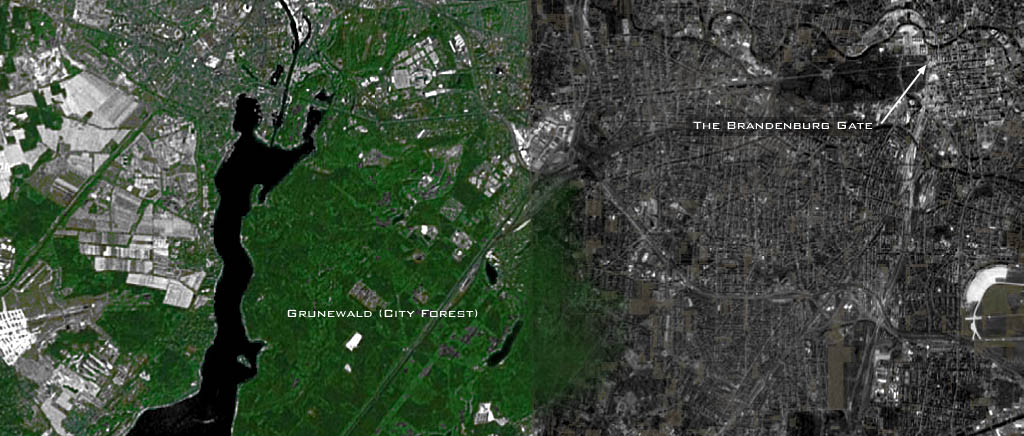
for forty years as part of Western Germany, the city of Berlin
depended greatly on its forest. It was the main source of wood,
water, and recreation. It was also in the forest where sand and
gravel extraction was undertaken, and where sanitary landfills
were located.
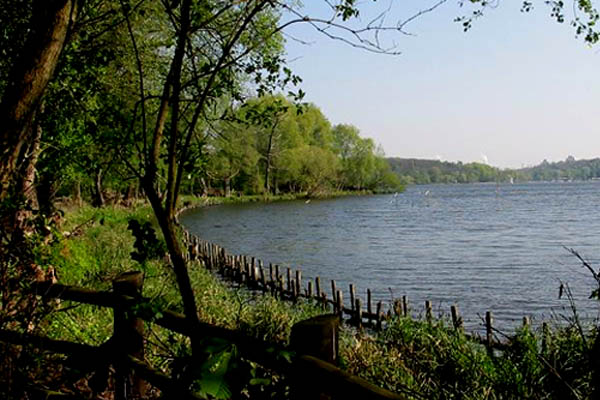
Today, the forest still provides an important source of water,
specifically from rain and snow that seeps into the soil. The
forest is also used to help filter the water of the river Havel,
which after it has been partially treated, is fed into irrigation
ditches and ponds in the forests and penetrates slowly in the
soil into aquifers later to be tapped for use.
Since the forest is an important site for recreation, it has been
organized in rings that correspond to activity so that the impact
of people on the forest can be limited. As such, the outermost
ring nearest to housing is where the playgrounds are located,
next are playing fields, and the rings further in are reserved
for activities that will cause the least impact on the forest,
such as trails for hiking.
Foresters are constantly intervening in the regeneration and development
of the forest. Selection cutting is carried out in order to assure
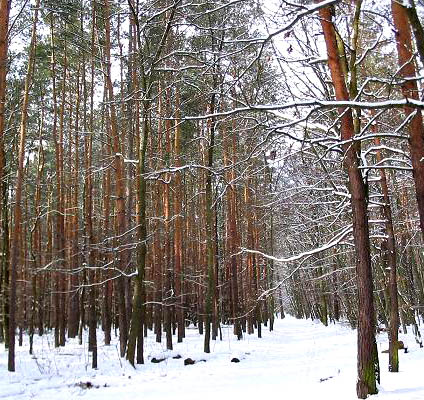
a diverse forest of approximately half coniferous and half broadleaf
trees. The broadleaf trees are generally planted along roads and
near recreation areas where they are most needed to provide noise
and air quality protection. The coniferous trees, are planted
in the interior of the forest where it is managed for the production
of timber.
Intervention is even carried out at the level of transplanting
an entire biological system from one setting with certain desired
characteristics to a new setting. An example is found in the creation
of a new lake that once it was excavated, plants and soil were
implanted in the water from another already established lake ecosystem
in order to speed the process of plant regeneration of that type.
Part of the expenditure of maintaining the forest is funded by
the extraction of gravel and sand. The pits that remain are usually
reforested. In order to re-nourish the land, rye and clover are
first planted, followed by trees. The pits can also become ponds,
or refilled to created hills. They can also be used as landfills,
later to be covered and reforested as well.