|

The Maxwell-Boltzmann distribution
and Bragg scattering of thermalized neutrons;
the DeBroglie relation; neutron absorption cross
sections. The technique of time-of-flight spectroscopy
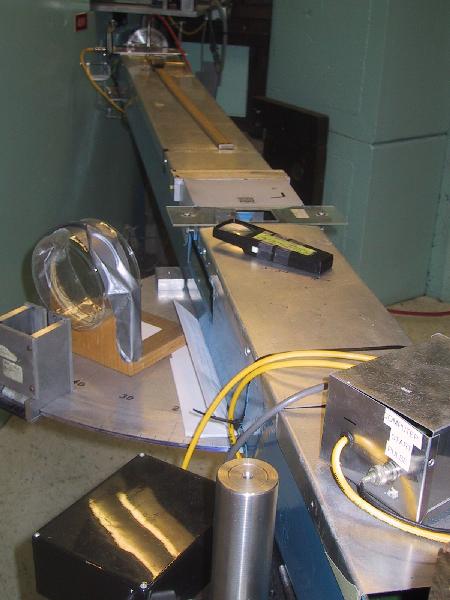
with a mechanical beam chopper is used to study
the properties of thermal neutrons in a beam emerging
from the MIT research reactor.
First, the distribution in velocity
of the neutrons is measured, and the results are
compared with the Maxwell Boltzmann distribution
for the temperature of the reactor.
Second, the DeBroglie relation
between wavelength and momentum of neutrons is
determined from measurements of the angle of Bragg
reflection of the beam from a copper crystal as
a function of the velocity measured by time-of-flight.
Third, the absorption cross sections of several
elements are measured, and the 1/v dependence
of the boron cross section is observed.
Download
Getting Started in iLabs (PDF)
Download
Lab Guide in PDF format
(certificates
required)
- Instructions
for Taking Web-Based General Employee Radiological Training. (2005)
- iLab web page
on remote operation of the experiment. (html)
Written with the Nuclear Engineering Department in mind, this
site contains much useful information.
Notes
on the analysis of time-of-flight data. (pdf)
Properties
of the neutron chopper wheel. (pdf)
(certificates
required)
- W.H. Bragg and W.L. Bragg, Nobel Prize Lecture "Analysis of Crystal Structure by Beams of Rontgen Rays," (1915).
- C. Shull (shared with B. Brockhouse), Nobel Prize Lecture "Early Development of Neutron Scattering," (1994).
- Chadwick, J., "Possible Existence of a Neutron", Nature, Page 245, February 27,
1932
- Chadwidk, J., "The Existence of a Neutron", Proc. Roy. Sci. Vol. 136, No. 830, pp. 692-702, June 1 1932
- Cross Sections
of various detector materials
- Description of the MITR-II Research
Reactor
- CYLINDRICAL BF3 NEUTRON DETECTOR specifications (LND #20135)
- CYLINDRICAL BF3 NEUTRON DETECTOR specifications (LND #20127)
- CYLINDRICAL He3 NEUTRON DETECTOR specifications (LND #25143)
- TGM Neutron Detectors - Background and Specifications (4-pages)
- Laser Diode Isolator
|











 8.13 Syllabus and Policies






