|
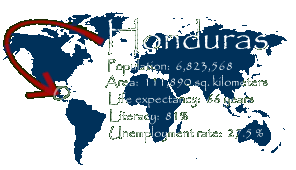
D-lab Honduras
Team Leader
Marta Fernandez-Suarez,
martafs@mit.edu
Elizabeth Basha, e_basha@mit.edu
Past Projects
(D-lab 2003-2004)
Inexpensive
Water Testing:
By building upon
an invention by Instructor Amy Smith, students taking last year's
D-lab class brought a technology for cheaply test drinking water
in developing countries significantly closer to a finished, workable
product. Instead of costing around US$1000, as most water testing
apparata do, the water testing system designed in D-lab costs less
than US$20. The D-lab Honduras team took prototypes of the water
testing system to sites around Honduras, and preliminary data have
shown that indeed the new, cheaper water testing system works in
the field. The team which advanced the cheap water testing system
won one of the top prizes in the most recent IDEAS
competition.
Water Chlorination
Controllers:
Using spare parts
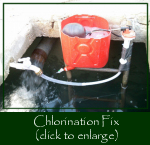
from a flush toilet, the D-lab Honduras team solved a problem of
overchlorination in a community's water supply. The toilet apparatus
served as a feedback mechanism for the chlorinating tank, thus simply
solving the problem. Perhaps most importantly of all, this fix used
locally available materials and locally available skills.
A related invention,
which also won one of the top prizes in this year's IDEAS
competition, solved a problem of misdosed chlorination, this
time caused by changing water flow rates, by taking advantage of
the venturi effect (The venturi effect is the basis of the workings
of carburetors in cars as well). Their invention was simple to construct
and used locally available skills and materials, which will likely
contribute to its continued success in Honduras.
Early Warning
System (SAT)
Flooding, especially due to hurricanes, destroys many communities
in Honduras and, without adequate warning, many lives are lost.
Last year's D-lab students examined ways to provide an adequate
warning through an automated system that measures the river level
far upstream, determines if flooding is occurring, and sounds an
alarm at the communities. They visited community sites, met with
government officials and investigated current systems within Honduras.
With this information, they designed a system and continued the
project as an IDEAS winner as well as a PSC Fellowship.
Regional
Partners
Centro Technico
del San Alonso Rodriguez
Related Links
CIA
World Factbook, Honduras:
http://www.cia.gov/cia/publications/factbook/geos/ho.html
For more information
on how to fix a problem of overchlorination using wit, engineering,
and a toilet, go to the "Down and Dirty Tech of the Day"
section of the Design for Developing Countries site:
http://web.mit.edu/d-lab/portfolio/
The
CDC website with recommendations for travellers to Honduras:
http://www.cdc.gov/travel/camerica.htm
The
US Dept. of State travel site with advice and information for travellers
to Honduras:
http://travel.state.gov/travel/honduras.html
|